On this page
Every example below is printed in Biotechnology and its Applications, NCERT Class 12 Biology Chapter 10 (Reprint 2026-27), spelt as the book spells it. The NEET (UG) 2026 syllabus places this chapter in Biology Unit 9, Biotechnology and Its Applications. All 12 questions are original practice, not past-paper items or forecasts.
This is a study summary, not medical advice; insulin, HIV and vaccines appear only as NCERT describes them.
Which example organisms does NCERT name in Biotechnology and its Applications?
Micropropagated on a commercial scale (10.1): tomato, banana, apple.
Meristems cultured to recover virus-free plants (10.1): banana, sugarcane, potato.
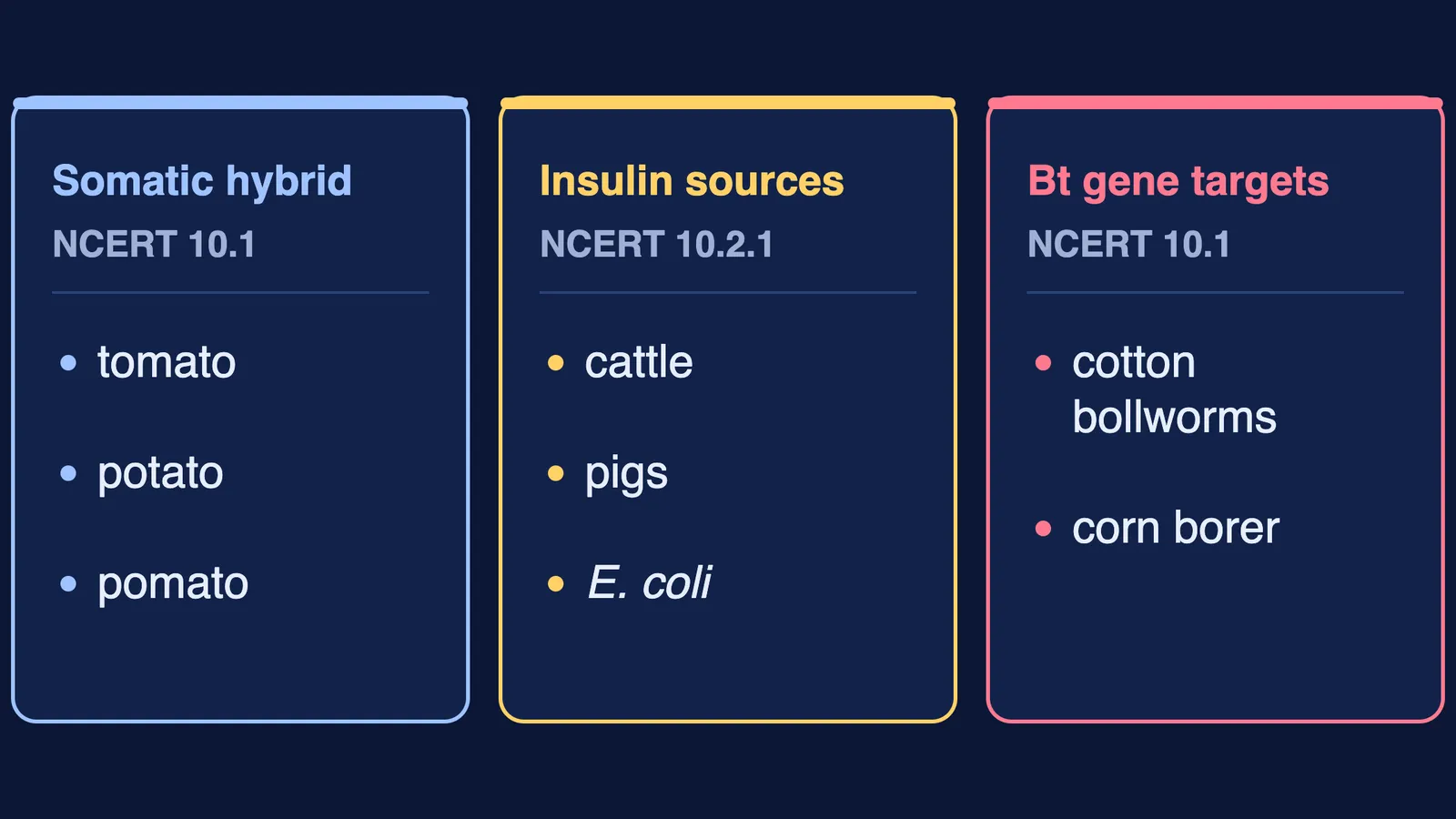
Somatic hybrid (10.1): protoplasts of tomato and potato fused to give pomato.
GM and Bt crops (10.1): golden rice, the Vitamin 'A' enriched rice; Bt toxin from *Bacillus thuringiensis*; Bt cotton, Bt corn, rice, tomato, potato and soyabean.
Insects some Bt proteins kill (10.1): lepidopterans (tobacco budworm, armyworm), coleopterans (beetles), dipterans (flies, mosquitoes); also cotton bollworms and corn borer.
RNAi example (10.1): the nematode *Meloidegyne incognitia*, its host tobacco, and *Agrobacterium* vectors.
Medicine (10.2): cattle and pigs, earlier sources of insulin; *E. coli*, whose plasmids took the DNA for insulin chains; HIV, detected by PCR.
Transgenic animals (10.3): rats, rabbits, pigs, sheep, cows and fish, with mice making up over 95 per cent; Rosie, the first transgenic cow; transgenic mice in polio vaccine safety tests, a possible stand-in for monkeys.
Patents and biopiracy (10.4): Basmati rice; turmeric and neem, traditional herbal medicines.
That is more than 30 names.
How do you remember NCERT examples without mixing them up?
Learn the size of each list before the names. Micropropagation has three, meristem culture three, Bt crops six, the insect list five across three orders, and transgenic animals six plus mice. When you recall a group, say its count first, then the names, and count on your fingers. If you stop at two of three, you know a name is missing before the exam tells you. Then circle the repeat names (tomato, potato, banana) so a "NOT" option does not trap you.
Can you answer these NCERT example questions?
How to attack this format: name the group each option belongs to before reading the stem twice. For "NOT" items, mark each option yes or no against NCERT's list.
Q1. Which is an example NCERT gives of a plant micropropagated on a commercial scale? (1) sugarcane (2) apple (3) soyabean (4) corn
Answer: (2). NCERT lists tomato, banana and apple (10.1).
Q2. Which is NOT among NCERT's examples of plants whose meristems were cultured? (1) banana (2) sugarcane (3) potato (4) tomato
Answer: (4). The meristem list is banana, sugarcane and potato (10.1).
Q3. Beetles, which some Bt proteins kill, belong to which group in NCERT? (1) Lepidopterans (2) Coleopterans (3) Dipterans (4) Nematodes
Answer: (2). NCERT names beetles as the coleopterans (10.1).
Q4. Which is NOT one of NCERT's examples of crops with a Bt version? (1) soyabean (2) rice (3) corn (4) sugarcane
Answer: (4). Sugarcane appears only as a meristem-culture example (10.1).
Q5. Match each organism with what NCERT uses it to show. List-I: A. sugarcane; B. apple; C. soyabean; D. sheep. List-II: I. A crop with a Bt version; II. Meristem culture for virus-free plants; III. An animal that has been made transgenic; IV. Commercial micropropagation. (1) A-II, B-IV, C-I, D-III (2) A-IV, B-II, C-I, D-III (3) A-II, B-I, C-IV, D-III (4) A-II, B-IV, C-III, D-I
Answer: (1). See 10.1 and 10.3.
Q6. Match each organism with its role in NCERT. List-I: A. HIV; B. monkeys; C. rats; D. mosquitoes. List-II: I. A dipteran some Bt proteins kill; II. Picked up by PCR in suspected AIDS patients; III. An animal listed as made transgenic; IV. Could be replaced by transgenic mice in polio vaccine safety testing. (1) A-II, B-III, C-IV, D-I (2) A-II, B-IV, C-III, D-I (3) A-IV, B-II, C-III, D-I (4) A-II, B-IV, C-I, D-III
Answer: (2). See 10.1, 10.2.3 and 10.3.
Options for Q7 to Q9: (1) Both statements correct (2) Both incorrect (3) Only I correct (4) Only II correct.
Q7. Statement I: Banana is among the food plants NCERT says were produced on a commercial scale by micropropagation. Statement II: NCERT names flies as coleopterans.
Answer: (3). Banana is listed with tomato and apple; flies and mosquitoes are NCERT's dipterans (10.1).
Q8. Statement I: Besides Bt cotton and Bt corn, NCERT's Bt crop examples include rice, tomato and potato. Statement II: Banana is one of NCERT's meristem-culture examples.
Answer: (1). Both appear in 10.1.
Q9. Statement I: Apple is among the plants NCERT says were cultured from meristems. Statement II: Turmeric is one of NCERT's examples of a crop with a Bt version.
Answer: (2). Apple is a micropropagation example, and turmeric appears only in the patents section (10.1, 10.4).
Q10. Which pair is correctly matched? (1) mosquitoes: coleopterans (2) beetles: dipterans (3) armyworm: lepidopterans (4) flies: lepidopterans
Answer: (3). NCERT pairs tobacco budworm and armyworm with lepidopterans (10.1).
Q11. Which pair is correctly matched? (1) tomato: commercial micropropagation (2) apple: meristem culture (3) fish: polio vaccine safety testing (4) corn: meristem culture
Answer: (1). Mice, not fish, test polio vaccine safety (10.1, 10.3).
Q12. NCERT gives golden rice as its example of which gain from genetic modification? (1) More tolerance to abiotic stresses (2) Lower post-harvest losses (3) Enhanced nutritional value of food (4) More efficient use of minerals
Answer: (3). Golden rice, the Vitamin 'A' enriched rice, is NCERT's example of enhanced nutritional value (10.1).
What should you practise next?
Rebuild the nine groups with their counts from memory, then check against NCERT. Try the Statement I/II and match-the-list questions for this chapter, the sequence and order questions and the NEET diagram questions on the chapter's figures.
Which list keeps losing a name? Fermi's AI tutor works out what you already know and builds a plan for the session.