On this page
In statement and match-the-list questions, one slip in any part costs the whole question. Here are eight original ones, easy to hard.
What does JEE Main test in Matrices and Determinants?
In NTA's Syllabus for JEE (Main) - 2027, Mathematics Unit 3 covers matrix algebra, types of matrices, determinants of order two and three, area of triangles using determinants, adjoint and inverse, and the consistency of linear equations in two or three variables. For the theory first, read how to prepare matrices and determinants for JEE Main.
Statement I/II options: (1) both correct (2) both incorrect (3) I correct, II incorrect (4) I incorrect, II correct.
Statement questions
Q1 (easy, Statement I/II). A is a 3×3 matrix with |A| = 4. Statement I: |adj A| = 16. Statement II: |2A⁻¹| = 1/2.
Answer: (3). I true: |adj A| = |A|ⁿ⁻¹ = 4² = 16. II false: |2A⁻¹| = 2³ × (1/4) = 2.
Trap: (1), writing |2A⁻¹| = 2/4 and forgetting that the scalar comes out as 2ⁿ.
Q2 (easy, statements). For square matrices of order 3, which are correct? A. A skew-symmetric A has |A| = 0. B. (AB)ᵀ = AᵀBᵀ. C. A + Aᵀ is symmetric. D. If A² = A, then (I − A)² = I − A. E. If AB = O, then A = O or B = O.
(1) A, C and D only (2) A, B and C only (3) C, D and E only (4) A, C, D and E only
Answer: (1). A true: |A| = |Aᵀ| = |−A| = −|A| for odd order. B false: it is BᵀAᵀ. C true: its transpose is itself. D true: I − 2A + A² = I − A. E false: a 3×3 matrix with a single 1 in the top-right corner squares to O.
Trap: (4), carrying the rule for numbers over to matrices in E.
Q3 (medium, Statement I/II). Consider x + y + z = 3, x + 2y + 3z = 6, x + 3y + λz = μ. Statement I: The system has a unique solution for every λ ≠ 5. Statement II: For λ = 5 and μ = 9, it has infinitely many solutions.
Answer: (1). I true: the coefficient determinant is λ − 5. II true: with λ = 5 the third row is 2 × (row 2) − (row 1), so it is consistent only when μ = 2 × 6 − 3 = 9, leaving a free variable.
Trap: (3), reading a zero determinant as "no solution" without testing the right-hand side.
Q4 (hard, Statement I/II). A = [[1, 2], [2, 1]]. Statement I: A⁻¹ = (2I − A)/3. Statement II: A⁵ = 61A + 60I.
Answer: (4). Multiplying out gives A² = 2A + 3I, so A(A − 2I) = 3I. I false: A⁻¹ = (A − 2I)/3, the opposite sign. II true: A² = 2A + 3I, A³ = 7A + 6I, A⁴ = 20A + 21I, A⁵ = 61A + 60I. Check with eigenvalues 3 and −1: 61(3) + 60 = 243 = 3⁵.
Trap: (1), a sign slip when rearranging A² − 2A − 3I = O.
Match-the-list questions
Q5 (easy, match). A is 3×3 with |A| = 2. List-I: (A) |3A| (B) |adj A| (C) |A⁻¹| (D) |adj(adj A)|. List-II: (I) 1/2 (II) 4 (III) 16 (IV) 54
(1) A-II, B-IV, C-I, D-III (2) A-IV, B-II, C-I, D-III (3) A-IV, B-III, C-I, D-II (4) A-I, B-II, C-IV, D-III
Answer: (2). A: 3³ × 2 = 54, IV. B: 2² = 4, II. C: 1/2, I. D: |A|^((n−1)²) = 2⁴ = 16, III.
Trap: (3), swapping the exponents n − 1 and (n − 1)². The |kA| = kⁿ|A| trap is the other classic.
Q6 (medium, match). List-I: (A) [[0, 3], [−3, 0]] (B) [[1, 1], [0, 0]] (C) [[0, 1], [0, 0]] (D) [[0, 1], [1, 0]]. List-II: (I) nilpotent, A² = O (II) involutory, A² = I (III) idempotent, A² = A (IV) skew-symmetric
(1) A-IV, B-I, C-III, D-II (2) A-IV, B-III, C-I, D-II (3) A-II, B-III, C-I, D-IV (4) A-IV, B-III, C-II, D-I
Answer: (2). Square each one. A: −9I, but Aᵀ = −A, IV. B: squares to itself, III. C: squares to O, I. D: squares to I, II.
Trap: (1), matching by appearance because B and C both have a zero row.
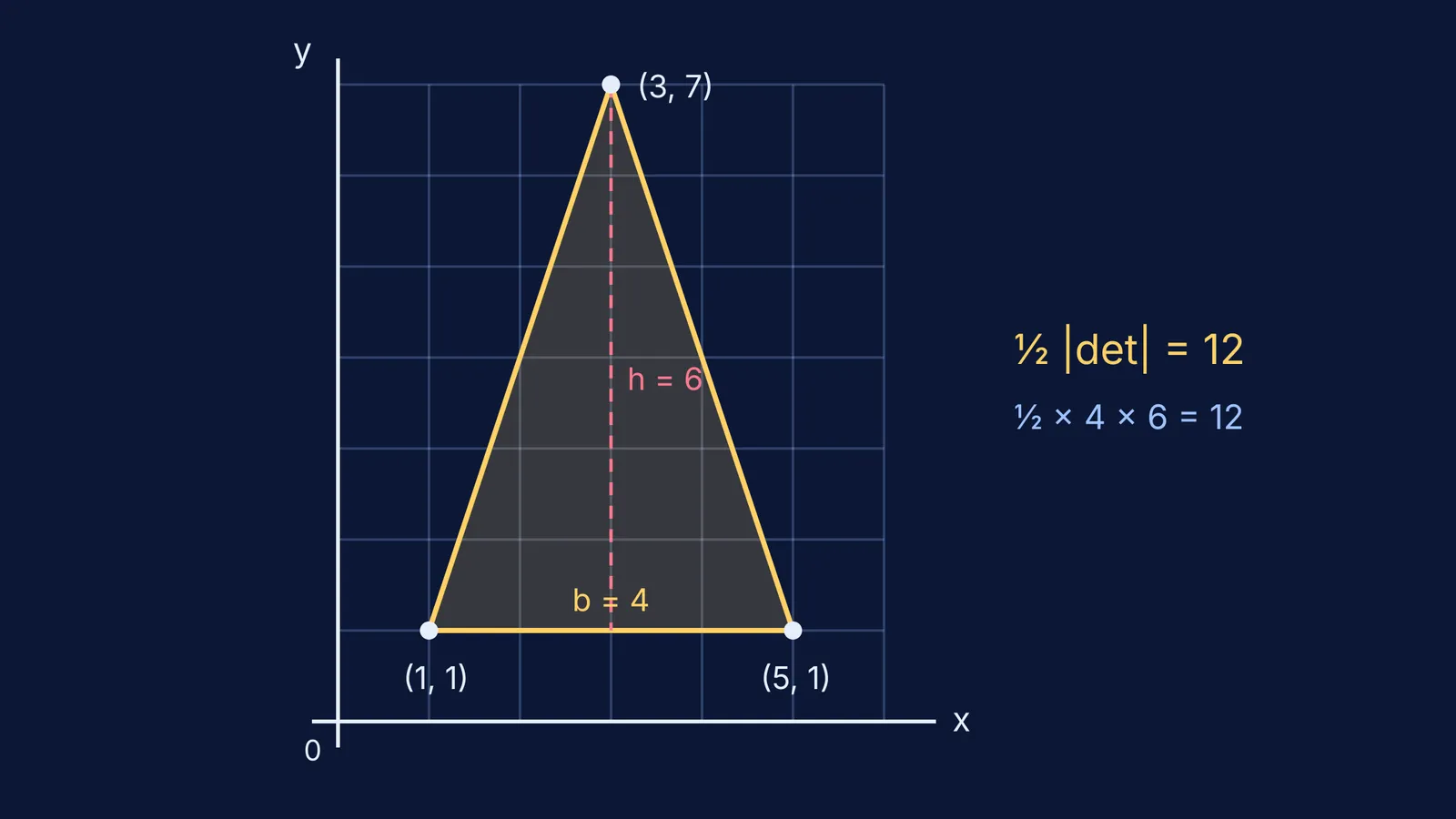
Q7 (medium, match). List-I: (A) the determinant with rows (1, 1, 1), (1, 2, 4), (1, 3, 9) (B) area of the triangle with vertices (1, 1), (5, 1), (3, 7) (C) the determinant with rows (x, x+1, x+2), (x+3, x+4, x+5), (x+6, x+7, x+8) (D) the determinant with rows (2, 0, 0), (5, 3, 0), (7, 4, 1). List-II: (I) 0 (II) 2 (III) 6 (IV) 12
(1) A-II, B-III, C-I, D-IV (2) A-III, B-IV, C-I, D-II (3) A-II, B-IV, C-I, D-III (4) A-I, B-IV, C-II, D-III
Answer: (3). A: Vandermonde form, (2 − 1)(3 − 1)(3 − 2) = 2, II. B: ½|1(1 − 7) + 5(7 − 1) + 3(1 − 1)| = ½ × 24 = 12, IV. C: C₃ − C₂ = C₂ − C₁, so 0, I. D: triangular, 2 × 3 × 1 = 6, III.
Trap: (2), taking the Vandermonde value as 1 × 2 × 3 = 6.
Q8 (hard, match). A = [[1, 1, 0], [0, 1, 1], [0, 0, 1]]. List-I: (A) the (1, 3) entry of A¹⁰ (B) the sum of all entries of A¹⁰ (C) the (2, 3) entry of A¹⁰ (D) the (1, 3) entry of A⁻¹. List-II: (I) 1 (II) 10 (III) 45 (IV) 68
(1) A-II, B-IV, C-III, D-I (2) A-III, B-I, C-II, D-IV (3) A-III, B-IV, C-I, D-II (4) A-III, B-IV, C-II, D-I
Answer: (4). Write A = I + N with N³ = O, so A¹⁰ = I + 10N + 45N², which is [[1, 10, 45], [0, 1, 10], [0, 0, 1]]. A: 45, III. B: 3 + 10 + 10 + 45 = 68, IV. C: 10, II. D: A⁻¹ = I − N + N², whose (1, 3) entry is 1, I.
Trap: (1), reading the (1, 3) and (2, 3) entries the wrong way round.
How do you attack statement and match questions quickly?
Mark each statement true or false on its own before you look at the options.
In a match, lock your surest pair, then strike out every option without it.
Test a claim about all matrices with one small counterexample such as [[0, 1], [0, 0]].
For systems, find where the determinant is zero, then test the right-hand side.
Preparing for the full paper? Fermi Test Prep is built for JEE Main and Advanced preparation. If the same slip keeps costing you marks, the Fermi Problem Library has a step-by-step solver that explains the reasoning rather than printing an answer. Then try the timed matrices and determinants JEE Main practice questions with solutions.