On this page
Matrices and determinants rewards method more than memory: the arithmetic is light, so many lost marks come from a few predictable slips.
What does the JEE Main syllabus include for matrices and determinants?
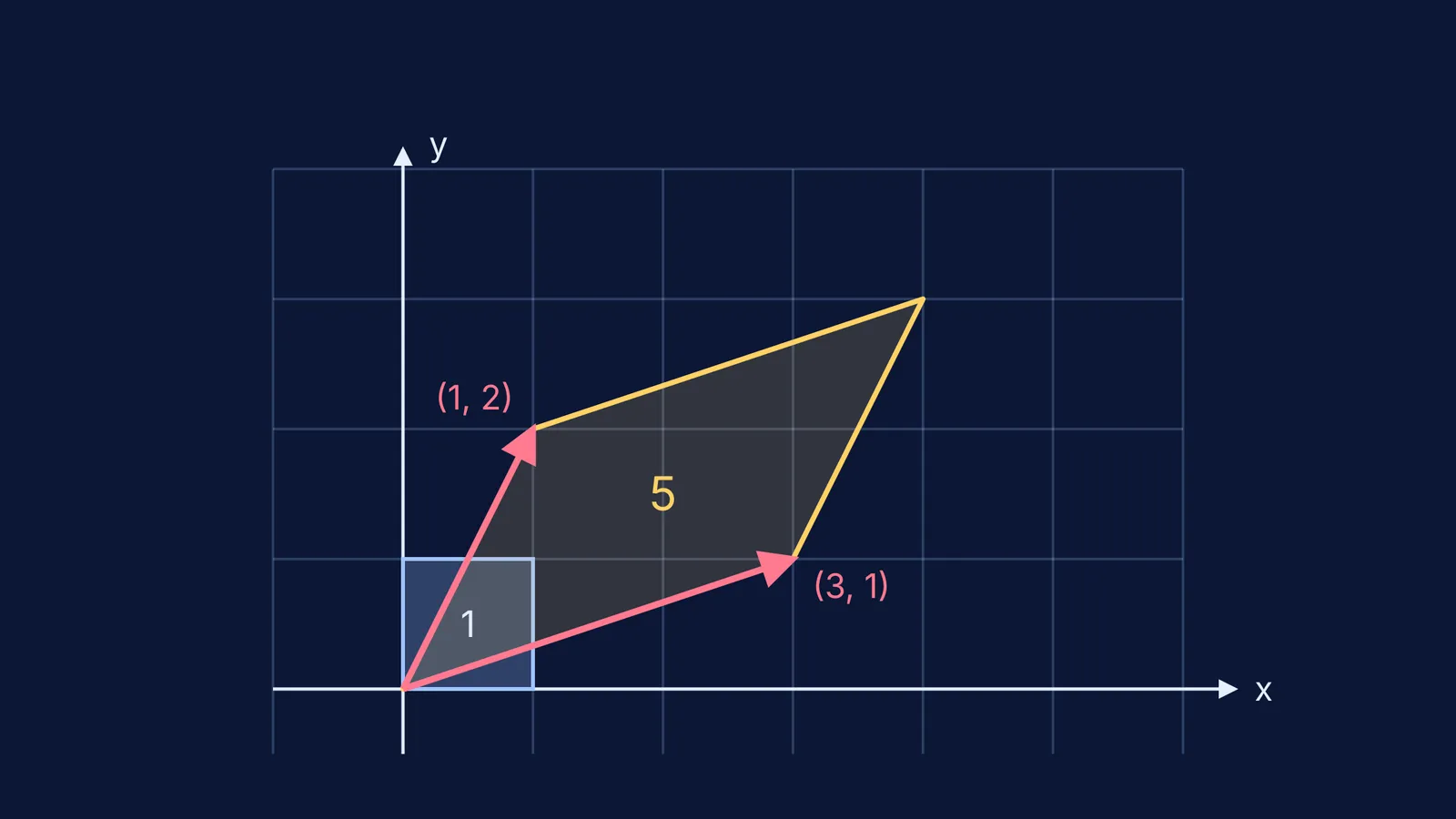
Unit 3 of the official JEE Main 2027 syllabus from NTA lists matrices, algebra of matrices, types of matrices, determinants and matrices of order two and three, evaluation of determinants, area of triangles using determinants, adjoint and inverse of a square matrix, and the test of consistency and solution of simultaneous linear equations in two or three variables using matrices.
The textbooks behind it are NCERT Class 12 Mathematics Part I, Chapter 3, Matrices and Chapter 4, Determinants. The 2026-27 reprint of Chapter 4 has no separate section on properties of determinants: 4.2 (evaluation) leads straight to 4.3 (Area of a Triangle). Row and column operations are still the quickest way to evaluate many determinants, so practise them beyond the textbook.
For JEE Advanced, the JEE Advanced 2026 syllabus lists one heading, Matrices, adding elementary row and column transformations, diagonal, symmetric and skew-symmetric matrices, and properties of these matrix operations. Secure the Main topics first, then add these.
How do you use properties of determinants to save time?
Example 1. Evaluate the determinant with rows (1, a, b + c), (1, b, c + a), (1, c, a + b).
Method: add column 2 to column 3. Every entry becomes a + b + c; take it out, and two identical columns of 1s remain, so the determinant is 0.
Check: with a = 1, b = 2, c = 3 the rows are (1, 1, 5), (1, 2, 4), (1, 3, 3), and expanding along row 1 gives −6 + 1 + 5 = 0.
How do you find the adjoint and inverse without errors?
Example 2. Find the inverse of A with rows (2, 1, 1), (1, 3, 2), (1, 0, 0).
Determinant: expand along row 3, which has two zeros. |A| = 1 × (1·2 − 1·3) = −1. Check along row 1: 2(0) − 1(0 − 2) + 1(0 − 3) = −1.
Adjoint: find all nine cofactors, then transpose. adj A has rows (0, 0, −1), (2, −1, −3), (−3, 1, 5).
Inverse: divide by |A|. A⁻¹ has rows (0, 0, 1), (−2, 1, 3), (3, −1, −5).
Check: A(adj A) must equal |A|I, here −I (NCERT Chapter 4 states this identity). It catches a forgotten transpose at once.
How do you test a system of equations for consistency?
Write the system as AX = B. NCERT Chapter 4 gives the rule: if |A| ≠ 0 there is a unique solution X = A⁻¹B; if |A| = 0 and (adj A)B ≠ O, the system is inconsistent; if (adj A)B = O, it may have infinitely many solutions or none.
Example 3. x + y + z = 6, x + 2y + 3z = 10, x + 2y + λz = μ.
|A| = λ − 3: subtracting row 2 from row 3 leaves (0, 0, λ − 3). Check by full expansion: 1(2λ − 6) − 1(λ − 3) + 1(0) = λ − 3.
If λ ≠ 3, the solution is unique. λ = 4, μ = 13 gives x = 5, y = −2, z = 3.
If λ = 3, (adj A)B = (μ − 10)(1, −2, 1). For μ ≠ 10 there is no solution. For μ = 10 the last two equations coincide: x = 2 + t, y = 4 − 2t, z = t. Check: equation 3 minus equation 2 gives 0 = μ − 10.
What are the common traps?
Each follows from the rules in NCERT Chapter 4:
|kA| = kⁿ|A| for an n × n matrix, so for a 3 × 3 matrix |2A| = 8|A|, not 2|A|.
(AB)⁻¹ = B⁻¹A⁻¹: the order reverses.
Cofactor signs alternate as (−1) to the power i + j.
adj A is the transpose of the cofactor matrix; do not skip the transpose.
(adj A)B = O alone does not mean infinitely many solutions.
Area takes the absolute value; if the area is given, solve with both signs.
What does a two-week practice plan look like?
Start with NCERT Chapter 3, then past papers.
Days 1-2: matrix algebra and types; every NCERT Chapter 3 exercise.
Days 3-4: determinants, solved only by row and column operations.
Day 5: area of triangles and collinearity.
Days 6-7: adjoint and inverse, each verified with A(adj A) = |A|I.
Days 8-9: consistency; redo Example 3 with new numbers.
Days 10-11: untimed mixed past questions, each checked by a second route.
Days 12-13: timed mixed sets; log every error under a trap above.
Day 14: redo only the logged errors.
If a method keeps going wrong and you cannot see where, the Fermi Problem Library has worked problems with a step-by-step solver that explains the reasoning rather than printing an answer. For the rest of the syllabus, Fermi Test Prep covers JEE Main and Advanced preparation.