On this page
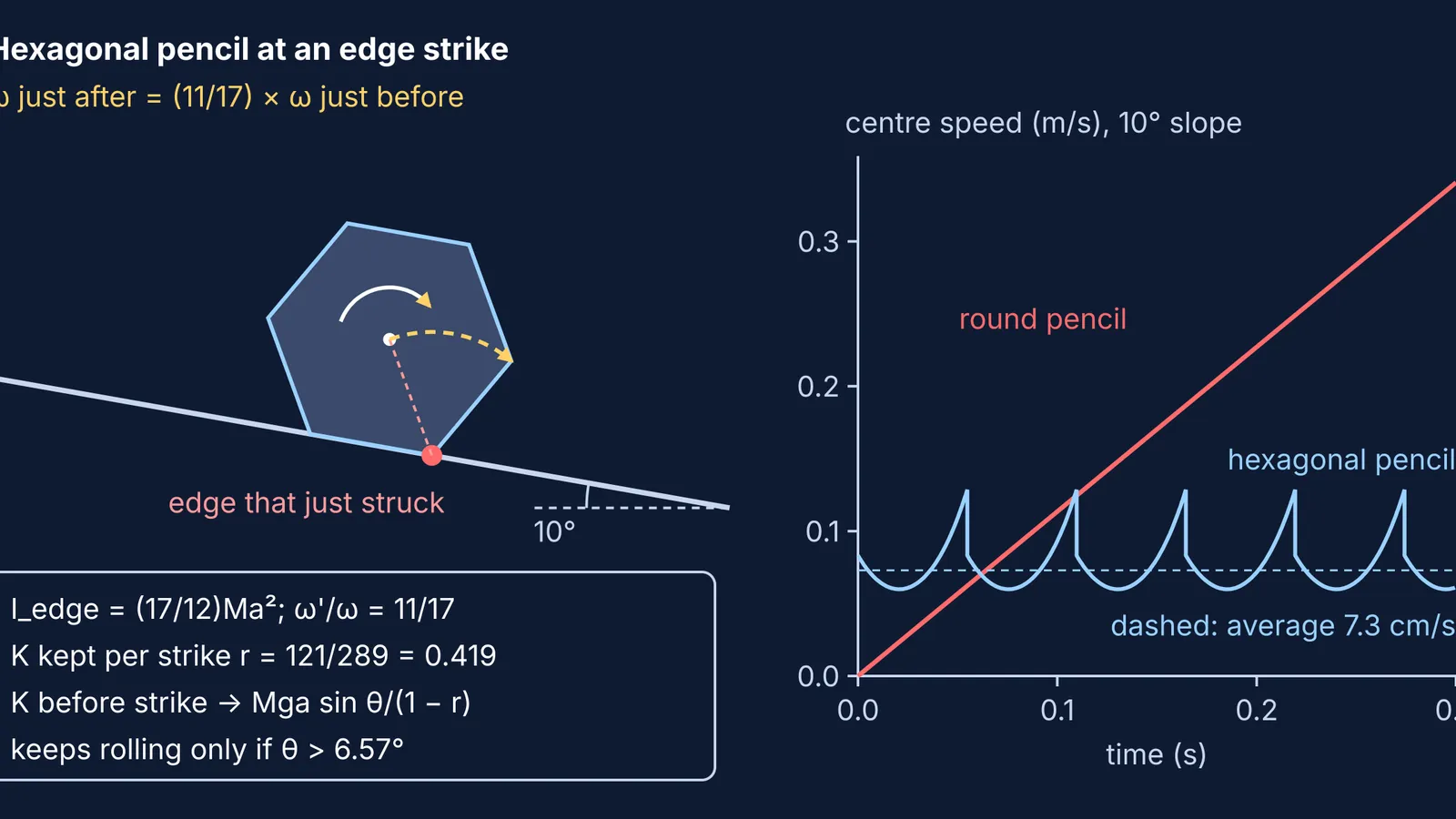
Put a round pencil on a sloping desk and it speeds up until it falls off. Put a hexagonal pencil on the same slope, give it a nudge, and something odd happens: it settles into a steady, bumpy roll and does not go faster. On a shallow enough slope it stops altogether. This was Problem 1 at the International Physics Olympiad in Reykjavík in 1998. The reason is that every time an edge strikes the desk, the pencil loses a fixed fraction of its kinetic energy.
The key tool is angular momentum about an edge, the same trick used for a rolling body climbing a step. That post handles a single impact. Here the impacts repeat, every sixth of a turn, and that changes the answer from "does it get over?" to "what speed does it settle at?". This is JEE Advanced level, built from Class 11 pieces.
What happens when each edge strikes the slope?
Model the pencil as a uniform hexagonal prism of side a and mass M. Its moment of inertia about its own axis is (5/12)Ma², and about an edge it is (17/12)Ma², by the parallel-axis theorem: 5/12 + 1 = 17/12. These are the values given in the official IPhO 1998 problem.
Between strikes, the pencil pivots about one edge. When the next edge hits, the desk gives a large, brief impulse at that edge. That impulse has no torque about the edge it acts at, and gravity is too weak to matter during the brief impact. So angular momentum about the new edge is conserved.
Just before: the centre moves at aω, at 30° to the line from the new edge to the centre. Angular momentum about the new edge = (5/12)Ma²ω + Ma²ω sin 30° = (11/12)Ma²ω.
Just after: the pencil pivots about the new edge, so the angular momentum is (17/12)Ma²ω'.
Equate: ω'/ω = 11/17.
Kinetic energy goes as ω², so each strike keeps a fraction r = (11/17)² = 121/289 = 0.419. Almost 58% of the kinetic energy is lost at every strike, to sound, heat and small vibrations.
Why does the pencil settle at a steady speed?
Each time the pencil rolls over one face, its centre drops by a sin θ, so gravity adds Mga sin θ of kinetic energy. Each strike multiplies the kinetic energy by r. Call the kinetic energy just before the nth strike Kₙ:
Kₙ₊₁ = rKₙ + Mga sin θ
If Kₙ is small, the gain wins and K rises. If Kₙ is large, the loss wins and K falls. Either way it settles at the value where gain and loss balance:
K₀ = Mga sin θ/(1 − r)
The behaviour is like motion against friction that grows with speed, except that the loss comes in bursts. A round pencil has no strikes, so nothing balances the pull of gravity and it keeps accelerating.
Below what slope does the pencil stop?
After each strike, the pencil must lift its centre over the new edge before it can tip onto the next face. Just after a strike, the line from the edge to the centre is (30° − θ) from the vertical, so the climb is a(1 − cos(30° − θ)). The pencil keeps rolling only if the energy left after the strike, rK₀, beats that climb:
r sin θ/(1 − r) > 1 − cos(30° − θ)
Solving numerically gives θ > 6.57°. The official IPhO solution quotes 6.58°. The difference is rounding, not physics. The solution writes the answer as the difference of two angles, 41.94° − 35.36°, each rounded to two decimals. The unrounded angles are 41.936° and 35.364°, and their difference is 6.572°. The problem only asked for the answer to within 0.1°, and both round to 6.6°.
Worked example: how fast does a pencil roll on a 10° slope?
Take a hexagonal pencil about 7 mm across the flats (an illustrative, typical size). Then a = 7/√3 = 4.0 mm. Use g = 9.81 m/s² and θ = 10°.
Settled energy before a strike. K₀ = Mga sin 10°/(1 − 0.419) = 0.299 Mga.
Energy just after a strike. rK₀ = 0.419 × 0.299 = 0.125 Mga.
Climb needed. 1 − cos 20° = 0.060 Mga. Since 0.125 > 0.060, the pencil keeps going, with about twice the energy it needs.
Spin rates. From K₀ = ½(17/12)Ma²ω², ω = 32 rad/s just before a strike and 21 rad/s just after it (11/17 of 32).
Time per face. Integrating dψ/ω as the pencil pivots through 60° gives 55 ms.
Average speed. The centre moves a = 4.0 mm down the slope per face, so v = 4.0 mm / 55 ms = 7.3 cm/s.
Repeat for other slopes: about 10.3 cm/s on 15° and 12.5 cm/s on 20°. On 7°, just above the threshold, the pencil creeps at 4.0 cm/s.
A round pencil, treated as a solid cylinder, instead accelerates at (2/3)g sin θ = (2/3) × 9.81 × sin 10° = 1.14 m/s². After one second it is already doing 1.1 m/s, about 15 times the hexagonal pencil's steady speed. The rolling energy post explains where the 2/3 comes from.
Units check: Mga is mass × acceleration × length, joules. And a/t is mm/ms, a speed.
What happens between 6.6° and 30°, and above 30°?
A pencil lying still on a face needs a nudge to start. To tip over its downhill edge, it must lift its centre by a(1 − cos(30° − θ)). For any slope below 30° that takes some energy, so the pencil sits still until you push it. Above 30°, the centre already lies beyond the downhill edge, so the pencil tips over by itself.
So there are three regimes:
Below 6.6°: a nudged pencil rolls a few faces and stops.
6.6° to 30°: a nudged pencil settles into a steady roll at a few centimetres per second.
Above 30°: the pencil starts rolling on its own.
The same polygon-on-a-wheel effect shows up in machines: a chain on a small sprocket pulses because the chain wraps a polygon, not a circle.
How good is this model?
The IPhO problem says the faces are slightly concave, so the pencil touches the slope only at its edges, and it assumes no sliding and no bouncing. A real pencil has a graphite core and paint, so it is not quite uniform, and its edges are rounded. On steeper slopes it may hop at a strike instead of pivoting cleanly. Treat the speeds as estimates.
The Fermi Problem Library has rotational impact and rolling problems with a step-by-step solver that explains the reasoning. If you are preparing for JEE Main & Advanced, Fermi Test Prep offers personalised preparation with an AI tutor, live classes, adaptive mocks, mentorship and a study plan that updates based on mastery.
Quick checklist
I = (5/12)Ma² about the axis, (17/12)Ma² about an edge.
Angular momentum about the struck edge is conserved: ω'/ω = 11/17.
Each strike keeps r = 121/289 = 0.419 of the kinetic energy.
Steady state: K₀ = Mga sin θ/(1 − r) just before each strike.
It keeps rolling only above about 6.57° (IPhO quotes 6.58° after rounding).
On 10° a 7 mm pencil settles at about 7.3 cm/s; a round one accelerates at 1.14 m/s².