

On this page
A rolling ball meets a low step. Does it climb or roll back? Energy alone cannot say, because the bump against the edge wastes some kinetic energy. The tool that works is angular momentum about the edge.
Syllabus note: this problem is beyond the NCERT textbook and at JEE Advanced level, though the pieces it uses are in the JEE Main and NEET syllabi.
What happens when a rolling ball hits a step?
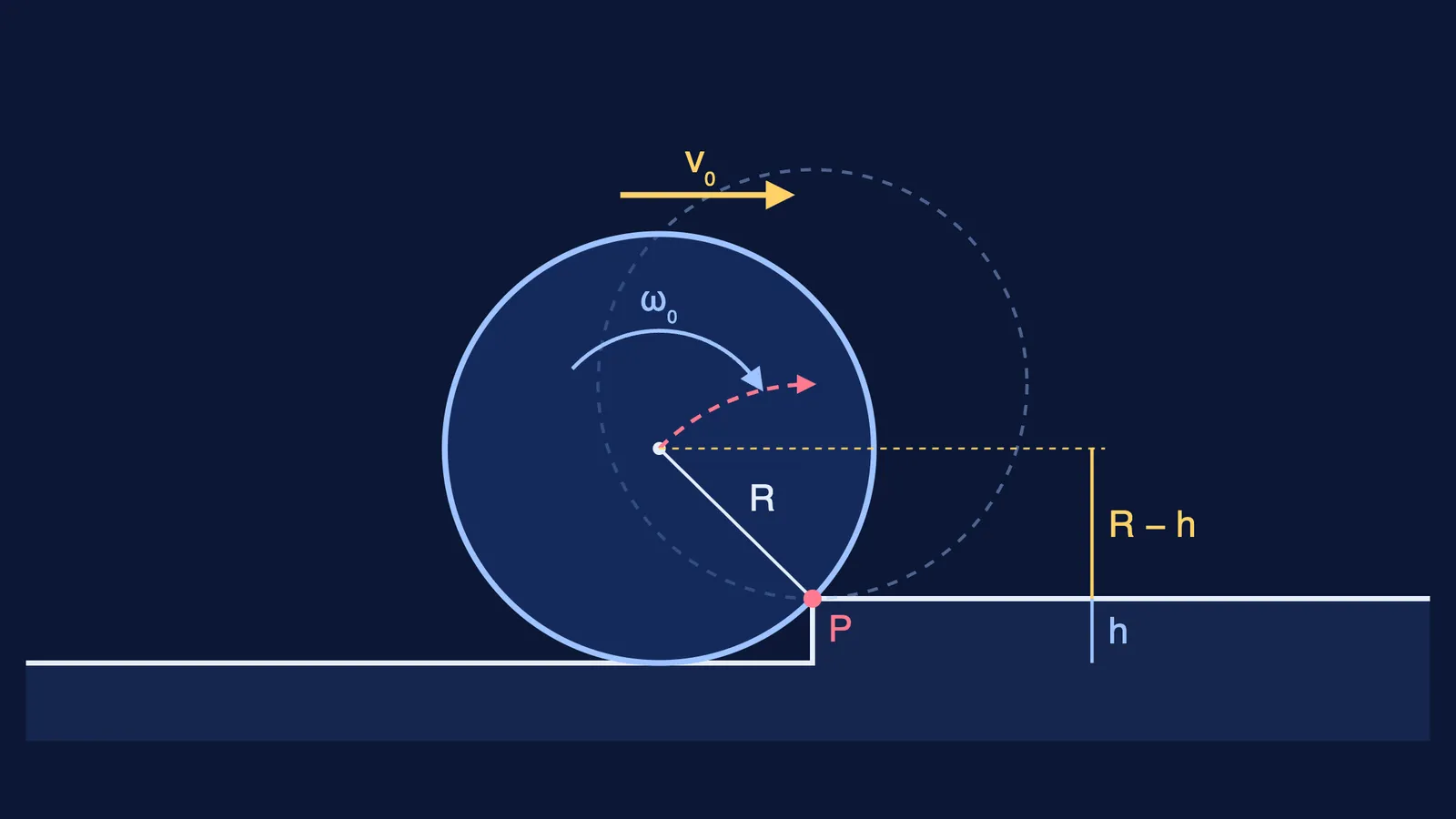
A uniform cylinder or sphere (mass m, radius R) rolls without slipping at speed v₀ towards a step of height h < R. Rolling without slipping means v₀ = Rω₀, because the contact point is momentarily at rest (OpenStax University Physics, section 11.1).
The motion has three stages:
Rolling on the floor at v₀.
A very short impact at the edge P. The edge pushes hard, the body leaves the floor and starts to turn about P.
A climb: the body pivots about P until its centre is directly above the edge, then it rolls on along the top.
The edge force in stage 2 is huge but brief, and it acts at P, so its torque about P is zero. Angular momentum is conserved about any point where the net external torque is zero (OpenStax, section 11.3). Gravity and the floor force are finite, so during the instant of impact their effect is negligible.
How do you find the minimum speed to climb the step?
Write the moment of inertia about the centre as I = βmR², with β = 1/2 for a solid cylinder and β = 2/5 for a solid sphere.
Before impact, about P. Add the spin about the centre to the moment of the moving centre, which travels at perpendicular distance R − h from P:
L = βmR²ω₀ + mv₀(R − h) = mv₀R(1 + β − h/R)
Both terms turn the same way (clockwise for a body moving to the right), so they add. With ω₀ = v₀/R the spin term is βmRv₀.
After impact, about P. The body now rotates about P with angular speed ω₁. By the parallel axis theorem its moment of inertia about P is βmR² + mR² = (1 + β)mR². Writing v₁ = Rω₁ for the speed of the centre:
L = (1 + β)mR²ω₁ = mv₁R(1 + β)
Setting the two equal:
v₁ = v₀ (1 + β − h/R) / (1 + β)
The climb. From here only gravity does work, so energy is conserved. The centre rises by h. To just reach the top, ½(1 + β)mv₁² = mgh, so v₁² = 2gh/(1 + β). Putting it back:
v₀(min) = √[2gh(1 + β)] / (1 + β − h/R)
When does this method apply, and is it in your syllabus?
Three assumptions sit underneath:
No slip at the edge. The edge is rough enough that the body pivots about P instead of skidding over it.
No bounce. The impact is perfectly inelastic, so the body stays on the edge.
It stays in contact while climbing. The centre moves on a circle of radius R about P, so the component of gravity towards P, g(R − h)/R, must be at least v₁²/R. That gives v₁² ≤ g(R − h). The start of the climb is the tightest point. If v₀ is too large, the body hops off the edge and the pivot model fails.
If h ≥ R, the edge cannot push the body upwards at all, so it cannot lift.
On the syllabus: the topic belongs to Class 11 NCERT Physics Chapter 6, Systems of Particles and Rotational Motion, but the rationalised NCERT chapter mentions rolling only in its introduction and has no rolling section. Both the JEE Main 2027 syllabus and the NMC NEET-UG 2026 syllabus list conservation of angular momentum and its applications, and the parallel and perpendicular axes theorems. The full step problem, with an impulsive impact at a fixed edge, is beyond NCERT and at JEE Advanced level. For JEE Main and NEET, master the pieces: v = Rω, angular momentum about a point, and rolling energy.
Worked examples: two original problems
Example 1 (quick, beyond NCERT). A solid cylinder rolls without slipping at 3.0 m/s and hits a step of height R/4. Find the speed of its centre just after impact and the fraction of kinetic energy lost.
With β = 1/2 and h/R = 1/4: v₁ = 3.0 × (1.5 − 0.25)/1.5 = 3.0 × 5/6 = 2.5 m/s.
Before impact it turns about the floor contact point, after it about P; both times KE = ½(1 + β)mv², so the energy ratio is (5/6)² = 25/36. About 31% of the kinetic energy is lost in the impact.
Example 2 (JEE Advanced level, multi-step). A solid sphere of radius 0.30 m rolls without slipping towards a 9.0 cm step. Take g = 9.8 m/s². (a) Find the least speed with which it can climb the step. (b) Find the largest speed for which it stays in contact with the edge at the start of the climb.
(a) Here β = 2/5 and h/R = 0.30. The speed needed just after impact is v₁ = √(2gh/1.4) = √(2 × 9.8 × 0.09/1.4) ≈ 1.12 m/s. Then v₀ = 1.12 × 1.4/(1.4 − 0.30) ≈ 1.43 m/s.
(b) Contact needs v₁² ≤ g(R − h) = 9.8 × 0.21, so v₁ ≤ 1.43 m/s. Then v₀ ≤ 1.43 × 1.4/1.1 ≈ 1.83 m/s.
Between about 1.43 and 1.83 m/s the sphere pivots over the step; slower, it rolls back; faster, it leaves the edge.
What is the main trap?
The common mistake is to conserve energy straight through the impact: ½(1 + β)mv₀² = mgh. For the sphere in Example 2 that gives 1.12 m/s, well below the right answer of 1.43 m/s. The impact is inelastic. Use angular momentum about the edge for the impact, and energy only for the climb.
A related slip is dropping the mv₀(R − h) term. For the energy half alone, see how high a rolling ball climbs an incline.
The Fermi Simulation Lab has interactive simulations for the ideas that are easier to see than to read.
For where this fits in your revision, see the chapter guides on Rotational Motion for NEET and Rotational Motion for JEE Main.


