

On this page
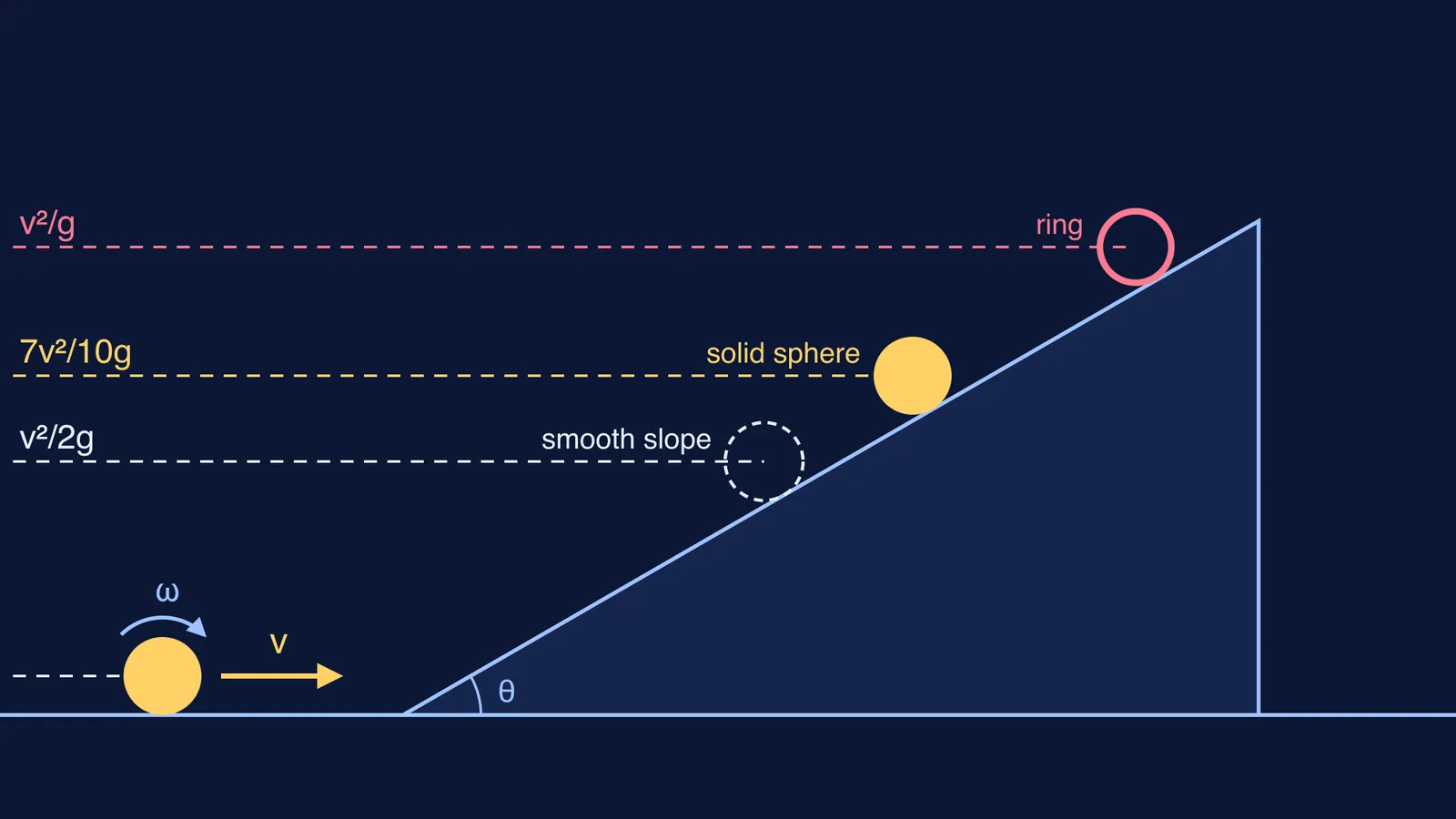
A ball rolling up a rough slope goes higher than a block sliding up a smooth one at the same speed. The reason is that the ball carries extra energy in its spin, and on the way up that spin energy turns into height too. For a solid sphere rolling without slipping, the centre rises by h = 7v²/10g. Here is why, and the exam trap that undoes it.
Why does a rolling ball go higher than a sliding block?
A rolling body's kinetic energy is the translational kinetic energy of its centre of mass plus the rotational kinetic energy about the centre of mass, as HyperPhysics explains for rolling without slipping. With no slipping, ω = v/R, so the total is KE = ½mv²(1 + β), where β = I/mR².
For a solid sphere, β = 2/5, that is I = (2/5)MR² (LibreTexts, Kinetic Energy of rolling bodies). That makes its total kinetic energy (7/10)mv². The same page's table splits a rolling solid sphere's kinetic energy into 5/7 translation and 2/7 rotation, about 71% and 29%. The split depends only on β, so the slope angle does not change it.
Now the climb. In pure rolling, the contact point is momentarily at rest, so static friction does no work, as OpenStax University Physics, section 11.1 shows. Mechanical energy is conserved, and all the kinetic energy becomes potential energy at the highest point:
(7/10)mv² = mgh
h = 7v²/10g, which is (7/5) × v²/2g
How high does each shape climb? A worked example
Take a speed of 7 m/s at the foot of the slope and g = 9.8 m/s². Then v²/2g = 49/19.6 = 2.5 m, and each shape climbs (1 + β) times that. The β values below are from the LibreTexts table of rolling bodies.
Block sliding up a smooth slope (no spin): 2.5 m
Solid sphere, β = 2/5: 1.4 × 2.5 = 3.5 m
Solid cylinder, β = 1/2: 1.5 × 2.5 = 3.75 m
Spherical shell, β = 2/3: about 4.17 m
Ring or hollow cylinder, β = 1: 2 × 2.5 = 5.0 m
On a 30° incline, the distance along the slope is h/sin 30° = 2h, so the solid sphere travels 7 m up the surface before it stops.
Notice the order. In a race down a slope the ring comes last, but from the same starting speed it climbs highest. Both facts have one cause: at a given speed, the ring stores the most energy in spin. Going down, that spin soaks up energy; going up, it pays it back. For the friction side of the same problem, our post on the minimum friction needed for pure rolling on an incline works through it shape by shape.
What if the incline is smooth?
This is the trap. On a frictionless slope, gravity acts through the centre and the normal force points at the centre, so neither has a torque about the centre. The spin cannot change. Its rotational energy stays locked in, and only ½mv² turns into height.
So a solid sphere that rolls along a rough floor onto a smooth incline rises only v²/2g, which is 2.5 m in our example, and it is still spinning at the top. Look for the words smooth or frictionless before you write the energy equation.
How do you solve a rolling-up-an-incline question?
Use this four-step check:
Decide the surface. Rough slope and rolling without slipping means all KE converts; smooth slope means only the translational part does.
Write β for the shape from the moment of inertia about the centre of mass.
Set the energy that can change equal to mgh. Rough: ½mv²(1 + β) = mgh. Smooth: ½mv² = mgh.
Convert to slope distance if asked: s = h/sin θ.
Two slips cost marks often. The first is writing v²/2g out of habit, which ignores the spin. The second is double-counting: if you take kinetic energy about the contact point as ½I_Pω², with I_P found from the parallel axis theorem, as HyperPhysics notes, do not add ½mv² again, because I_P already contains it. Our guide to energy and friction in rolling without slipping covers the downhill version, and three common mistakes in work-energy problems lists other ways marks slip away.
If you keep choosing the wrong method, try a few rolling problems in the Fermi Problem Library, where a step-by-step solver explains the reasoning rather than printing an answer. If moment of inertia itself still feels shaky, the Fermi Concept Library gives each concept its own lesson.
Try it yourself: a hollow sphere arrives at the foot of a rough slope at 3 m/s. With g = 9.8 m/s², it should rise about 0.77 m.


