On this page
Turn a sprocket at a perfectly steady speed and the chain leaving it still does not move steadily. It speeds up and slows down once for every tooth, and it rises and falls a fraction of a millimetre as it goes. Engineers call this chordal action. The cause is simple geometry from Class 11 circular motion: a chain wraps a sprocket as a polygon, not a circle. On a big cycle chainring the effect is too small to notice. On a small motorcycle drive sprocket it is one source of chain noise and wear.
Why does a chain wrap a sprocket as a polygon?
A roller chain is a string of rigid links, each one pitch p long, joined by pins. Where it sits on a sprocket of N teeth, the pins rest on a circle called the pitch circle, and each link is a straight chord of that circle. So the chain forms a regular polygon with N sides, each side p long.
Each side subtends an angle of 360°/N at the centre, so half a side subtends 180°/N. Simple trigonometry on that half-triangle gives the pitch radius:
R = p ÷ [2 sin(180°/N)]
For an ordinary cycle chain the pitch is ½ inch, 12.7 mm, on all modern bicycles, as Sheldon Brown's bicycle glossary notes. Motorcycle chains come in several pitches depending on the model, so the motorcycle example below simply assumes the same 12.7 mm. If you want a refresher on how a chain and sprocket transmit force in the first place, see how bicycle brakes and chain drives work.
Why does the chain speed rise and fall every tooth?
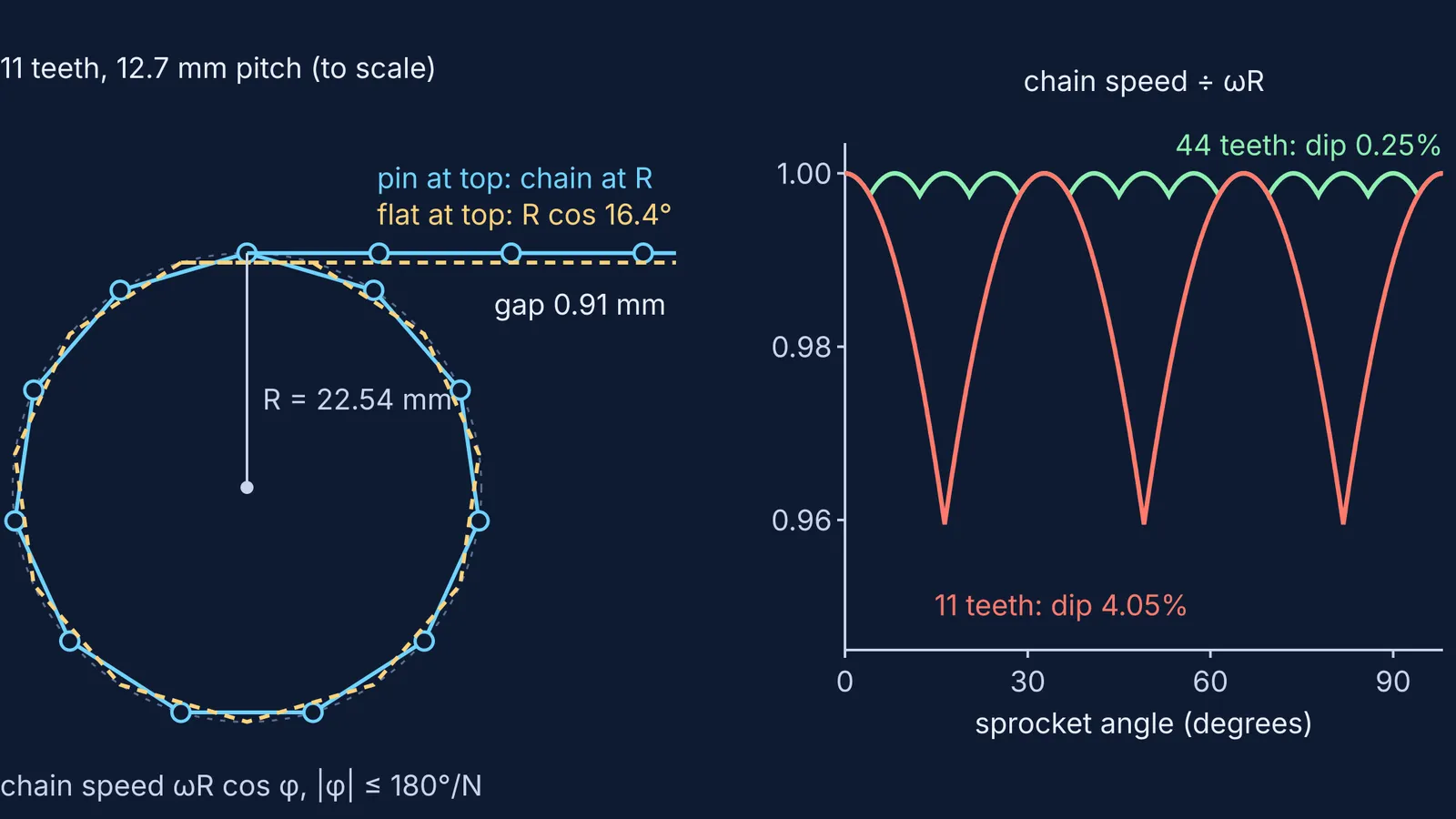
Look at the link that is leaving the top of the sprocket and pulling the straight run of chain. Its pin moves on the pitch circle at speed ωR. But the chain run is horizontal, and the pin's velocity is horizontal only when the pin is right at the top. If the pin is at an angle φ from the top, only the horizontal part, ωR cos φ, moves the chain along.
As the sprocket turns through one tooth, the pulling pin swings from 180°/N before the top to 180°/N after it. Then the next pin takes over and the cycle repeats. So the chain speed goes between:
Maximum: ωR, when a pin is at the top.
Minimum: ωR cos(180°/N), when the pins sit 180°/N either side of the top and the flat side of the polygon is uppermost.
The fractional dip is 1 − cos(180°/N). This is exactly the formula a chain maker gives: Tsubaki's Complete Guide to Chain states that the ratio of speed change, (Vmax − Vmin)/Vmax, equals 1 − cos(180°/N), and that chordal action depends on the number of teeth. The same picture says the chain line rises and falls by R − R cos(180°/N), because the top of the polygon alternates between a corner (height R) and a flat (height R cos(180°/N)).
You have seen this projection before: ωR cos φ is the horizontal part of uniform circular motion, the same idea as in SHM and the reference circle. The difference is that φ never goes beyond ±180°/N, because a new pin takes over each tooth.
How big is the effect? A worked example
Problem. A 12.7 mm pitch chain runs on sprockets of 11, 14, 18 and 44 teeth. Find the pitch radius, the speed dip and the rise and fall of the chain line for each.
11 teeth, step by step:
Half-angle: 180°/11 = 16.36°.
Pitch radius: R = 12.7 ÷ (2 × sin 16.36°) = 12.7 ÷ (2 × 0.2817) = 22.54 mm.
Speed dip: 1 − cos 16.36° = 1 − 0.9595 = 0.0405, a 4.05% dip.
Rise and fall: R(1 − cos 16.36°) = 22.54 × 0.0405 = 0.91 mm.
Check the units: a ratio of lengths for the dip (dimensionless), and mm × dimensionless for the rise (mm). As a sanity check, R is slightly more than the circle estimate pN/(2π) = 22.23 mm, as it must be, since the chain's straight chords cut inside the pins' circle.
The same steps for the other sprockets:
11 teeth: R = 22.54 mm, dip 4.05%, rise and fall 0.91 mm.
14 teeth: R = 28.54 mm, dip 2.51%, rise and fall 0.72 mm.
18 teeth: R = 36.57 mm, dip 1.52%, rise and fall 0.56 mm.
44 teeth: R = 89.01 mm, dip 0.25%, rise and fall 0.23 mm.
Four times the teeth cut the dip by about sixteen times. For large N, 1 − cos(180°/N) ≈ ½(π/N)², so the dip falls as 1/N².
What does this mean on a motorcycle and a bicycle?
Take an illustrative motorcycle drive sprocket of 14 teeth turning at 2,000 rpm, with an assumed 12.7 mm pitch chain.
ω = 2,000 × 2π ÷ 60 = 209.4 rad/s.
Chain speed at most ωR = 209.4 × 0.02854 = 5.98 m/s.
Dip: 2.51% of 5.98 m/s = 0.15 m/s.
Pulses: one per tooth, 14 × 2,000 ÷ 60 = 467 times a second.
A 467 Hz jerk is in the audible range, and each one tugs the chain and the bearings. Tsubaki's guide also notes that the centre distance between shafts, and manufacturing and alignment errors, affect chordal action, so a real drive differs from this ideal figure.
Now a bicycle with a 44-tooth chainring turned at 70 rpm. The chain moves at about 0.65 m/s and the speed dip is 0.25%, about 1.7 mm/s, 51 times a second. You will never feel that. The small rear cog does not drive the chain, but it is driven by it, so its own polygon makes the rear wheel's turning speed flicker instead. With an 11-tooth cog that flicker is about 4%, still smoothed out by the heavy, spinning wheel. The way tooth counts set the average ratio is covered in bicycle gears: torque and speed, tested sprocket by sprocket.
To see the projection ωR cos φ build up from circular motion, the Concept Library has a lesson on every concept in physics, including uniform circular motion and its components.
Why do designers prefer more teeth?
The speed dip falls roughly as 1/N², so a 17- or 18-tooth driver is much smoother than an 11- or 12-tooth one.
Fewer jerks mean less noise and less impact as each roller seats in a tooth.
A larger sprocket also bends each link through a smaller angle, 360°/N, as it wraps on, so pins and bushes wear less.
Quick checklist
A chain wraps a sprocket as an N-sided polygon of side p.
Pitch radius R = p ÷ [2 sin(180°/N)].
Chain speed swings between ωR cos(180°/N) and ωR; dip = 1 − cos(180°/N).
The chain line rises and falls by R(1 − cos(180°/N)).
Pulses per second = teeth × revolutions per second.
11 teeth: 4.05% dip; 44 teeth: 0.25%.