On this page
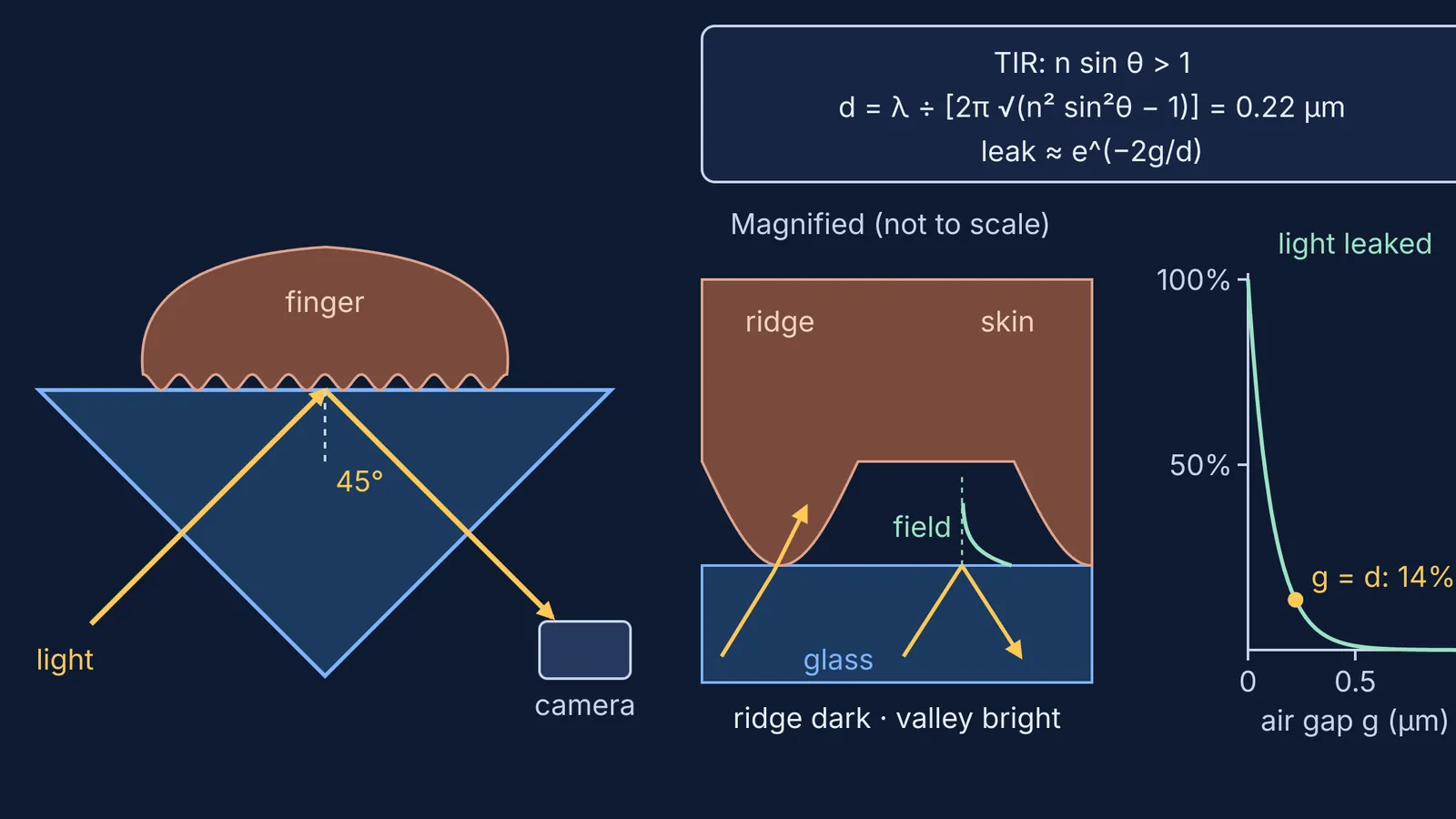
Press your thumb on the glass of a prism-type fingerprint scanner and a camera inside sees your ridges as dark lines on a bright background. The glass is a prism working by total internal reflection, and the reason ridges and valleys look so different is a part of total internal reflection that school books skip. The light does not stop exactly at the glass surface. Its field reaches about a fifth of a micron into the air beyond, and anything that comes that close can take the light away.
What happens just outside a totally reflecting surface?
You already know the ray rule. Light going from glass (n = 1.52) into air is totally reflected when the angle of incidence is above the critical angle, sin C = 1/n, which is 41.1° here. Water on the glass raises the critical angle and lets light out, as the critical angle between glass and water works through. We will not repeat that here.
What the ray picture leaves out is this. Light is a wave, and its electric field has to be continuous across the surface. So even when all the energy is reflected, the field does not drop to zero at the glass. It continues into the air as an evanescent wave: a wave that travels along the surface but dies away exponentially with distance from it.
The field falls by a factor e over a distance
d = λ ÷ [2π √(n² sin² θ − 1)]
where λ is the wavelength in air, n the glass's index and θ the angle of incidence. The intensity, which goes as the square of the field, falls twice as fast, so its decay length is d/2. The TIRF microscopy review by Martin-Fernandez, Tynan and Webb (Journal of Microscopy, 2013) gives this intensity depth and notes that it is comparable to the wavelength or smaller, and does not depend on polarisation.
With nothing within reach, no energy flows out. Reflection really is total. The evanescent wave only matters when a second material comes close.
How deep does the evanescent wave reach in a prism?
Worked example. A right-angle glass prism (n = 1.52) is lit with green light, λ = 550 nm. The light enters one short face straight on and meets the long face at θ = 45°. Find the decay length d, and the fraction of light that leaks across an air gap g.
Check for total reflection. n sin θ = 1.52 × 0.7071 = 1.075. This is above 1, so the light is totally reflected. (The same test as θ = 45° > C = 41.1°.)
Square root. n² sin² θ − 1 = 1.1552 − 1 = 0.1552, and its square root is 0.394.
Decay length. d = 550 nm ÷ (2π × 0.394) = 222 nm, about 0.22 µm. The intensity falls by e in half of this, 0.11 µm.
Leak across a gap. As a rough guide, the fraction that crosses a gap g goes as e^(−2g/d). That gives 64% at 0.05 µm, 41% at 0.1 µm, 17% at 0.2 µm, 1.1% at 0.5 µm and 0.01% at 1 µm.
The exact fraction comes from the full wave equations and depends on polarisation, so treat these percentages as a sketch. The firm point is the length scale. A second surface closer than a few tenths of a micron takes light away; one a micron off takes almost none. This is called frustrated total internal reflection.
A steeper angle makes the wave shorter. At θ = 60° in the same glass, d falls to 0.10 µm.
Why does a fingerprint prism see only the ridges?
Now put a finger on the long face. Skin has a refractive index well above 1; take about 1.4 as a round illustrative value. Measured values differ between the skin's layers and with wavelength, as Ding and colleagues (Physics in Medicine and Biology, 2006) found when they measured epidermis and dermis at eight wavelengths.
At a ridge, skin touches the glass. For light to pass into the skin, the skin's index only has to exceed n sin θ = 1.075. At 1.4 it does, so the light refracts into the finger at about 50° and is scattered and absorbed there. Little comes back. The ridge looks dark.
In a valley, there is an air gap many microns deep, far more than 0.22 µm. The evanescent wave cannot reach across it, so the light is totally reflected to the camera. The valley looks bright.
So the image is a contact map, not an ordinary photograph. Only skin within a fraction of a micron of the glass shows up. Smith and Sharp (Science & Justice, 2017) describe an inexpensive fingerprint imager built on frustrated total internal reflection, with images as good as ink and paper. The same group's footwear imaging paper (Scientific Reports, 2016) explains the evanescent field and notes that it decays over lengths comparable to the wavelength of the light.
Water in the valleys can spoil the image, because water's index of 1.33 is also above 1.075 and lets light out there too. Many phone sensors under the screen work differently, as how fingerprint sensors work on phones describes.
Can you see this with a glass of water?
Yes. Fill a smooth glass with water and hold it with your fingers on the outside. Look down through the water surface at the side wall, at a steep angle. Light from inside meets the outer glass surface at a large angle. Once the angle in the water is above 48.6° (the water–air critical angle, sin C = 1/1.333), it is totally reflected and the wall looks silvery. Where your fingertips press the glass, the ridges frustrate the reflection and you see your fingerprints, dark lines on silver. Where the glass is dry, you see only the mirror.
Practising total internal reflection problems
Critical angles, prism faces and "will the ray come out?" questions are regular JEE ground, and the decay length adds a short wave-optics step. Work similar problems with the Fermi Problem Library, whose solver explains the reasoning. If you are preparing for JEE Main and Advanced, Fermi Test Prep offers personalised preparation with an AI tutor, live classes, adaptive mocks, mentorship and a study plan that updates based on mastery. For more on prisms that turn light by total reflection, see how a total reflecting prism turns light by 90° and 180°.
Quick checklist
Total reflection needs n sin θ > 1 at a glass–air surface.
The field still reaches past the surface: d = λ ÷ [2π √(n² sin² θ − 1)], about 0.22 µm for 45° glass in green light.
Intensity decays twice as fast as the field.
A second surface within a few tenths of a micron frustrates the reflection.
Ridges touch, frustrate and look dark; valleys stay bright.
With nothing nearby, reflection is total and no energy leaks.