On this page
Put a bag of rice in the middle of a shop scale and it reads 2.000 kg. Push it to the edge of the pan and it still reads 2.000 kg. That should surprise you: the bag now sits 10 cm off-centre, so it applies a torque. The reading does not change because the pan rides on a parallelogram. This post finds where the torque goes, using moments and virtual work.
What is inside a shop scale under the pan?
The French mathematician Gilles Personne de Roberval invented it in 1669, and Britannica's entry on the Roberval balance describes it as a linked mechanism later used in commercial weighing machines.
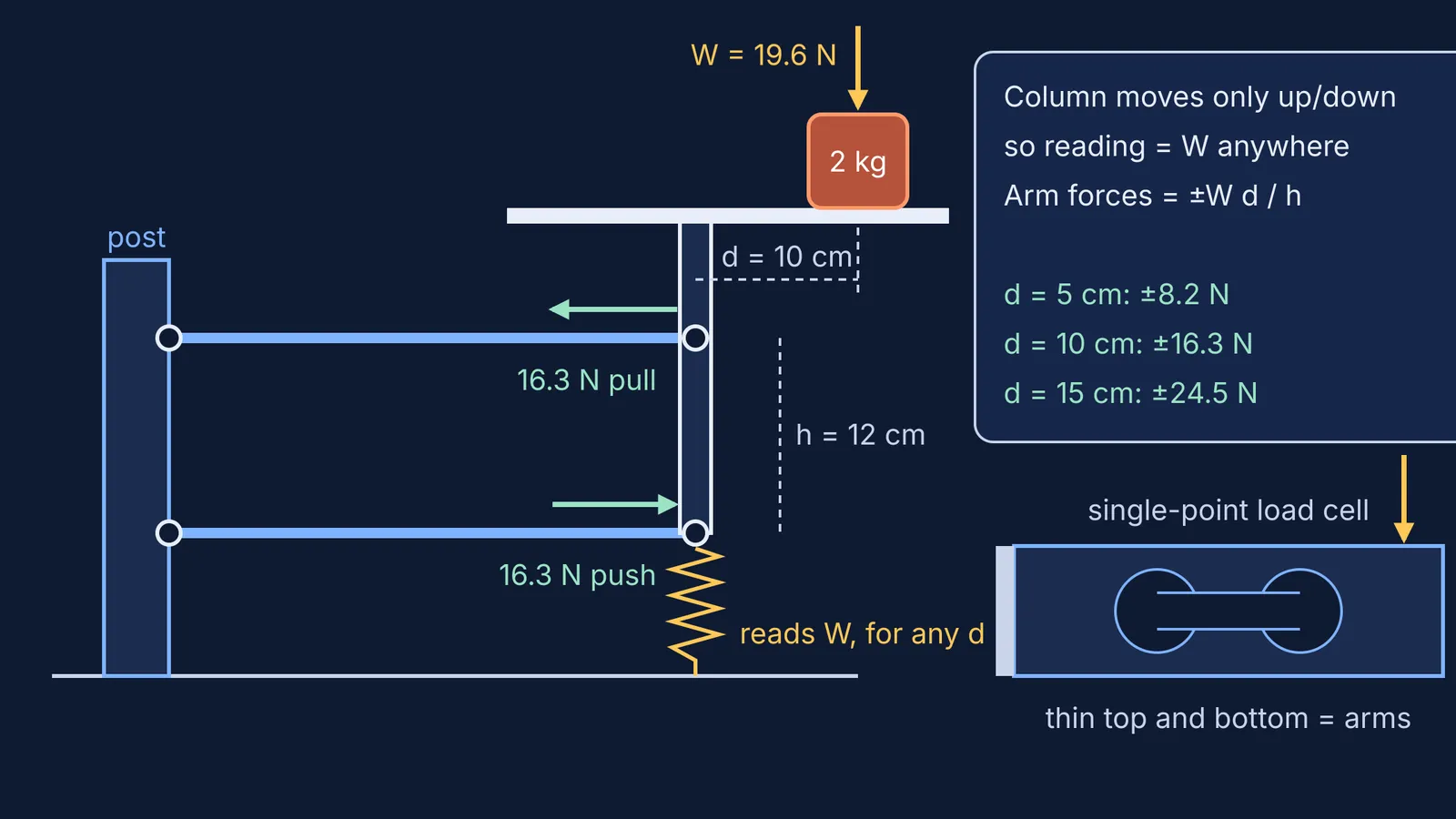
Stripped down to one side, it looks like this:
A fixed post.
Two arms of equal length, one above the other, a distance h apart, each pinned to the post at one end.
A vertical column pinned to the other ends of both arms. The pan sits on top of the column.
Something under the column that measures the downward force: a spring, a beam with weights, or today a load cell.
Post, arms and column form a parallelogram. It can shear, but opposite sides stay parallel, so the column stays vertical like the post. It can move up and down, never tilt.
The Ingersoll Physics Museum at the University of Wisconsin shows the two-pan version: the weights balance wherever they sit, because the unequal torques become tension and compression in the horizontal arms.
Why does the reading ignore where the bag sits?
Use the principle of virtual work. Imagine the column moving down by a tiny distance δy. Because it does not tilt, every point on the pan also moves down by exactly δy, wherever it is. A bag of weight W sitting anywhere on the pan therefore does work W δy.
The arms are pinned at both ends, and when they are level their forces are horizontal. A horizontal force does no work in a vertical movement. So the only other force that does work is the push from the sensor underneath, N, which does −N δy.
For equilibrium the total virtual work is zero:
W δy − N δy = 0, so N = W
The distance d never entered the equation.
A single beam with a pan hung off one end would tilt instead. The parallelogram is what turns any load position into a pure vertical push.
Where does the off-centre torque go?
It does not vanish. It is carried by the arms as a couple. Take moments about the bottom pin of the column, for a bag a horizontal distance d from the column's centre line:
The bag gives a moment W d.
The top arm, a height h above the bottom pin, gives a horizontal force F with moment F h.
For balance, F h = W d, so F = W d/h. The bottom arm carries an equal and opposite horizontal force, so that the horizontal forces on the column add to zero. One arm pulls, the other pushes. Together they form a couple, as in what a couple is and why it causes rotation without translation, and it cancels the bag's moment so the column does not rotate.
Worked example: a 2 kg bag at different positions
Question (JEE style). A Roberval scale has arms 12 cm apart. A 2 kg bag is placed on the pan. Find the scale reading and the force in each arm when the bag is at the centre, 5 cm, 10 cm and 15 cm from the column's centre line. Take g = 9.8 m/s².
Weight. W = 2 × 9.8 = 19.6 N.
Reading. By virtual work, N = W = 19.6 N in every case, so the scale shows 2 kg.
Centre, d = 0. F = 19.6 × 0 / 0.12 = 0. The arms carry nothing.
d = 5 cm. F = 19.6 × 0.05 / 0.12 = 8.2 N.
d = 10 cm. F = 19.6 × 0.10 / 0.12 = 16.3 N.
d = 15 cm. F = 19.6 × 0.15 / 0.12 = 24.5 N.
One arm is in tension and the other in compression, by the same amount. With the bag on the side away from the post, the top arm pulls and the bottom arm pushes.
Units check: N × m ÷ m = N. The arm force grows with d; the reading does not.
Can a real scale still make a corner error?
Yes, but it takes two faults at once. If one arm is slightly longer, the column turns a little as it moves. If the arms are also tilted from level, that turn gives the off-centre load a little more (or less) vertical movement, and the reading shifts.
To first order, the fractional error is about (Δl/l) × φ × (d/h), where Δl/l is the arm-length mismatch, φ is the arm tilt in radians, d the load offset and h the arm spacing.
Take illustrative values: one arm 1 mm longer in 100 mm (Δl/l = 0.01), arms tilted 3° (0.05 rad), the bag 10 cm off-centre and h = 12 cm.
Error ≈ 0.01 × 0.05 × 0.10 / 0.12 = 0.00042, about 0.04%.
On 2 kg, that is about 0.8 g.
A direct calculation of the linkage gives 0.8 to 0.9 g, depending on which arm is longer. With level arms the error falls below 0.1 g; with equal arms it is zero at any tilt.
How does a digital shop scale use the same idea?
Many platform scales use one single-point load cell: a metal block with a double-hole cut-out. The thin metal above and below the hole acts as the two arms; the thick ends act as post and column. Minebea Intec's load cell guide says this parallelogram structure is what compensates off-centre loads.
The same page describes the corner-load check for such scales, done under the legal-metrology standard OIML R76: a load of one third of the range is placed at the centre of each quarter of the platform, and the error must stay within one scale division. That check looks for exactly the two-fault error worked above. How the strain gauges turn bending into a reading is covered in how a digital weighing scale works. The older beam balance, with its own error from unequal arms, is in the unequal-arm balance and double weighing.
Practising statics problems like this
Linkage problems test whether you pick the right tool: moments for the arm forces, virtual work for the reading. To check your method step by step, the Fermi Problem Library has a solver that explains the reasoning. If you are preparing for JEE Main and Advanced, Fermi Test Prep offers personalised preparation with an AI tutor, live classes, adaptive mocks, mentorship and a study plan that updates based on mastery.
Quick checklist
Equal, parallel arms keep the column vertical, so the pan only moves straight up and down.
Virtual work gives reading = W, independent of where the load sits.
The off-centre moment W d is carried as a couple: arm forces ±W d/h.
A corner error needs both unequal arms and tilted arms; it grows with the offset d.