

On this page
Turn a steering wheel with both hands, open a tap, or watch a compass needle settle, and you are watching a couple at work. Once you see why a couple has no net force but a fixed moment, many JEE torque sums get shorter.
What is a couple in physics?
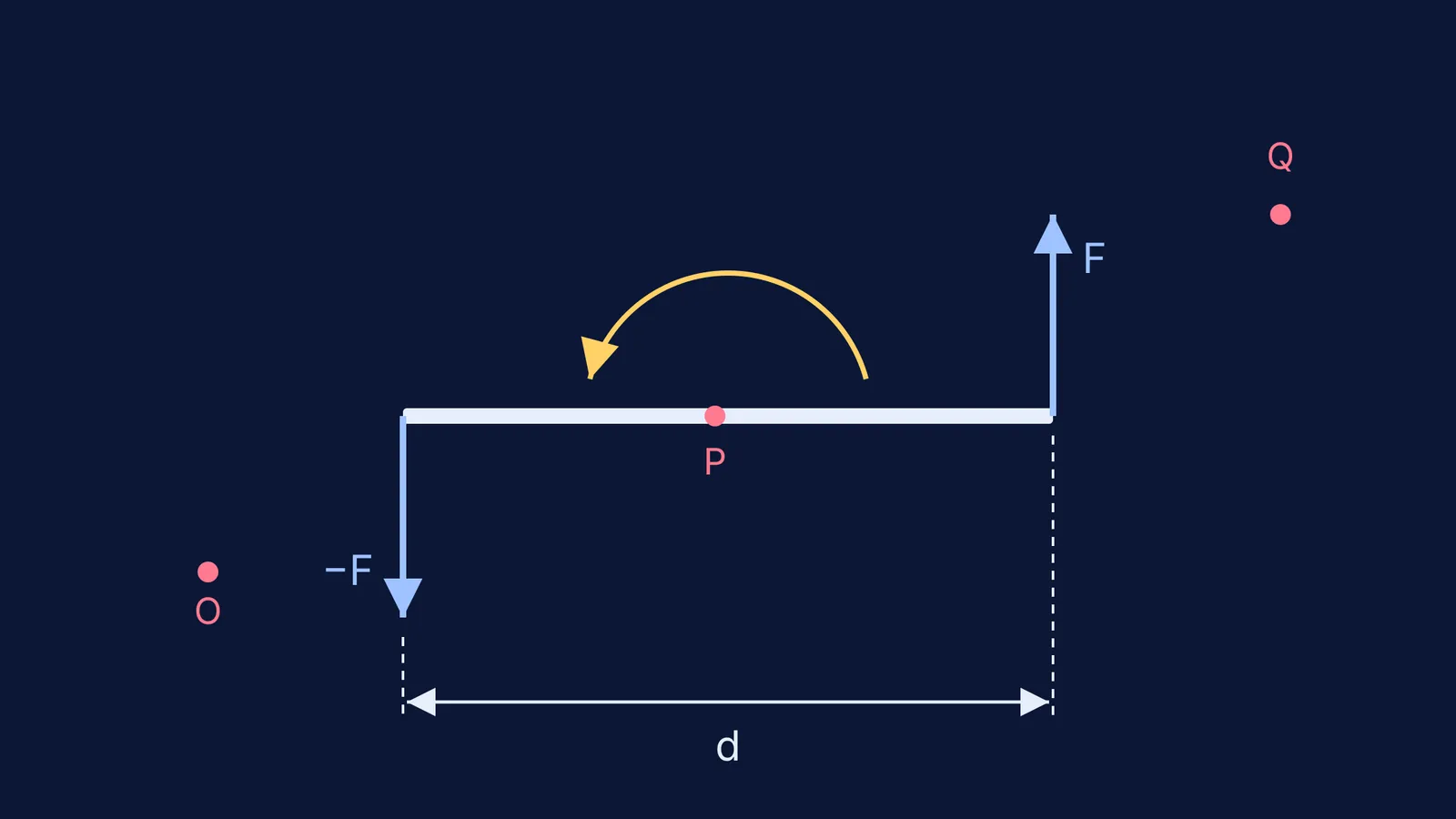
A couple is a pair of forces of equal magnitude acting in opposite directions along different lines of action, and it produces rotation without translation (NCERT Class 11 Physics, Chapter 6, section 6.8).
The words "different lines" matter: equal and opposite pushes along the same line cancel completely, with no net force and no turning. NCERT's example is a light rod pushed one way at one end and the opposite way at the other: the total force is zero, yet the rod undergoes pure rotation.
Why does a couple have zero net force?
Add the two forces as vectors: F + (−F) = 0. The centre of mass accelerates only if the net external force is non-zero, so it stays at rest (or keeps its velocity) and the body can only spin.
Compare a single force: push a ruler on a smooth table near one end and it both slides and turns. A couple does only the turning.
Why is the moment of a couple the same about every point?
Take force −F at point A (position r₁) and +F at point B (position r₂), both measured from any origin O. The total moment is r₁ × (−F) + r₂ × F = (r₂ − r₁) × F = AB × F. AB joins the two points and does not depend on O, so neither does the moment. This is NCERT's Example 6.7 in the same Class 11 chapter.
Its size is F × d, where d is the perpendicular distance between the two lines of action. Check it with numbers. Put a rod along the x-axis from x = 0 to x = 0.5 m, with 10 N downward at x = 0 and 10 N upward at x = 0.5 m. Take anticlockwise as positive:
About x = 0: (0.5)(10) + 0 = 5 N m
About x = 0.2 m: (0.3)(10) + (0.2)(10) = 5 N m
About x = 1.0 m, off the rod: (−0.5)(10) + (1.0)(10) = 5 N m
Three points, one answer: each force's moment changes, but the changes cancel.
Steering wheel, tap and compass needle: three quick sums
NCERT's own examples are fingers turning a bottle lid and a compass needle in the Earth's magnetic field (section 6.8). The numbers below are made up for practice, not measured.
Steering wheel. Your hands are at opposite ends of a 36 cm diameter and each pushes 20 N along the rim, one up and one down. The lines are a diameter apart, so torque = 20 × 0.36 = 7.2 N m. One hand pushing 20 N gives only 20 × 0.18 = 3.6 N m about the column, and the column must push back with 20 N to hold the wheel in place.
Tap. Your thumb and finger grip a tap handle 5 cm apart and each pushes 12 N in opposite directions. Torque = 12 × 0.05 = 0.6 N m, and the pipe feels no net push.
Compass needle. A 4 cm needle sits at 30° to the field, with a force of 3 × 10⁻⁵ N on each pole, one towards north and one towards south. The gap between the lines is L sin θ = 0.04 × 0.5 = 0.02 m, so torque = 3 × 10⁻⁵ × 0.02 = 6 × 10⁻⁷ N m. At θ = 0 the gap is zero, which is why NCERT notes there is no couple once the needle points north-south.
The compass case is the same physics as a magnetic dipole in a uniform field, which we work through in current loops as magnetic dipoles and the torque on them.
How do couples show up in JEE problems?
Run through these checks:
Are the two forces equal in size, opposite in direction and on different lines? Then it is a couple: net force zero, moment F × d.
Is the body free? The couple gives it angular acceleration but does not accelerate its centre of mass.
Does a single force balance a couple in your working? It cannot; only an equal and opposite couple can.
In equilibrium sums, take moments about the point that removes the most unknowns. The couple's contribution will not change.
For the vector form, see torque as r × F, found about a point with vectors. For a full equilibrium setup, try torque and equilibrium in ladders, beams and hinged rods.
If you get the right torque but the wrong sense or sign, the Fermi Problem Library has worked problems with a step-by-step solver that explains the reasoning rather than printing an answer. If moments themselves feel shaky, the Fermi Concept Library gives each concept its own lesson and its place in the map.


