On this page
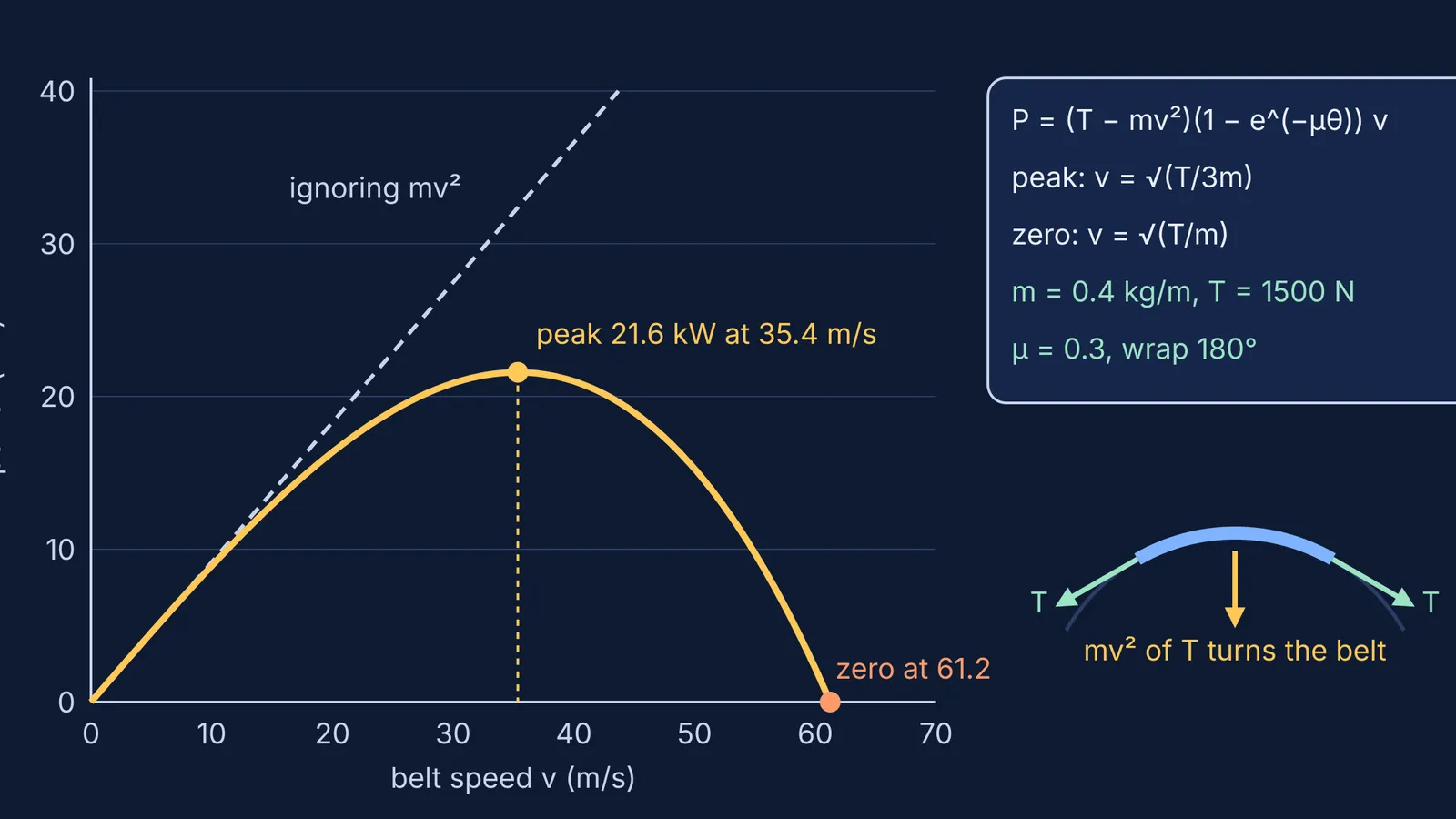
Power is force times speed, so a faster belt should carry more power. That holds at first. But a belt is a moving loop of mass, and part of its tension is used up just to keep it bending round the pulleys. Past a certain speed that part grows so fast that the power falls. For a flat belt the power peaks when the speed is v = √(T/3m), and at v = √(T/m) a belt that is not slipping carries nothing at all.
What is centrifugal tension in a belt?
Every bit of belt that runs round a pulley moves in a circle, so it needs a centripetal force towards the pulley's centre. For a belt with mass m per metre running at speed v, the tension needed to supply that force is
T_c = mv²
This is exactly the hoop tension of a spinning ring, derived step by step in why a grinder disc is rated in m/s: hoop stress σ = ρv². Multiply σ = ρv² by the cross-section A and you get T = ρAv² = mv², because m = ρA. We will use that result here, not derive it again.
Two features matter for a belt drive:
T_c does not depend on the pulley radius. On a smaller pulley each metre of belt needs more inward force, mv²/r, but a tension T also pulls harder round a tighter curve, T/r. The radius cancels.
T_c appears on both the tight and the slack side. It is not a load the belt carries for you. It is the price of moving the belt.
Why does centrifugal tension reduce grip?
Look at a short piece of belt on the pulley, subtending an angle dφ. The tensions at its two ends pull it inwards with a force T dφ. Of that, m v² dφ is needed to make the piece go round the curve. Only what is left presses the belt onto the pulley:
dN = (T − mv²) dφ
Friction depends on that normal force. So the capstan rule from why rope tension grows exponentially around a cylinder now applies to T − mv², not to T:
(T₁ − mv²) / (T₂ − mv²) = e^(μθ)
This is the form given in IIT Kharagpur's NPTEL lesson on belt drives (equation 13.1.10), where T₁ and T₂ are the total tensions on the tight and slack sides.
Running faster does not press the belt harder onto the pulley. It does the opposite: more of the tension is used up turning the belt, and less is left for grip.
At what speed does a belt drive carry the most power?
The belt material sets a largest safe tension, T_max, on the tight side. Then:
Tension left for grip. T₁ − mv² = T_max − mv².
Tension difference. With slip about to begin, T₁ − T₂ = (T_max − mv²)(1 − e^(−μθ)). The mv² parts cancel in the difference.
Power. P = (T₁ − T₂)v = (T_max − mv²)(1 − e^(−μθ))v.
Maximise. The bracket (1 − e^(−μθ)) does not depend on v. So maximise T_max v − m v³. Setting the derivative to zero: T_max − 3mv² = 0.
Result. v = √(T_max/3m), and at that speed mv² = T_max/3.
So at the peak one third of the allowed tension goes into centrifugal tension. Khurmi and Gupta's A Textbook of Machine Design (section 18.22) states the same condition, T = 3T_c, and gives the same speed. Its section 18.8 suggests belt speeds of about 20 to 22.5 m/s for efficient transmission, below the 35.4 m/s peak in the example below.
The power is zero at both ends: at v = 0 nothing moves, and at v = √(T_max/m) all the allowed tension is used up by centrifugal tension.
Worked example: a flat belt from 5 m/s to 61 m/s
Question (JEE style). A flat belt has mass 0.4 kg per metre and a largest safe tension of 1,500 N. It wraps 180° round the pulley, with μ = 0.3. Find the power it can carry at different speeds, the speed for maximum power, and the speed at which it can carry nothing. (Illustrative values.)
Grip factor. μθ = 0.3 × π = 0.942. e^(−0.942) = 0.390, so 1 − e^(−μθ) = 0.610.
Power formula. P = (1500 − 0.4v²) × 0.610 × v watts.
Table of values.
v = 5 m/s: mv² = 10 N, P = 4.6 kW.
v = 10 m/s: mv² = 40 N, P = 8.9 kW.
v = 20 m/s: mv² = 160 N, P = 16.4 kW.
v = 30 m/s: mv² = 360 N, P = 20.9 kW.
v = 50 m/s: mv² = 1,000 N, P = 15.3 kW.
Speed for maximum power. v = √(1500 / (3 × 0.4)) = √1250 = 35.4 m/s. Here mv² = 500 N, a third of 1,500 N.
Maximum power. P = (1500 − 500) × 0.610 × 35.4 = 21.6 kW.
Tensions at the peak. Tight side 1,500 N in total. Slack side 1000 × 0.390 + 500 = 890 N. Difference 610 N, and 610 × 35.4 = 21.6 kW, which checks.
Zero power. v = √(1500 / 0.4) = 61.2 m/s.
What ignoring centrifugal tension would predict. At 40 m/s the simple formula P = T_max(1 − e^(−μθ))v gives 1500 × 0.610 × 40 = 36.6 kW. The real figure is (1500 − 640) × 0.610 × 40 = 21.0 kW. The simple formula is 74% too high.
Units check: N × m/s = W, and mv² is kg/m × m²/s² = N.
For a feel of the speeds: a 300 mm pulley at 1,440 rpm, a common motor speed, gives v = π × 0.3 × 1440 / 60 = 22.6 m/s. At that speed this belt carries about 17.5 kW, roughly 81% of its peak.
Does this apply to V-belts too?
Yes. The wedge in the groove replaces μ with μ/sin β, as explained in why pump and fan belts are V-shaped. That post's worked example ignored centrifugal tension, which is fair at 7.5 m/s: there, mv² is a small fraction of the allowed tension. The same subtraction, T − mv², applies to a V-belt; only the grip factor changes.
Safety. Belts on flour mills, pumps and threshers run at tens of metres per second and can pull in a hand, sleeve or dupatta in a fraction of a second. Never go near a running belt, and keep the guard on.
Practising friction and circular-motion problems
This problem joins friction and circular motion. To check your method step by step, the Fermi Problem Library has a solver that explains the reasoning. If you are preparing for JEE Main and Advanced, Fermi Test Prep offers personalised preparation with an AI tutor, live classes, adaptive mocks, mentorship and a study plan that updates based on mastery.
Quick checklist
Centrifugal tension T_c = mv², the same for any pulley size.
It cancels in T₁ − T₂ but uses up part of T_max.
Use (T₁ − mv²)/(T₂ − mv²) = e^(μθ).
Power peaks at v = √(T_max/3m), where T_c = T_max/3.
Power falls to zero at v = √(T_max/m).