On this page
A crack inside a rail head cannot be seen from the top of the rail. Indian Railways finds such cracks with ultrasonic rail testers: trolleys or machines pushed along the track that send short bursts of sound into the steel and listen for echoes. The surprising part is the probe that looks for cracks across the rail head. It sends sound into the steel at 70° to the vertical, and it does this with a plastic wedge cut at only about 52.6°. The reason is Snell's law, written for sound instead of light.
How does an ultrasonic rail tester see inside the rail?
A probe contains a piezoelectric crystal that turns a voltage pulse into a burst of sound at a few megahertz. The sound crosses a thin layer of water or gel, called a couplant, into the rail. Any surface inside the steel, such as the far face of the rail or a crack, reflects part of the sound back. The same crystal picks up the echo, and the time delay tells you how far away the reflector is.
The Research Designs and Standards Organisation (RDSO) sets the probe set used on Indian rails in its Manual for Ultrasonic Testing of Rails and Welds (Revised 2022). It lists a 0° 4 MHz probe for horizontal defects in the head, web and foot, a 70° 2 MHz probe (looking forward and backward) for transverse defects in the rail head, and a 37° 2 MHz probe for star cracks at bolt holes. The 0° probe sends sound straight down. The angled probes are the interesting ones.
The couplant matters: an air gap would reflect almost all of the sound, so a dry probe sees nothing.
Why does sound bend away from the normal going into steel?
Snell's law holds for any wave crossing a boundary:
sin θ₁ / v₁ = sin θ₂ / v₂
Here θ₁ and θ₂ are measured from the normal, and v₁ and v₂ are the wave speeds on each side. Light slows down when it enters glass, so it bends towards the normal (see when light bends towards the normal). Sound does the opposite when it goes from plastic into steel, because sound is faster in steel. So the ray in the steel is always further from the normal than the ray in the wedge. That is why a 52.6° wedge gives a 70° beam.
Steel also carries two kinds of sound wave, which gases cannot (see why transverse waves cannot travel through gases). A longitudinal wave squeezes the steel along the direction of travel. A shear (transverse) wave shakes it sideways. One ray in the wedge therefore produces two refracted rays in the steel, each with its own speed and its own angle.
The speeds used here are typical room-temperature values. For mild steel, the NDT instrument maker Karl Deutsch lists 5,890 to 5,960 m/s for longitudinal waves and 3,230 to 3,270 m/s for shear waves; we use 5,920 m/s and 3,230 m/s, and the RDSO manual itself uses 3,230 m/s for shear-wave calibration. For acrylic (Perspex), Evident's sound velocity table gives 2,730 m/s. Real wedges and rail steels vary a little, so treat every angle below as approximate to a few tenths of a degree.
What are the two critical angles for a Perspex wedge on steel?
A critical angle here is the wedge angle at which one of the refracted waves in steel reaches 90° and skims along the surface. Put θ₂ = 90° in Snell's law, so sin θ₁ = v₁ / v₂.
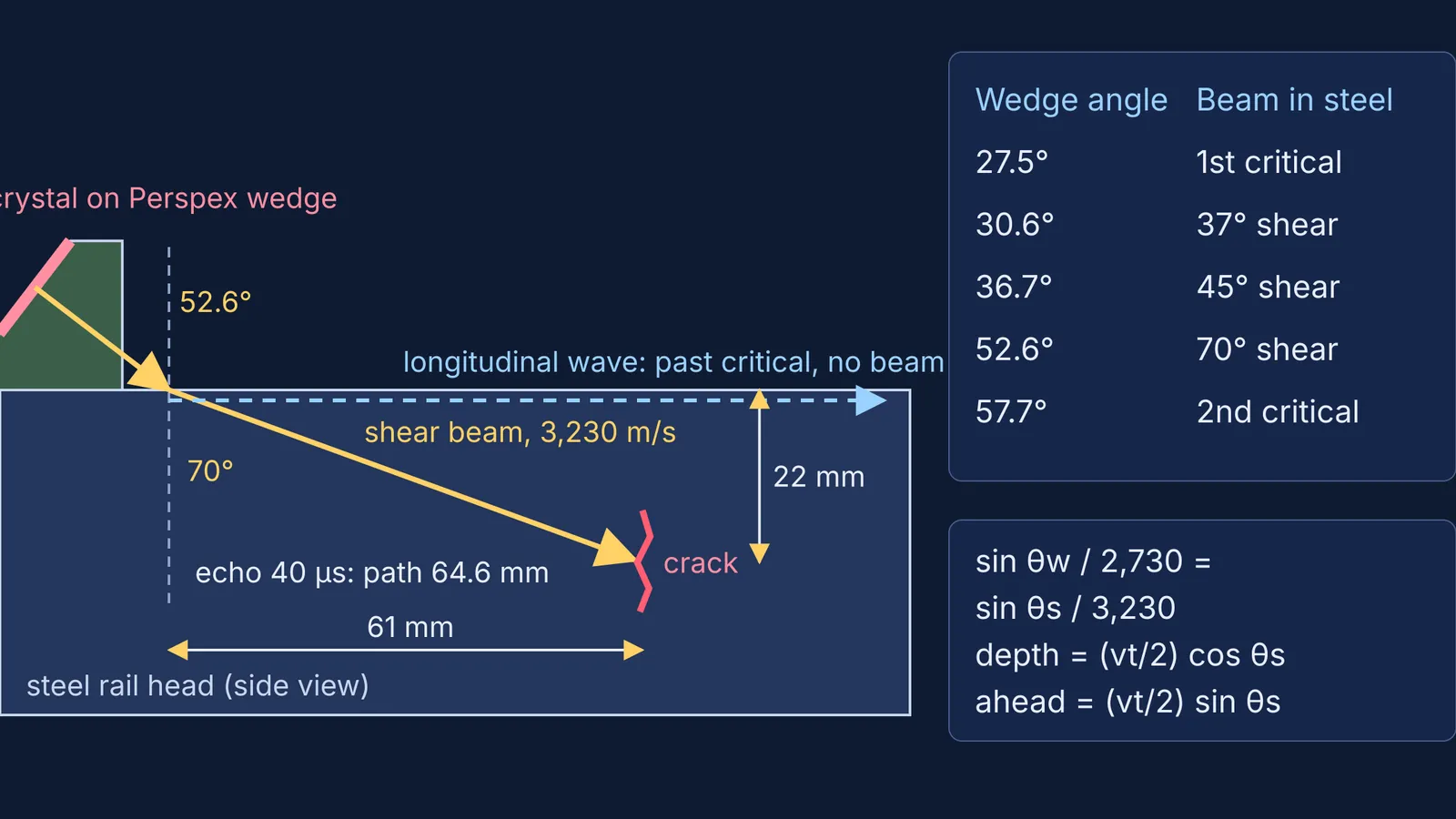
First critical angle (longitudinal wave). sin θ₁ = 2,730 / 5,920 = 0.461, so θ₁ = 27.5°.
Second critical angle (shear wave). sin θ₁ = 2,730 / 3,230 = 0.845, so θ₁ = 57.7°.
Between 27.5° and 57.7°, the longitudinal wave can no longer travel into the steel as a beam, but the shear wave can. Only one wave enters. That is exactly what you want: one beam, one speed, and one echo for each reflector. Below 27.5° both waves enter, so one crack gives two echoes at two different times. Above 57.7°, neither wave enters as a beam.
How do you cut the wedge for a 70° probe?
Here is the full calculation, with v₁ = 2,730 m/s in the wedge and v₂ = 3,230 m/s for shear waves in steel.
Write Snell's law for the shear wave. sin θ_wedge = (2,730 / 3,230) × sin θ_steel.
For a 70° beam. sin θ_wedge = 0.845 × 0.940 = 0.795, so θ_wedge = 52.6°. This lies between 27.5° and 57.7°, so only the shear wave enters.
For a 45° beam. sin θ_wedge = 0.845 × 0.707 = 0.598, so θ_wedge = 36.7°.
For a 37° beam. sin θ_wedge = 0.845 × 0.602 = 0.509, so θ_wedge = 30.6°.
Find a crack from its echo. Suppose the 70° probe receives an echo 40 µs after the pulse. The sound went out and back, so the one-way path along the beam is 3,230 × 40 × 10⁻⁶ / 2 = 0.0646 m, or 64.6 mm.
Resolve the path. The beam is at 70° to the vertical, so the depth is 64.6 × cos 70° = 22.1 mm and the distance ahead of the probe's exit point is 64.6 × sin 70° = 60.7 mm.
Check the units: (m/s) × s gives metres, and the angles only scale it. Check the size: a rail head is several centimetres deep, so a crack 22 mm down sits inside the head, which is where the 70° probe is meant to look.
Notice that the probe angle is the angle of the shear beam in the steel, not the angle the wedge is cut at. A "70° probe" has a wedge near 52.6°.
Why use the slow shear wave and not the faster one?
Apart from giving one clean beam, the slower wave has a shorter wavelength at the same frequency, and shorter waves pick out smaller flaws. At 2 MHz, λ = v / f gives 3,230 / (2 × 10⁶) = 1.62 mm for the shear wave and 5,920 / (2 × 10⁶) = 2.96 mm for the longitudinal wave. A crack only a few millimetres across reflects the shear wave far better.
Sound bending because its speed changes also steers sound in the ocean, as in the SOFAR channel.
Rail testing is done by trained, authorised staff working under track protection rules. Never walk on or near railway tracks yourself, whether to look at rails or to take photos.
If you want to see how one ray splits and bends at a boundary, try the refraction concepts in the Concept Library, or work similar Snell's law questions step by step in the Fermi Problem Library.
Quick checklist
Snell's law for sound: sin θ₁ / v₁ = sin θ₂ / v₂, angles from the normal.
Sound bends away from the normal going from plastic into faster steel.
First critical angle (longitudinal): about 27.5°. Second (shear): about 57.7°.
Between them, only the shear wave enters the steel.
A 70° probe has a wedge near 52.6°; 45° needs 36.7°; 37° needs 30.6°.
Depth = (v t / 2) cos θ and forward distance = (v t / 2) sin θ, with the shear speed.