

On this page
When you pluck a guitar string, a transverse wave travels down the wire, shifting each segment perpendicular to the wave's path. Yet if you try to send that same transverse wiggle through the surrounding air, it vanishes instantly. In air, sound travels strictly as a longitudinal wave of alternating compressions and rarefactions.
This contrast between solids and fluids is central to mechanical physics. It explains how musical instruments work, sets the speed of sound, and provides our clearest window into Earth's deep interior.
Why do mechanical waves need a restoring force?
Every mechanical wave requires two physical properties from its medium: inertia to store kinetic energy, and an elastic restoring force to pull displaced particles back to equilibrium.
As demonstrated by acoustics educator Daniel A. Russell at Pennsylvania State University, wave propagation is about local particle oscillations transferring energy rather than matter traveling across space. In a longitudinal wave, particles oscillate parallel to wave travel. Pushing a layer of gas compresses its volume, raising pressure and pushing against adjacent layers. The restoring force is governed by the bulk modulus, B, which measures resistance to uniform compression. Because solids, liquids, and gases all resist compression, longitudinal waves travel through all three phases of matter.
Transverse waves behave differently: particles oscillate perpendicular to wave travel, sliding adjacent layers sideways. Propagating this lateral disturbance requires a restoring force that opposes changes in shape rather than volume.
The Fermi Concept Library maps every concept in physics, chemistry, biology, mathematics and computing, each with its own lesson and its place in the map, showing how elasticity and wave equations connect across topics.
Why is the shear modulus of a gas equal to zero?
The physical quantity that measures resistance to shape deformation is the shear modulus (modulus of rigidity), G:
G = (F / A) / θ
where F / A is the tangential force per unit area and θ is the angular shear strain.
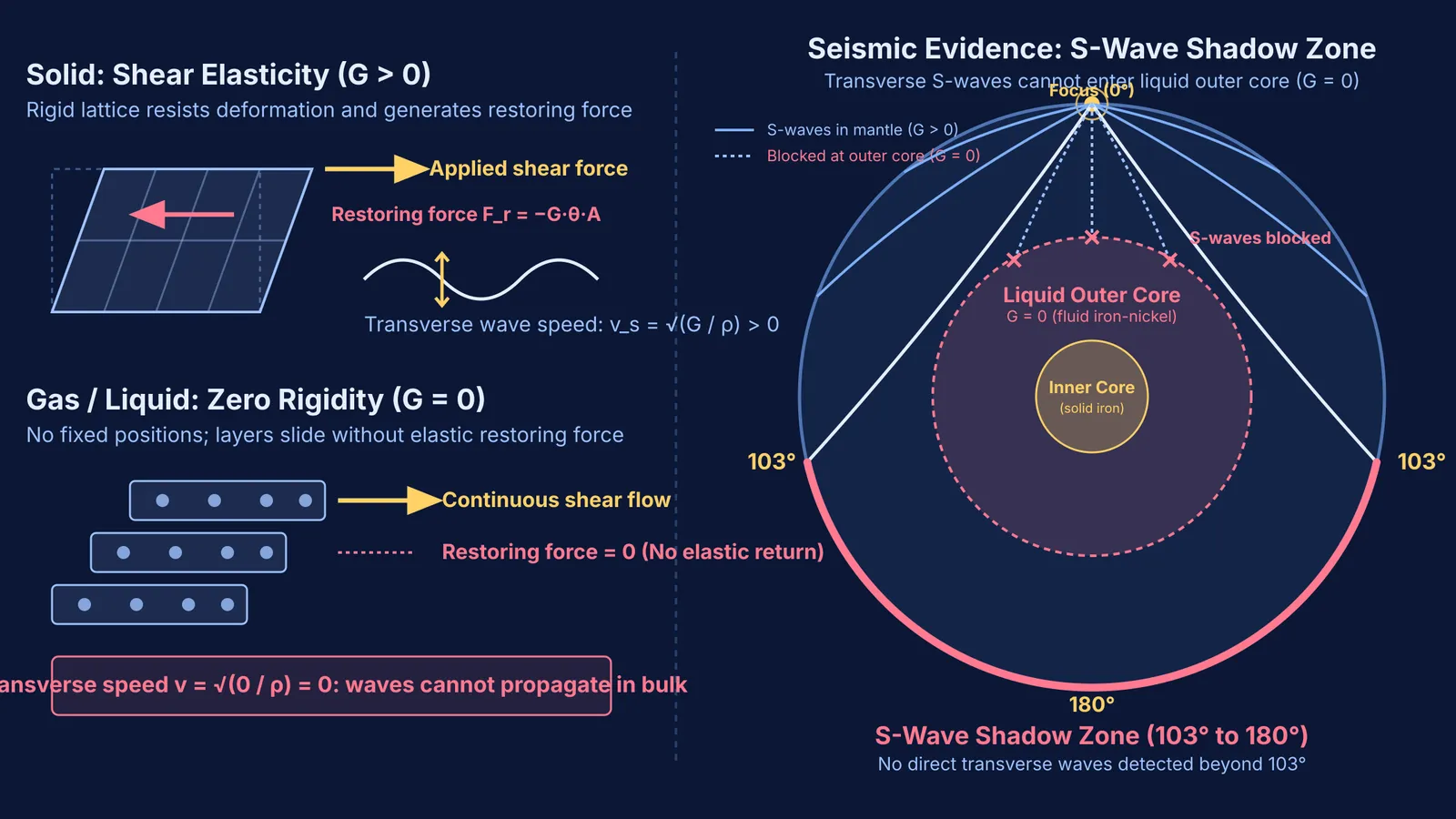
In a solid, chemical bonds lock atoms into a fixed lattice. Applying shear stress stretches those bonds, generating an elastic restoring force that pulls the lattice back into shape.
Fluids—both liquids and gases—lack a fixed lattice. Gas molecules move freely, colliding without equilibrium positions. When a tangential force acts on a gas layer, molecules slide past each other without resisting. The gas flows rather than deforms elastically, giving a static shear modulus of zero (G = 0).
According to OpenStax *University Physics*, transverse wave speed in an extended medium depends directly on shear modulus and density:
v_transverse = √(G / ρ)
Because G = 0 in fluids, v_transverse = 0. Without a restoring force to transmit sideways displacement, mechanical transverse waves cannot propagate through the bulk of a gas or liquid.
How did S-waves reveal Earth's liquid outer core?
This missing shear restoring force resolved a major mystery about Earth's interior. Earthquakes radiate two main types of seismic body waves:
P-waves (primary): Longitudinal waves compressing and dilating rock at speed v_P = √((B + (4/3)G) / ρ).
S-waves (secondary): Transverse shear waves oscillating perpendicular to travel at speed v_S = √(G / ρ).
In 1914, Beno Gutenberg located the core-mantle boundary at a depth of 2,900 km, as explored in our guide on how Beno Gutenberg measured the depth of Earth's core. In 1926, geophysicist Harold Jeffreys demonstrated in the *Monthly Notices of the Royal Astronomical Society* that Earth's outer core has near-zero rigidity, confirming it is liquid.
Because liquid iron-nickel has G = 0, S-waves cannot enter the outer core. As shown by the Incorporated Research Institutions for Seismology, this blockage creates a global S-wave shadow zone: direct S-waves vanish completely beyond an angular distance of 103° from an earthquake focus, spanning all the way to 180°.
How to solve wave propagation questions in exams?
According to OpenStax *University Physics*, mechanical wave speed is determined by the ratio of an elastic restoring factor to an inertial density factor. When analyzing wave propagation across different media, follow this systematic three-step method:
Check the medium phase: Solids sustain both compression and shear (B > 0, G > 0). Fluids sustain only compression (B > 0, G = 0).
Select the velocity formula:
Solid: longitudinal speed is v = √((B + (4/3)G) / ρ); transverse speed is v = √(G / ρ).
Fluid: transverse speed is 0; longitudinal sound speed is v = √(B / ρ). For an ideal gas with B = γP, Laplace's correction for the speed of sound gives v = √(γP / ρ).
Track phase shifts: Pressure and displacement waves oscillate 90° out of phase, as shown in our guide on displacement and pressure waves in sound.
Using standard elastic and acoustic values from OpenStax *University Physics*, consider steel (ρ = 7,850 kg/m³, B = 160 GPa, G = 80 GPa) versus air (ρ = 1.2 kg/m³, P = 101.3 kPa, γ = 1.4):
In steel: v_P = √((160 × 10⁹ + (4/3) × 80 × 10⁹) / 7,850) ≈ 5,830 m/s; v_S = √(80 × 10⁹ / 7,850) ≈ 3,190 m/s.
In air: v_sound = √(1.4 × 101,300 / 1.2) ≈ 344 m/s; v_transverse = √(0 / 1.2) = 0 m/s.
The Fermi Problem Library features worked problems with a step-by-step solver that explains the reasoning rather than printing an answer, helping you master elasticity and wave dynamics.


