On this page
Press the brake pedal of a healthy car and it goes down a short way, then feels firm. If air has got into the brake pipes, the pedal sinks further and feels soft, as if pressing on a sponge. The reason is Boyle's law. Brake fluid hardly compresses, so when you push the master-cylinder piston, the fluid pushes the brake pads almost one for one. A gas bubble is different: it shrinks as the pressure rises, and every millilitre it gives up is a millilitre of piston travel that never reaches the pads. This post works out how much pedal a 1 mL bubble costs, and why the same thing can happen with no leak at all when brake fluid boils.
Safety first: brakes are a safety-critical system. If a pedal feels soft or sinks, do not drive the car; have a qualified mechanic inspect it. Finding and removing air from brake lines is workshop work, and this post gives no repair steps.
How do hydraulic brakes multiply your push?
The pedal is a lever that pushes a piston into the master cylinder. The pressure it creates is carried by the fluid to pistons at each wheel, which press the pads against the disc. That is Pascal's law, worked through in our post on Pascal's law in hydraulic machines. The force multiplication only works because the liquid passes on volume as well as pressure: a small movement at the master cylinder becomes a small movement of the wheel pistons.
The numbers below are illustrative round values for a small car, not data for any model:
master-cylinder bore 22.2 mm, so area A = π × (0.0111 m)² = 3.87 cm²
pedal ratio 4:1, so the pedal moves 4 times as far as the master-cylinder piston
light braking at 5 bar gauge (6 bar absolute), a hard stop at 80 bar gauge (81 bar absolute)
How much does a trapped air bubble shrink?
At constant temperature pV is constant for a fixed amount of gas, the law you can test with a syringe in our post on Boyle's law with a syringe. Pressure here must be absolute: atmospheric pressure plus the gauge reading.
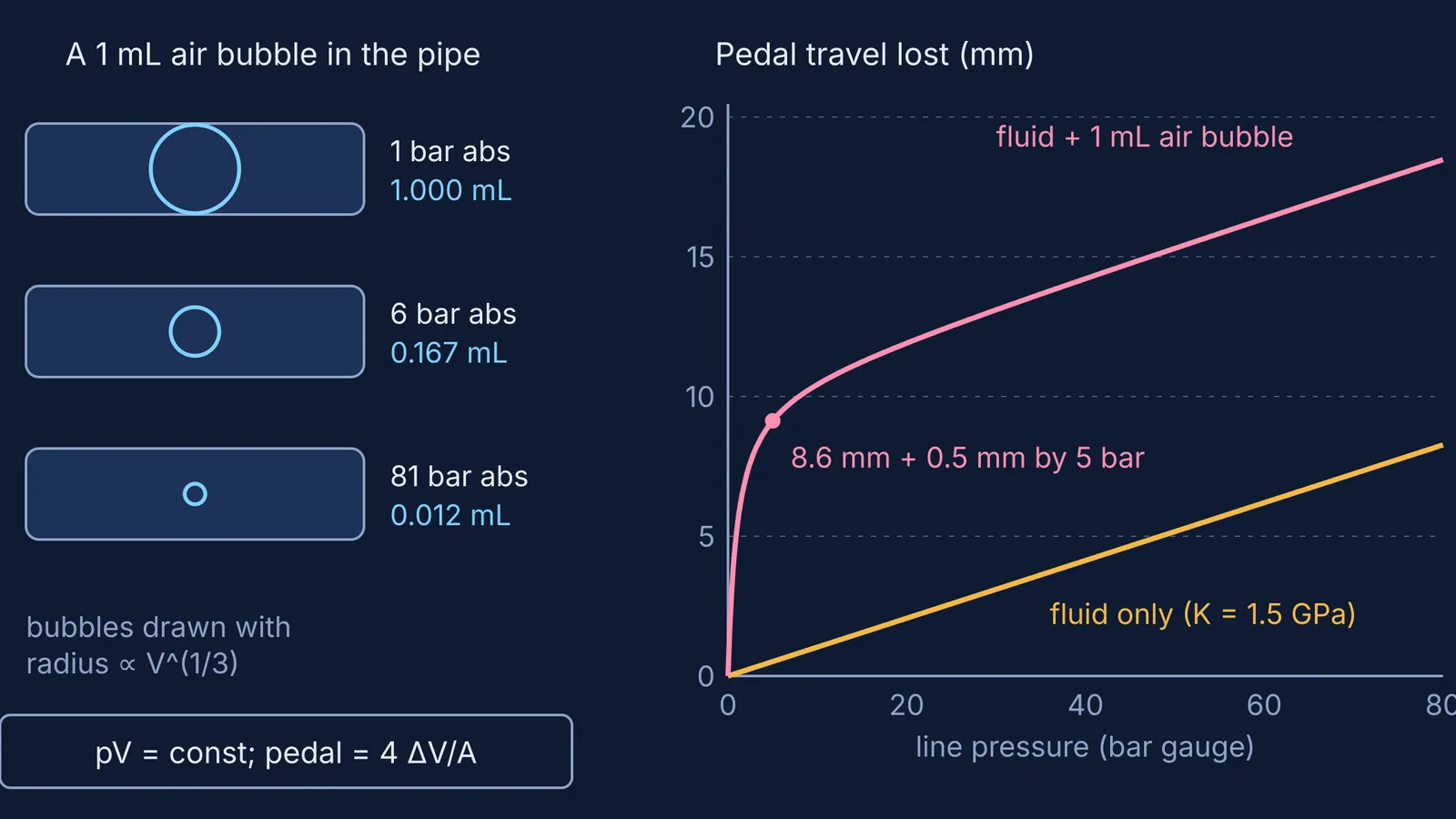
A 1 mL bubble at atmospheric pressure, about 1 bar absolute:
at 6 bar absolute: V = 1 × 1/6 = 0.167 mL, so it has given up 0.83 mL
at 81 bar absolute: V = 1/81 = 0.012 mL, so it has given up 0.99 mL
Most of the shrinking happens in the first few bar. Going from 1 to 6 bar takes 0.83 mL; going from 6 to 81 bar takes only another 0.15 mL. That is exactly what you feel: a long, soft first part of the pedal stroke.
How far does the pedal sink because of the bubble?
Volume the bubble swallows at light braking: ΔV = 1 − 1/6 = 0.833 mL = 0.833 × 10⁻⁶ m³.
Master-cylinder travel: x = ΔV/A = 0.833 × 10⁻⁶/3.87 × 10⁻⁴ = 2.15 × 10⁻³ m = 2.15 mm.
Pedal travel: 4 × 2.15 = 8.6 mm.
At a hard stop (81 bar absolute): ΔV = 0.988 mL, x = 2.55 mm, pedal 10.2 mm.
A 5 mL bubble: ΔV = 4.94 mL at 81 bar, x = 12.8 mm, pedal 51 mm, a large part of the pedal's travel.
Check the units: m³ ÷ m² = m. All of that pedal travel is spent squashing gas before the pads do any extra work.
The squeeze is taken as isothermal. A quick stamp on the pedal is partly adiabatic, so the bubble shrinks a little less at first; the conclusion does not change. The bubble's buoyancy is a separate story, covered in our post on an air bubble rising from a lake bottom, and it is why air collects at the high points of a pipe.
Doesn't brake fluid compress too?
It does, a little, and the difference is the shape of the curve. A liquid's volume change is ΔV = V Δp/K, where K is the bulk modulus. Take an illustrative round value of K = 1.5 GPa for brake fluid (the same order as water's 2.2 GPa) and 150 mL of fluid under pressure, also illustrative:
at 5 bar gauge: ΔV = 150 × 0.5 × 10⁶/1.5 × 10⁹ = 0.05 mL, about 0.5 mm of pedal
at 80 bar gauge: ΔV = 150 × 8 × 10⁶/1.5 × 10⁹ = 0.8 mL, about 8.3 mm of pedal
So the fluid's give grows steadily with pressure, which feels like a firm, progressive pedal. The bubble takes 0.83 mL in the first 5 bar, 17 times the fluid's 0.05 mL, so the pedal falls away before the pads bite. Rubber hoses also swell a little under pressure, which adds a small, steady amount of travel.
Why can hot brakes give a soft pedal with no leak?
On a long ghat descent, brakes used for a long time heat the fluid. If it reaches its boiling point, vapour bubbles form in the pipes and behave exactly like the air bubble above. Brembo, a brake maker, describes this as vapour lock: the vapour bubbles increase compressibility, and moisture absorbed by the fluid makes it boil well below the boiling point on the label.
The US safety standard for brake fluid, FMVSS No. 116, sets minimum boiling points for new ("dry") fluid and for "wet" fluid, tested after it has been humidified until a reference fluid holds 3.7% water:
DOT 3: at least 205 °C dry, 140 °C wet
DOT 4: at least 230 °C dry, 155 °C wet
DOT 5: at least 260 °C dry, 180 °C wet
The 65 to 75 °C drop for DOT 3 and DOT 4 is why fluid is checked and replaced at the intervals the car maker sets. A vapour bubble can also condense again as the brakes cool, so the pedal may feel normal later even though the problem is real; that is another reason to have it inspected rather than trusting the next press.
Problems that combine Boyle's law, gauge pressure and Pascal's law in one system are a JEE favourite. The Fermi Problem Library has a step-by-step solver that explains the reasoning. For a full plan, Fermi Test Prep offers personalised preparation for JEE Main & Advanced with an AI tutor, live classes, adaptive mocks, mentorship and a study plan that updates based on mastery.
Quick checklist
Brake fluid passes on both pressure and volume; a gas bubble swallows volume.
Boyle's law needs absolute pressure: gauge + about 1 bar.
A 1 mL bubble gives up 0.83 mL by 6 bar absolute, most of it early.
Pedal travel = pedal ratio × ΔV/A: about 8.6 mm for 1 mL here.
Liquid compression ΔV = V Δp/K is small at low pressure and grows steadily.
Boiling fluid makes vapour bubbles (vapour lock); wet boiling points are much lower.
A soft pedal means: do not drive, see a qualified mechanic.