On this page
A 50 or 60 Hz current from hand to hand has to be around 100 mA before it is likely to send the heart into fibrillation, according to a review by Fish and Geddes (2009). Yet medical equipment with a part that may touch the heart, such as a catheter or a pacing wire, is allowed to leak only 10 microamperes into the patient in normal use, under the IEC 60601-1 limits tabulated by Tavakoli Golpaygani and colleagues (2017). That is ten thousand times less. The difference is not caution for its own sake. It comes from one line of Class 12 physics: current density, J = I/A. The same current is far more concentrated when it enters the heart through a tiny tip than when it spreads across the whole chest.
What is microshock?
A shock through the skin, say from hand to hand, is called a macroshock. The current enters through the skin and spreads out through the chest, and only part of it passes through the heart.
A microshock is current delivered straight to the heart muscle, through something that conducts and already sits inside or on the heart: a pacing wire, or a catheter filled with salt solution. There is no skin resistance in the way, and the current does not spread out before it reaches the muscle.
How small can such a current be and still matter? In a peer-reviewed study of 40 patients by Swerdlow and colleagues in Circulation (1999), 60 Hz current was passed through a right-ventricular pacing catheter during scheduled defibrillator testing. The lowest currents that made the heart follow the AC were about 20 µA. Loss of effective pumping began from about 32 µA, and ventricular fibrillation (VF), the chaotic rhythm in which the heart stops pumping, was seen from about 49 µA. These were the minimum values; most patients needed more.
For comparison, a review by Fish and Geddes in Eplasty (2009) lists about 100 mA as the VF threshold for 60 Hz current through the body. Both figures are approximate and depend on the path and how long the current flows.
How does current density explain the difference?
Current density is current per unit area, J = I/A, in A/m². What disturbs heart muscle is how strongly the current acts on the cells it passes through, and that depends on the current density at the muscle, not on the total current far away. Current density in this sense, as a vector that can spread or crowd, is explained in what current density J is and why it is a vector.
The same idea explains why an electrosurgery tip cuts while the large return pad stays cool, in electrosurgery physics: why the tip cuts and the pad stays cool. There the concern is heating; here it is the electrical stimulation of heart muscle.
Worked example: a catheter tip against a chest shock
All areas here are round, illustrative values, chosen to show the scaling. They are not measured anatomy.
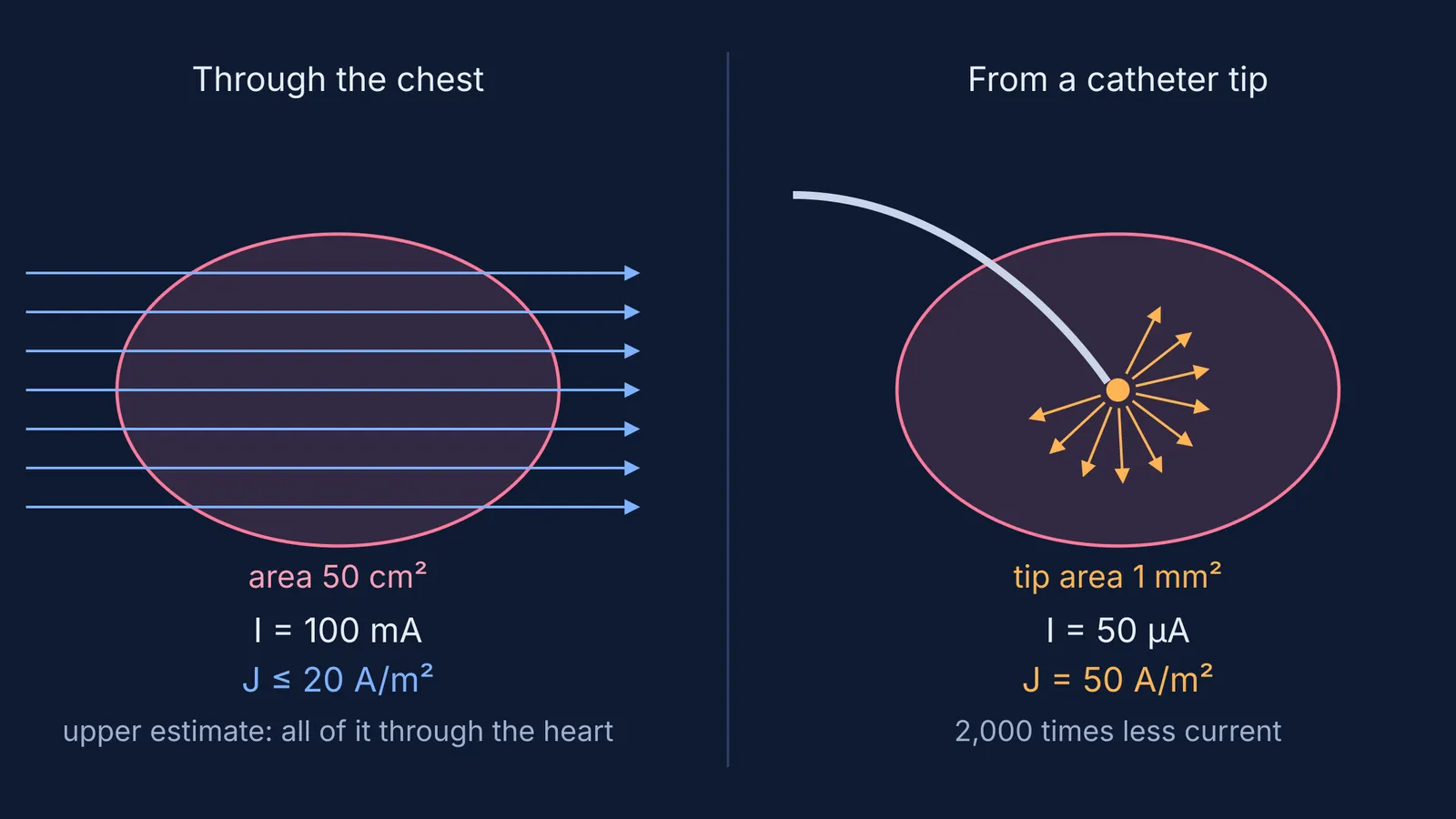
Catheter tip. A current of 50 µA leaves through a tip of area 1 mm² = 1 × 10⁻⁶ m². J = I/A = (50 × 10⁻⁶)/(1 × 10⁻⁶) = 50 A/m².
Shock through the chest. Take 100 mA, and suppose, generously, that all of it passes through the heart, spread over 50 cm² = 50 × 10⁻⁴ m². J = (100 × 10⁻³)/(50 × 10⁻⁴) = 20 A/m².
Compare the currents. 100 mA/50 µA = 2,000. The catheter current is 2,000 times smaller.
Compare the densities. 50 A/m² against 20 A/m². The tiny catheter current is more concentrated, even against an upper estimate for the chest shock. In reality only part of a chest current goes through the heart, so its density there is lower still.
At the limit. 10 µA through the same 1 mm² gives 10 A/m².
Units check: A divided by m² gives A/m² in every line. Note that 1 mm² is 10⁻⁶ m² and 1 cm² is 10⁻⁴ m²; mixing these up is the most common slip.
What limits do medical safety standards set?
The international standard for medical electrical equipment, IEC 60601-1, sorts the parts that touch a patient into classes. Type B and BF parts are for contact with the body in general. Type CF parts are for direct contact with the heart. As tabulated in a peer-reviewed study of equipment safety testing by Tavakoli Golpaygani and colleagues in the Journal of Biomedical Physics and Engineering (2017), the patient leakage limit for CF parts is 10 µA in normal condition and 50 µA under a single fault, against 100 µA and 500 µA for BF parts.
Note that B, BF and CF describe the applied part, the bit that touches the patient, not the whole device. The 50 µA single-fault figure is close to the 49 µA lowest VF current in the Swerdlow study, which is why that paper argued for a stricter limit for currents lasting several seconds.
Why do millivolts matter in an ICU?
Ohm's law, I = V/R, shows why the wiring of the room matters as much as the device. Suppose a catheter and another earthed device on the same patient form a path of 1 kΩ (an illustrative value). Then every millivolt of difference between their earths drives one microampere:
50 mV across 1 kΩ gives 50 µA.
20 mV gives 20 µA.
A fault that lifted one earth by just 1 V would drive 1 mA.
So in rooms where patients may have connections to the heart, the earth points must sit at almost exactly the same potential. Wiring rules for medical locations require supplementary equipotential bonding, which connects the earthed metal around the patient to one earth reference bar. An IET Wiring Matters article on medical locations (2011), describing BS 7671 Section 710 based on IEC 60364-7-710, gives limits of 20 mV between the fixed wiring and that bar and 50 mV in all. This is the idea in why birds on a power line don't get a shock: no potential difference, no current.
Who checks this in a hospital?
This post explains the physics only. It is not clinical advice and not a guide to testing or modifying any equipment. Leakage-current and electrical safety testing of medical devices is done by qualified biomedical engineers to the relevant standards. If you want to go deeper into current, resistance and current density, the Concept Library covers each idea, and the Fermi Problem Library has a step-by-step solver that explains the reasoning for current-density problems.
Quick checklist
Microshock is current delivered straight to the heart through a wire or fluid-filled catheter.
J = I/A: a small current through a small area can match or beat a large current spread out.
50 µA through 1 mm² is 50 A/m²; 100 mA through an illustrative 50 cm² is at most 20 A/m².
Peer-reviewed data: heart effects from about 20 to 49 µA delivered inside the heart.
CF limit: 10 µA normal, 50 µA single fault.
I = V/R: millivolts between earths drive microamperes, hence bonding to one earth bar.