On this page
A steel bracket that must come out 500 mm long is not moulded from a 500 mm pattern. The pattern maker builds it about 510 mm long, because the steel keeps shrinking long after it has frozen. It cools through more than 1,400 °C after turning solid, and ΔL = αLΔT takes about 2% off every length. That 2% is the pattern's shrinkage allowance.
Molten metal and foundry moulds are work for trained foundry staff only. This post explains the physics of the allowance. It is not a guide to casting anything.
What is a shrinkage allowance on a casting pattern?
A sand casting starts with a pattern, a wooden or metal copy of the part. Sand is packed around it and the pattern is lifted out, leaving a cavity exactly the pattern's size for the metal to fill.
Metal shrinks in three separate stages:
Liquid contraction, as the melt cools from its pouring temperature to its freezing point.
Solidification shrinkage, as liquid turns to denser solid.
Solid contraction, as the solid casting cools to room temperature.
The first two happen while there is still liquid, so a riser can feed them, as explained in how Chvorinov's rule sizes a casting's risers. The third stage cannot be fed, so the cavity must be made larger to begin with. The NPTEL metal casting lecture on patterns says exactly this: risers take care of liquid shrinkage, and solid shrinkage is taken by the pattern's shrinkage allowance.
How much does steel shrink after it freezes?
The NPTEL lecture gives a table of allowances in inches per foot. For cast steel parts up to 2 feet long it lists 0.251 inch per foot. One foot is 12 inches, so:
allowance = 0.251 ÷ 12 = 0.0209, or 2.09%
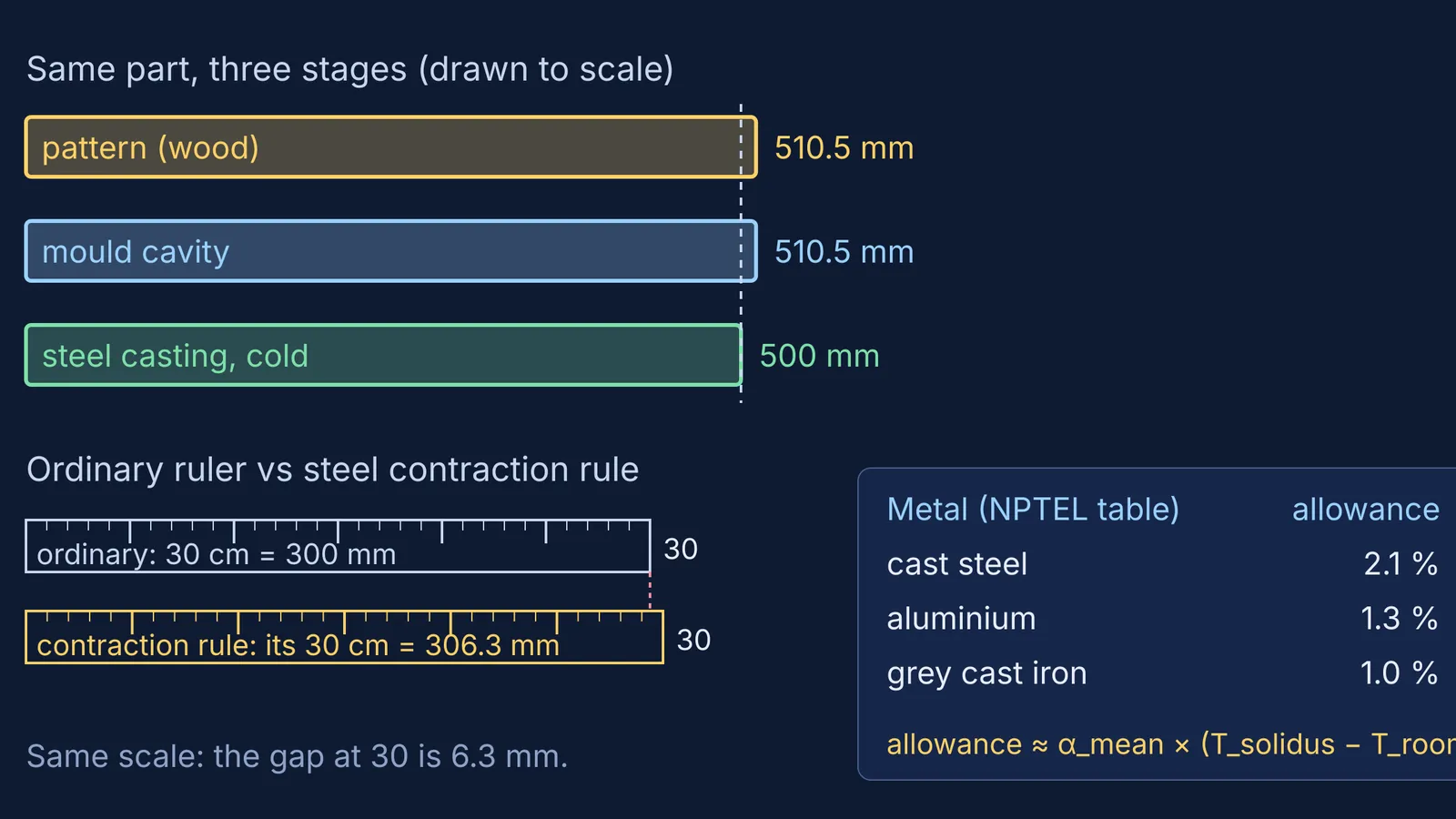
The same table gives 0.155 inch per foot (1.29%) for aluminium and 0.125 inch per foot (1.04%) for grey cast iron, both for the shortest size band. Longer castings get smaller allowances, because a long casting is held more by the sand and cannot shrink freely.
Where does the 2% come from? Apply the linear expansion law to the whole cooling range. If steel turns solid at about 1,450 °C (the exact solidus depends on the grade, so take this as approximate) and ends at about 30 °C, then ΔT ≈ 1,420 °C, and
ΔL/L = α_mean × ΔT
so α_mean = 0.0209 ÷ 1,420 ≈ 1.5 × 10⁻⁵ per °C.
At room temperature steel's α is about 1.2 × 10⁻⁵ per °C. The mean over the whole range comes out higher because α grows as metal gets hotter, so the hot part of the cooling counts for more. Steel also changes crystal structure on the way down, so foundries use measured allowances, not a table value of α.
Why is the allowance not the same for every casting?
If a casting could shrink without anything in the way, steel would contract by about 2.4%. That figure comes from classic measurements on a 0.35% carbon steel quoted by Ou and Beckermann in their 2003 Steel Founders' Society paper on simulating dimensional changes. The same paper reports that when the sand or a core holds the casting back, the allowance needed falls anywhere from 2.4% down to 0.39%. This is called hindered contraction. A thin bar is free to shrink end to end; the inside of a ring cast around a sand core is not.
So 2.1% is a starting value, corrected after trial castings are measured.
Why does grey cast iron need only about half of steel's allowance?
Grey iron's 1.04% is not explained by a smaller α alone. A room-temperature α of about 1.1 × 10⁻⁵ per °C over roughly 1,120 °C of cooling would predict about 1.2%.
The extra help comes from graphite. As grey iron freezes, carbon comes out of solution as graphite flakes, and graphite takes up more room than the iron it came from. In a 2019 Materials Transactions study of shrinkage in grey cast iron, Kishi and co-workers explain that the melt expands as graphite crystallises and shrinks as austenite crystallises, and that the two can balance. This expansion pushes against the mould and offsets part of the contraction, so the cold casting ends up closer to the pattern size.
How do you size the pattern for a 500 mm steel bracket?
Here is the full calculation in the form a JEE problem would set it.
Choose the allowance. Cast steel, under 2 feet long: 0.251 inch per foot, or 2.09%.
Pattern length. L_pattern = 500 × (1 + 0.0209) = 510.5 mm. The pattern maker makes it about 510 mm.
Check with ΔL = αLΔT. With α_mean = 1.47 × 10⁻⁵ per °C and ΔT = 1,420 °C, a 510.5 mm solid bar shrinks by 510.5 × 1.47 × 10⁻⁵ × 1,420 ≈ 10.6 mm, giving about 499.9 mm. That checks out.
Volume. Volume shrinks by (1.0209)³ − 1 ≈ 6.4%, about three times the linear figure, as γ ≈ 3α predicts.
What is a contraction rule?
Pattern makers do not multiply every dimension by 1.0209. They use a contraction rule (a shrink rule), a ruler whose markings are already stretched by the allowance. The NPTEL lecture notes that a shrink rule is used to lay out the pattern's measurements.
A steel rule's "1 foot" is a quarter of an inch longer than a real foot. In metric terms, the "30 cm" mark on a steel contraction rule sits at 300 × 1.0209 = 306.3 mm on an ordinary ruler. The pattern maker reads "500 mm" off the contraction rule and gets 510.5 mm of real wood without doing any arithmetic.
The same idea, a scale whose length is not what its markings say, turns up when a metal scale is used at the wrong temperature. That case is worked in how to correct a metal scale's reading error with temperature.
If a wooden pattern is first used to cast an aluminium master pattern for steel castings, two shrinkages stack: 500 × 1.0209 × 1.0129 ≈ 517.0 mm of wood.
If you want to practise thermal-expansion numericals of this kind, the Fermi Problem Library has a step-by-step solver that explains the reasoning. For a full plan, Fermi Test Prep offers personalised preparation for JEE Main & Advanced with an AI tutor, live classes, adaptive mocks, mentorship and a study plan that updates based on mastery.
Quick checklist
Solid contraction cannot be fed by a riser, so the pattern is made larger instead.
Allowance ≈ α_mean × (T_solidus − T_room), applied to each length.
NPTEL values for short castings: steel 2.09%, aluminium 1.29%, grey iron 1.04%.
A 500 mm steel part needs a pattern of about 510 mm.
Volume contraction is about three times the linear figure.
A casting held back by sand or cores shrinks less, so allowances are corrected by measurement.
Grey iron needs less because graphite expands as it forms.