On this page
Stand on a hill and you might see a 2G mobile tower 40 km away across flat farmland. Your phone may even pick up its signal. Yet an ordinary GSM tower will not keep a call going beyond about 35 km. The reason is not weak signal. It is timing. Radio waves travel at the speed of light, and over 35 km the delay is large enough to wreck the way GSM shares one channel among several phones.
How GPS finds your location uses light-travel time to measure distance. GSM uses the same delay, but for a different job: keeping phones from talking over each other.
How does one GSM channel carry eight phones?
GSM uses time sharing. One radio channel is divided into frames, and each frame into eight time slots. Each phone gets one slot and sends a short burst of data only in that slot, then stays silent while the other seven take their turns.
The numbers come from the GSM standard, 3GPP TS 45.010 and TS 45.002:
One bit (symbol) period is 48/13 µs = 3.69 µs.
One slot lasts 156.25 bit periods = 577 µs.
A normal burst carries 148 bits. The remaining 8.25 bits, 30.5 µs, are a guard period, a short gap so that neighbouring bursts do not overlap at the tower.
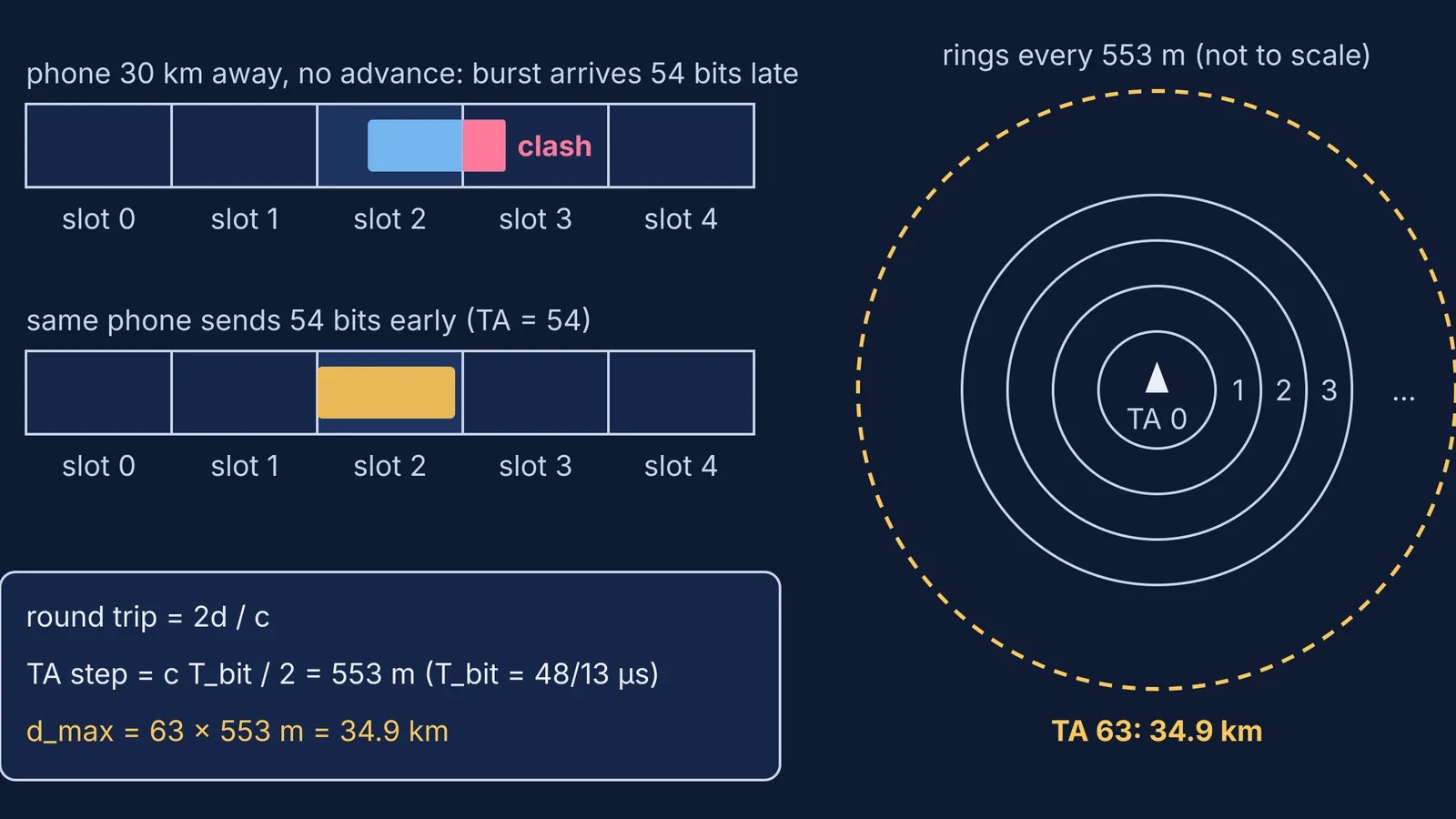
The tower expects each burst to arrive inside its own slot. If a burst arrives too late, its tail runs into the next phone's slot and both are damaged.
Why does a distant phone's burst arrive late?
A phone has no clock of its own that agrees with the tower's. It sets its timing from the signal it receives. That signal has already taken time d/c to reach the phone. The phone then transmits, and its burst takes another d/c to get back. So a phone at distance d is late by the round-trip time
t = 2d/c
For a phone 30 km away, t = 2 × 30,000 / (3.00 × 10⁸) = 200 µs. That is 200 / 3.69 = 54 bit periods, far more than the 8.25-bit guard period.
How far could a phone be before its delay used up the guard period alone? Set 2d/c = 30.5 µs, so d = c × 30.5 µs / 2 = 4.6 km. Without any correction, GSM cells could only be a few kilometres across.
What is timing advance?
The fix is to tell each phone to transmit early by exactly its round-trip delay. The tower measures how late the phone's burst arrives, rounds it to whole bit periods and sends the phone a number called the timing advance, TA. The phone then sends each burst TA bit periods early, so it lands on time at the tower. As the phone moves, the tower keeps updating TA.
TS 45.010 states that the timing advance runs from 0 to a maximum of 63 (clause 5.5). The field is 6 bits long, and 2⁶ − 1 = 63.
Worked example: the largest GSM cell
One bit period: T = 48/13 µs = 3.692 µs.
One step of TA corrects one bit period of round-trip delay. Since the round trip covers the distance twice, one step equals a distance of c T / 2 = 3.00 × 10⁸ × 3.692 × 10⁻⁶ / 2 = 553 m.
The largest advance is 63 steps: 63 × 553 m = 34,870 m = 34.9 km.
Check the units: (m/s) × s = m. At 35 km the round trip is 2 × 35,000 / (3.00 × 10⁸) = 233 µs, which is 63.2 bit periods, just past the limit. That is where the 35 km figure comes from.
How does a phone reach the tower before it has a timing advance?
The very first message a phone sends, asking for a channel, goes out before the tower has measured anything. GSM handles this with a shorter access burst that carries only 88 bits. TS 45.002 gives it an extended guard period of 68.25 bits, which is 252 µs. That covers a round trip to about 37.8 km, enough for the tower to measure the delay and send back the right TA.
Is 35 km a signal limit or a timing limit?
It is a timing limit. Over flat land or sea, a tall mast can deliver usable signal well beyond 35 km, but the tower cannot advance a phone's timing any further. Clause 5.5 of TS 45.010 notes two ways round it. The GSM 400 band supports an extended timing advance up to 219, which works out to 219 × 553 m = 121 km. Elsewhere, networks set up extended-range cells, which the standard leaves to 3GPP TR 43.030; the usual approach is for the tower to listen across two neighbouring slots, giving up one slot's capacity.
For newer networks, the limit is usually different. Higher frequencies lose signal faster, which is why 5G needs more towers than 4G. In LTE (4G), TS 36.213 lets the first timing advance go up to 1282 steps of 16 basic time units, where one unit is 1/(15,000 × 2,048) s. Each step is 0.52 µs, or c × 0.52 µs / 2 = 78 m, and 1282 steps reach 100 km. In practice an LTE cell runs out of signal strength long before that.
What does timing advance tell the network about a phone?
A TA value says only how far the phone is, to within one step of 553 m. It does not say in which direction. So it places the phone somewhere on a ring around the tower, about half a kilometre wide. A TA of 12, for example, means a radio path of roughly 6.4 to 6.9 km.
Even that ring is about the radio path, not the straight line. If the signal reaches the tower by bouncing off a hill or building, the path is longer than the direct distance, and the ring comes out too large.
You can see the same timing idea at work in sound echoes and radar. If you want to practise problems on wave speed and travel time, the Fermi Problem Library has a step-by-step solver that explains the reasoning, and the Concept Library covers electromagnetic waves from the start.
Quick checklist
GSM shares one channel among eight phones, each in its own 577 µs slot.
A phone at distance d is late by the round trip, 2d/c.
The guard period of 8.25 bits (30.5 µs) alone would cover only 4.6 km.
Each TA step is one bit period, 3.69 µs, which is c T/2 = 553 m of distance.
Maximum TA is 63, so an ordinary GSM cell reaches 34.9 km.
TA gives a ring about 553 m wide, measured along the radio path, not a point.