On this page
The NMC's NEET (UG) 2026 syllabus puts this chapter in Unit 5 (Human Physiology). Every rule and exception below comes from Chapter 16 of NCERT's Class 11 Biology textbook (Reprint 2026-27), with its section ("opening" means before 16.1). The 11 questions are our own, not past-paper items or predictions. Anything on kidney function here is a study summary of NCERT, not medical advice.
What are the NCERT exceptions in Excretory Products?
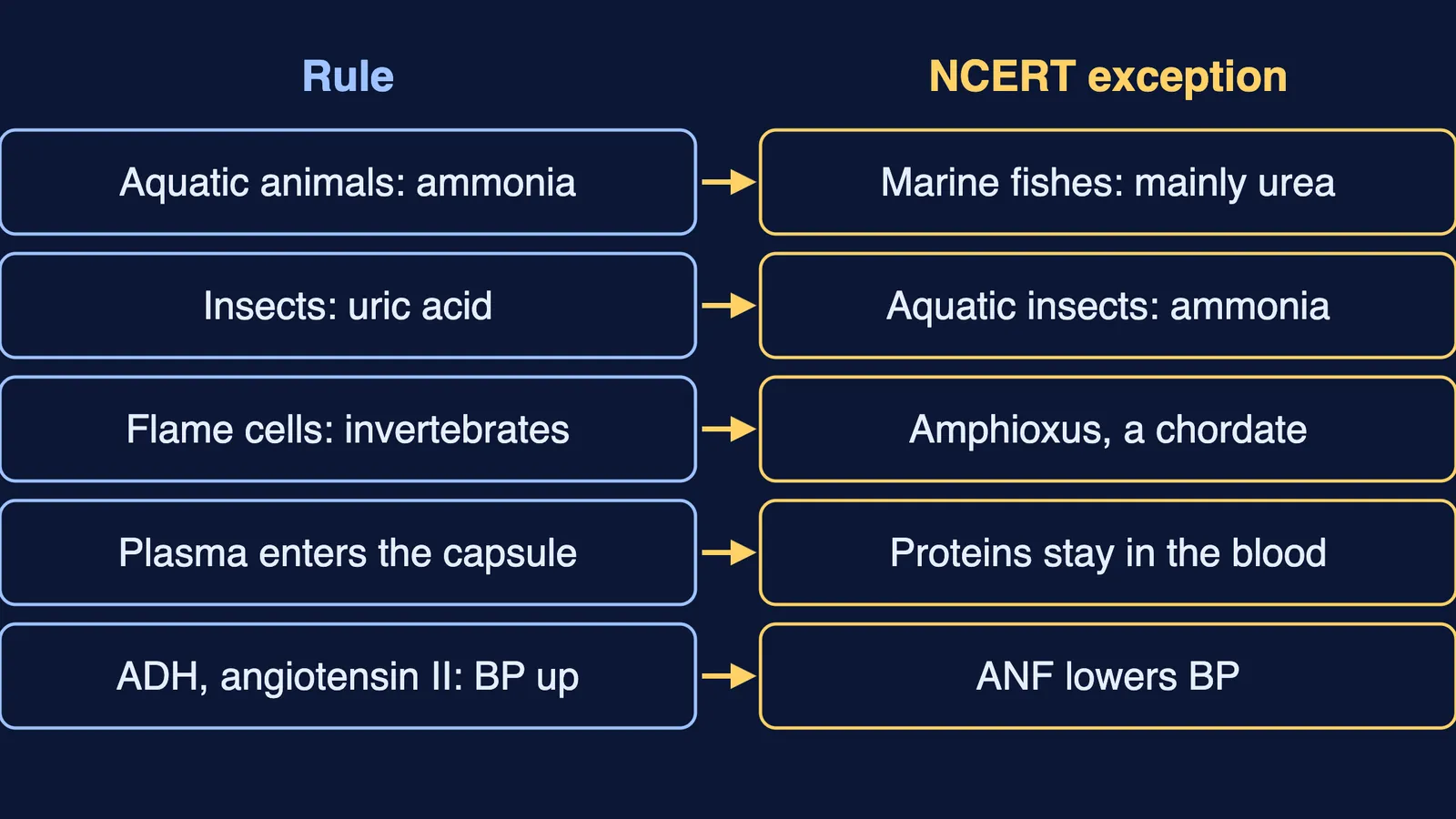
NCERT links the waste to water supply: aquatic animals such as many bony fishes are ammonotelic, and life on land brought urea and uric acid. Exception: marine fishes, though aquatic, mainly excrete urea (opening).
Insects are uricotelic, alongside reptiles, birds and land snails. Exception: aquatic insects are ammonotelic (opening).
In ureotelic animals, urea reaching the blood is filtered and excreted by the kidneys. Exception: some of these animals hold back a little urea in the kidney matrix to keep a desired osmolarity (opening).
Most invertebrates have simple tubular excretory structures; protonephridia are named for flatworms, rotifers and some annelids. Exception: *Amphioxus*, a cephalochordate, also has protonephridia (opening).
Nephridia are the excretory tubes of earthworms and other annelids. Exception: NCERT places some annelids among the animals with protonephridia (opening).
Almost every plasma constituent passes into Bowman's capsule. Exception: the proteins (16.2).
A U-shaped vasa recta runs alongside the loop of Henle. Exception: in cortical nephrons it is absent or highly reduced (16.1).
ADH, angiotensin II and aldosterone each push blood pressure and GFR up. Exception: ANF, released from the atria, widens blood vessels and lowers pressure, so it reins in the renin-angiotensin system (16.5).
How should you attack odd-one-out and exception items?
Find the basis the stem names: waste, structure, location or route. Score all four options on it. Then test a second feature, such as habitat or animal group, to make sure no other option stands alone; if one does, trust the basis the stem gives. For a "NOT an exception" stem, look for the option that simply follows its rule.
Odd-one-out questions
Q1. Judged by the excretory structure NCERT names for it, which is the odd one out? (1) *Amphioxus* (2) Humans (3) *Planaria* (4) A rotifer
Answer: (2). The other three have protonephridia (flame cells); humans have kidneys (opening, 16.1).
Q2. Judged by the main nitrogenous waste, which is the odd one out? (1) Mammals (2) Marine fishes (3) Aquatic amphibians (4) Many terrestrial amphibians
Answer: (3). The rest are ureotelic; aquatic amphibians are ammonotelic (opening).
Q3. Judged by whether blood is filtered through it on the way into Bowman's capsule, which is the odd one out? (1) Endothelium of the glomerular vessels (2) Basement membrane (3) Epithelium of Bowman's capsule (4) Brush border epithelium of the PCT
Answer: (4). Filtration crosses only the first three layers; the PCT lining works on the filtrate afterwards (16.2, 16.3).
Q4. Judged by the main nitrogenous waste, which is the odd one out? (1) Land snails (2) Aquatic insects (3) Many bony fishes (4) Aquatic amphibians
Answer: (1). Land snails are uricotelic; the other three are ammonotelic (opening).
Which is NOT an exception?
Q5. Which one is NOT an exception NCERT states? (1) Aquatic insects excreting ammonia (2) *Amphioxus* having protonephridia (3) Earthworms excreting through nephridia (4) Some annelids having protonephridia
Answer: (3). Nephridia in earthworms is the rule itself (opening).
Q6. Which rule-exception pair matches NCERT? (1) Vertebrates have kidneys; *Amphioxus* is a vertebrate with flame cells (2) Insects are uricotelic; aquatic insects are ammonotelic (3) Annelids have protonephridia; earthworms have nephridia (4) Crustaceans use Malpighian tubules; prawns use green glands
Answer: (2). *Amphioxus* is a cephalochordate, annelids generally have nephridia, and Malpighian tubules belong to insects (opening).
Two-statement questions
Codes for Q7 to Q11: (1) Both correct (2) Only I correct (3) Only II correct (4) Neither correct.
Q7. I: Not every annelid relies on nephridia; NCERT lists some with protonephridia. II: Antennal glands and green glands are two different organs of prawns.
Answer: (2). NCERT gives both names to one organ (opening).
Q8. I: The kidneys filter 1100-1200 mL of blood a minute, about one-tenth of what each ventricle pumps a minute. II: Glomerular capillary blood pressure drives filtration through the three layers.
Answer: (3). NCERT puts the share at roughly 1/5th (16.2).
Q9. I: NCERT names cooling the body surface as the primary function of sweat. II: Small amounts of nitrogenous wastes can also leave through saliva.
Answer: (1). Waste removal by sweat is secondary, and NCERT mentions saliva (16.7).
Q10. I: Most bile substances, such as bilirubin, leave the body in urine. II: Besides CO₂, the lungs remove significant quantities of water every day.
Answer: (3). Most bile substances pass out along with digestive wastes (16.7).
Q11. I: A rise in body fluid volume switches off the osmoreceptors and suppresses ADH release. II: Osmoreceptors respond to ionic concentration but not to blood volume.
Answer: (2). NCERT says changes in blood volume, body fluid volume or ionic concentration activate them (16.5).
What should you do with your misses?
Missed Q1, Q2, Q4, Q5, Q6 or Q7: rewrite the chapter opening's animal lists from memory. Missed Q3 or Q8: trace one millilitre of blood through the glomerulus. Missed Q9, Q10 or Q11: reread 16.5 and 16.7. For other formats, try our statement and match-the-list questions on excretion, the excretory products diagram-based questions or the assertion-reason questions on excretion.
Which exceptions keep slipping away? Fermi's AI tutor works out what you already know and builds a plan for the session.