On this page
Here are six assertion-reason items and four Statement I / Statement II pairs, each block running from easy to hard. Every statement was checked against Chapter 16 of NCERT Class 11 Biology (reprint 2026-27), and the chapter sits in Unit 5, Human Physiology, of the NMC NEET (UG)-2026 syllabus.
How do you answer assertion-reason questions on excretion?
Use these keys throughout.
Assertion-reason:
(A) Both A and R are true and R is the correct explanation of A.
(B) Both A and R are true but R is NOT the correct explanation of A.
(C) A is true but R is false.
(D) A is false but R is true.
Statement pairs:
(A) Both statements are correct.
(B) Both statements are incorrect.
(C) Statement I is correct, Statement II is incorrect.
(D) Statement I is incorrect, Statement II is correct.
Judge A alone, then R alone, and only if both are true ask, "Is R the reason NCERT gives for A?"
For the chapter itself, start with our Human Physiology for NEET guide and the worked walk-through of the nephron, GFR and counter-current.
Assertion-reason questions on excretory products
Q1 (easy). Assertion (A): Birds and reptiles get rid of their nitrogenous waste as a paste or pellet while losing very little water. Reason (R): Uric acid is the least toxic of the three major nitrogenous wastes.
Answer: (A). Both are true, and NCERT links them directly: these animals are uricotelic, and uric acid, being the least toxic, can be removed with minimum water loss. Trap: picking (B) because you half-remember solubility as the reason; NCERT's stated reason is low toxicity.
Q2 (easy). Assertion (A): In ammonotelic animals such as many bony fishes, kidneys play no significant role in removing ammonia. Reason (R): Ammonia is the least toxic nitrogenous waste, so it can be held in the body and released slowly.
Answer: (C). A is true: ammonia is readily soluble and diffuses out across body surfaces or gills as ammonium ions. R is false: ammonia is the most toxic form and needs much water to remove. Trap: carrying uric acid's "least toxic" label over to ammonia.
Q3 (medium). Assertion (A): Glomerular filtration is called ultrafiltration. Reason (R): Glomerular filtration takes place in the renal corpuscle, which lies in the cortex of the kidney.
Answer: (B). Both are true, but R only says where filtration happens. The name comes from how fine the filtration is: almost every plasma constituent except the proteins passes into Bowman's capsule. Trap: choosing (A) because both lines describe the same step.
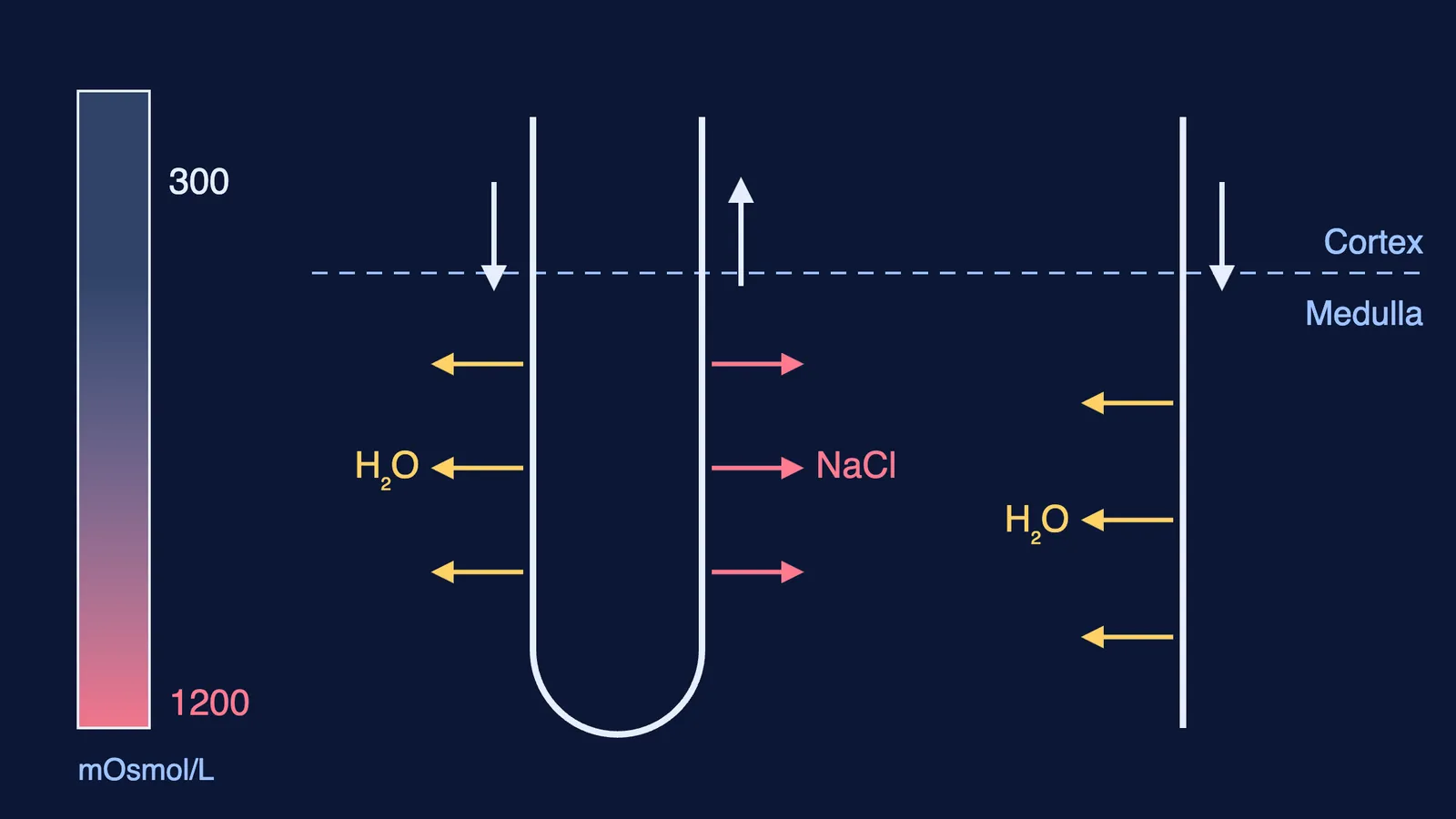
Q4 (medium). Assertion (A): The filtrate becomes more concentrated as it moves down the descending limb of Henle's loop. Reason (R): The descending limb is impermeable to water but allows electrolytes to be transported out.
Answer: (C). A is true. R describes the ascending limb; the descending limb is permeable to water and almost impermeable to electrolytes, so water leaves and the filtrate concentrates. Trap: swapping the two limbs, the most common slip in this chapter.
Q5 (hard). Assertion (A): Vasa recta is well developed in cortical nephrons. Reason (R): Vasa recta runs parallel to Henle's loop, and together they help keep up the rising osmolarity of the medullary interstitium.
Answer: (D). A is false: NCERT says vasa recta is absent or highly reduced in cortical nephrons. R is true; per NCERT section 16.4, the gradient runs from 300 mOsmol/L in the cortex to about 1200 mOsmol/L in the inner medulla. Trap: a clearly correct R pulls you into marking A true.
Q6 (hard). Assertion (A): Atrial natriuretic factor acts as a check on the renin-angiotensin mechanism. Reason (R): ANF causes dilation of blood vessels and so lowers blood pressure.
Answer: (A). Both are true, and R is NCERT's own reason. Angiotensin II constricts vessels to raise blood pressure; ANF does the opposite. Trap: choosing (B) because ANF comes from the heart, not the kidney.
Statement I and Statement II questions on excretion
Q7 (easy). Statement I: Each human kidney has nearly one million nephrons. Statement II: The Malpighian corpuscle, PCT and DCT lie in the cortex, while the loop of Henle dips into the medulla.
Answer: (A). Both match NCERT section 16.1. Trap: thinking the DCT lies in the medulla because it comes after the loop.
Q8 (medium). Statement I: GFR in a healthy person is about 125 mL per minute, roughly 180 litres a day. Statement II: Glucose and amino acids are reabsorbed passively, while nitrogenous wastes are reabsorbed actively.
Answer: (C). Statement I is correct (125 mL × 1,440 minutes = 180 litres). Statement II is reversed: glucose, amino acids and Na+ are reabsorbed actively, and nitrogenous wastes passively. Trap: reading only the nouns and not the adverbs.
Q9 (hard). Statement I: ADH is released from the adenohypophysis when excess fluid is lost from the body. Statement II: Angiotensin II stimulates the adrenal cortex to release aldosterone, which causes reabsorption of Na+ and water from the distal parts of the tubule.
Answer: (D). ADH is released from the neurohypophysis, not the adenohypophysis. Statement II is correct and part of the renin-angiotensin mechanism. Trap: the trigger in Statement I is right, so the wrong lobe slips past.
Q10 (hard). Statement I: In haemodialysis, the dialysing fluid contains nitrogenous wastes at the same concentration as plasma. Statement II: The collecting duct is impermeable to urea, so no urea reaches the medullary interstitium.
Answer: (B). Both are incorrect. The dialysing fluid matches plasma except that it lacks nitrogenous wastes, so they diffuse out of the blood. The collecting duct lets small amounts of urea into the medullary interstitium. Trap: "same as plasma" sounds right, and urea sounds like pure waste.
How should you use this set?
Do all ten in 12 minutes without notes, writing T or F above each line before choosing a key.
Score yourself, then sort every miss: a wrong fact (fix it in NCERT) or a wrong link (re-read the because test).
Redo the misses two days later, and write a new false version of each.
If a miss comes from a concept gap, such as which limb of Henle's loop lets water out, the Fermi Concept Library has every concept in biology with its own lesson. For more on the format, read our assertion-reason strategy.