On this page
In 1904 and 1905 the German chemist Carl Harries passed ozone into a solution of Pará rubber, broke the product down with water and looked for what came out. He found one volatile compound and nothing else: levulinaldehyde, CH₃COCH₂CH₂CHO, which you would name 4-oxopentanal. That single product told him how the isoprene units in rubber are joined to each other. It is the same "working back from the products" skill that Class 11 ozonolysis questions test, used on a real problem more than a century ago.
A note on sources: we read the English abstracts of Harries's papers printed in the Journal of the Chemical Society's Abstracts, not the original German papers in the Berichte. Quotes below are from those abstracts, and anything they do not say (such as yields) is left out.
Who was Carl Harries?
The Deutsche Biographie entry lists Carl (Karl Dietrich) Harries as a chemist born in Luckenwalde in 1866 who died in Berlin in 1923. It gives his roles as professor of chemistry at Kiel, head of the central office for scientific and technical research of the Siemens group, and president of the Deutsche Chemische Gesellschaft, the German Chemical Society.
His lasting contribution to the chemistry you study is ozonolysis as a tool for finding structures. Before you can use it on rubber, you need to know what ozone does to a C=C bond.
What did Harries find ozone does to a double bond?
The abstract of his 1904 paper (Ber. 37, 839), printed in J. Chem. Soc. Abstracts, vol. 86, part i, p. 361, says that in a dry solvent ozone "is added at the double linking, forming ozonides". It goes on: "In the presence of water, these ozonides are decomposed, forming ketones or aldehydes and hydrogen peroxide."
In modern symbols, for one double bond:
R₂C=CR'₂ + O₃ → ozonide
ozonide + H₂O → R₂C=O + R'₂C=O + H₂O₂
Check the overall change: O is 3 + 1 = 4 on the left and 1 + 1 + 2 = 4 on the right; H is 2 on each side. The same abstract warns that "the ozonides are mostly highly explosive". Ozone itself is a toxic gas. This post is history and structure reasoning only, not a method to try.
Notice the H₂O₂. It is an oxidising agent, so it can turn the aldehyde products into carboxylic acids. That is exactly why your textbook adds zinc in the work-up: Zn removes the peroxide and the aldehydes survive. Harries ran into this problem, as you will see next.
What did ozonolysis of rubber give?
The 1904 rubber paper (Ber. 37, 2708, abstracted on pp. 757–758 of the same volume) reports a glassy ozonide of composition (C₁₀H₁₆O₆)ₙ. Boiled briefly with water, it gave hydrogen peroxide and a keto-aldehyde. Boiled longer, "the hydrogen peroxide oxidises the aldehydes", and levulic (levulinic) acid was isolated. The abstract adds: "Oxalic acid is not formed."
The 1905 paper (Ber. 38, 1195, abstracted in vol. 88, part i, p. 364) settled the product. Steam distillation of the ozonide with water gave "levulic aldehyde". Harries identified it by several tests: it reduced Fehling's solution, gave a pyrrole reaction, and formed the same phenylhydrazine derivative and dioxime as an authentic sample. The key sentence: "No other volatile aldehydes or ketones result as products of the decomposition of the ozonide."
Two quick checks show the numbers fit:
The ozonide. C₁₀H₁₆O₆ = 2 C₅H₈ + 2 O₃. Molar masses: 2 × 68.12 + 2 × 48.00 = 232.23 g/mol, the same as C₁₀H₁₆O₆. So there is one O₃ per C₅H₈ unit, meaning one C=C per isoprene unit.
The acid. CH₃COCH₂CH₂CHO + H₂O₂ → CH₃COCH₂CH₂COOH + H₂O. Both sides contain C₅H₁₀O₄, so it balances.
How does one product prove head-to-tail joining?
This is the worked example. It uses the forward rule from ozonolysis of alkenes: working back to the starting structure: cut every C=C and put =O on each carbon that was in it.
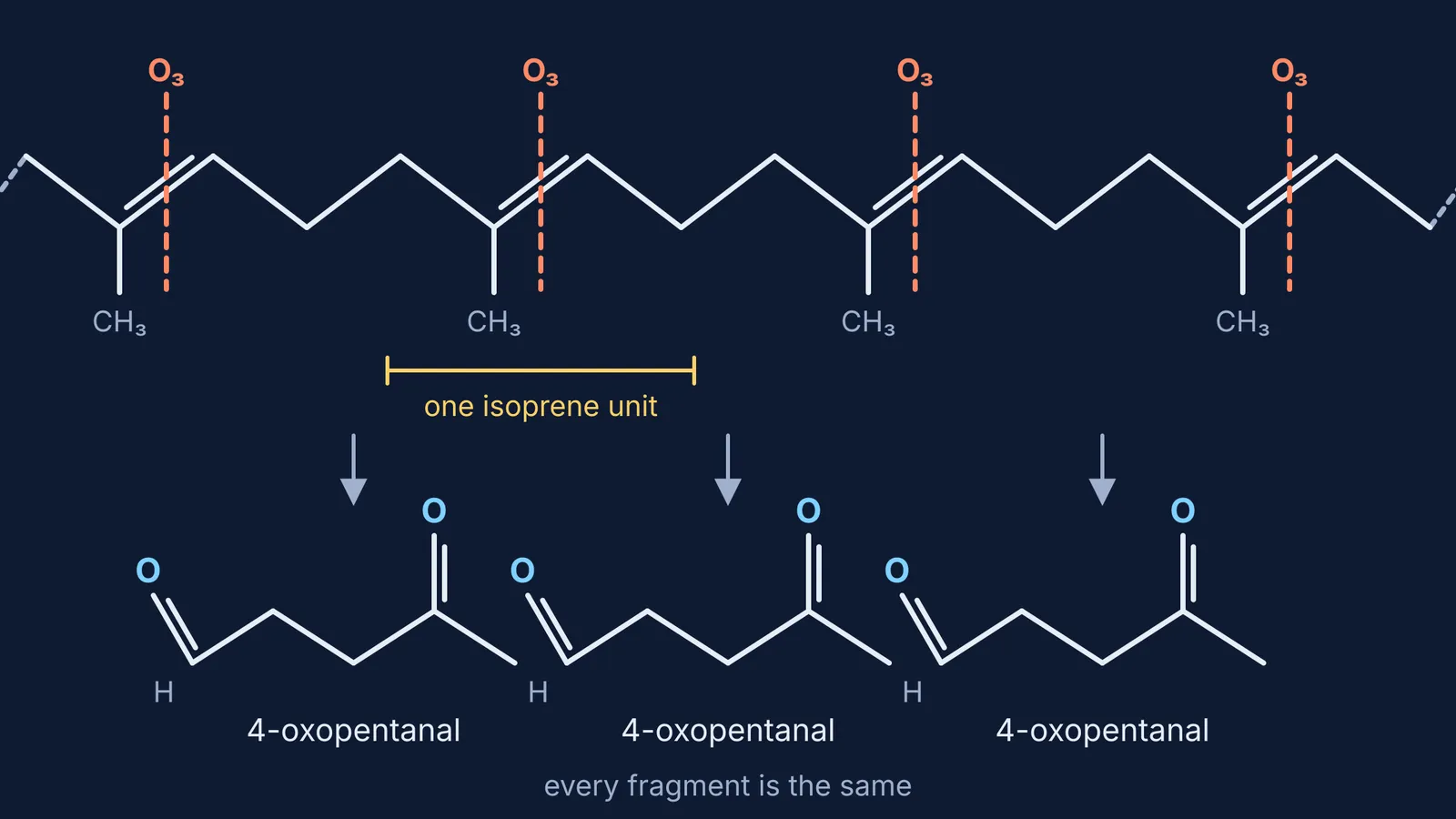
Number isoprene. CH₂=C(CH₃)–CH=CH₂, carbons C1 to C4, with the methyl on C2. In 1,4-addition C1 and C4 link to neighbours and a new C=C forms between C2 and C3. The repeat unit is –CH₂–C(CH₃)=CH–CH₂–.
Join head to tail. C4 of one unit bonds to C1 of the next: –CH₂–C(CH₃)=CH–CH₂–CH₂–C(CH₃)=CH–CH₂–CH₂–C(CH₃)=CH–CH₂–
Cut every C=C. Each piece runs from C3 of one unit to C2 of the next: O=CH–CH₂–CH₂–C(=O)–CH₃. Every piece is identical: 4-oxopentanal, C₅H₈O₂ (100.12 g/mol). One product only, as Harries found.
Test the alternative. Suppose units alternate head-to-head and tail-to-tail. A C4–C4 link gives OHC–CH₂–CH₂–CHO (butanedial), and a C1–C1 link gives CH₃CO–CH₂–CH₂–COCH₃ (hexane-2,5-dione). Two products, and no 4-oxopentanal at all.
Notice what mass cannot tell you. C₄H₆O₂ + C₆H₁₀O₂ = C₁₀H₁₆O₄ = 2 × C₅H₈O₂. Both chains give the same total mass of products. Only the identity of the products tells them apart, which is why Harries's identification tests mattered.
Bookkeeping. 1.000 kg of rubber is 1000 ÷ 68.12 = 14.68 mol of C₅H₈ units. At most that gives 14.68 × 100.12 g = 1.47 kg of 4-oxopentanal. The abstracts give no yields, so treat this only as the theoretical ceiling.
Where did Harries go wrong?
His products were right. His model was not. The 1905 abstract states: "Caoutchouc is a cyclic compound", and provisionally gives it a ring formula built from two isoprene units, an eight-carbon ring carrying two methyl groups and two C=C bonds (a dimethylcyclooctadiene).
Run the same cut on 1,5-dimethylcycloocta-1,5-diene, C₁₀H₁₆. It has two C=C bonds. Cutting both gives two pieces, and each piece is OHC–CH₂–CH₂–CO–CH₃. So the small ring also gives only 4-oxopentanal. A ring of two units and a chain of thousands give the same product.
That is the limit of the method. Ozonolysis shows the pattern between neighbouring double bonds, but not how long the molecule is. In a very long chain the two end groups are a tiny fraction of the material, so their products go unnoticed. The idea of rubber as one giant chain, a macromolecule, came later with Hermann Staudinger. Today NCERT describes natural rubber as cis-1,4-polyisoprene. The cis part comes from other evidence, as explained in natural rubber vs gutta-percha: gutta-percha, the trans polymer, would give the same ozonolysis product.
Knowing the head-to-tail pattern also helped later chemists who tried to make rubber in a factory, a story told in Sergei Lebedev and synthetic rubber from butadiene.
What can you take from Harries's work?
Identify, don't assume. He confirmed levulinaldehyde with several independent tests before drawing a conclusion.
A missing product is evidence too. "No other volatile aldehydes or ketones" ruled out mixed joining.
Separate data from model. The product data survived; the ring interpretation did not.
If you can cut a chain forwards but lose track when working back to a structure, the Fermi Problem Library has worked problems with a step-by-step solver that explains the reasoning.
Quick checklist
O₃ adds to C=C to give an ozonide; water splits it into C=O compounds and H₂O₂.
Without Zn, H₂O₂ oxidises aldehydes to acids, as levulinaldehyde became levulinic acid.
Head-to-tail polyisoprene gives only 4-oxopentanal; alternating joining gives butanedial and hexane-2,5-dione.
Ozonolysis shows the repeat pattern, not chain length or cis/trans geometry.
Harries's product was right; his ring model was replaced by the long-chain macromolecule.