On this page
Kashmir saffron is priced largely on its colour, and the colour grade is a number you can work out with Class 12 chemistry. A lab soaks a weighed sample in water, dilutes it, puts it in a 1 cm cell and reads the absorbance at about 440 nm. The result, the colouring strength E¹%₁cm, is the Beer–Lambert law with the concentration fixed at 1 g per 100 mL. Below: the test, a worked grading, and a twist: a cis isomer of the colour molecule also absorbs where aroma is read.
How is saffron graded under ISO 3632?
India's saffron is grown only in Jammu and Kashmir, and production there fell from 15.95 t in 1997 to 9.6 t in 2015, according to a 2025 Scientific Reports study on saffron trials in Sikkim. The grade is set by the international standard ISO 3632. Its test-method part (1993 edition) is reproduced word for word by the Bureau of Indian Standards as IS 5453 (Part 2):1996. It defines three properties, each read as the absorbance at a peak:
Colouring strength, "mainly due to its crocine content", at about 440 nm.
Bitterness, mainly from picrocrocin, at about 257 nm.
Flavour (aroma), mainly from safranal, at about 330 nm.
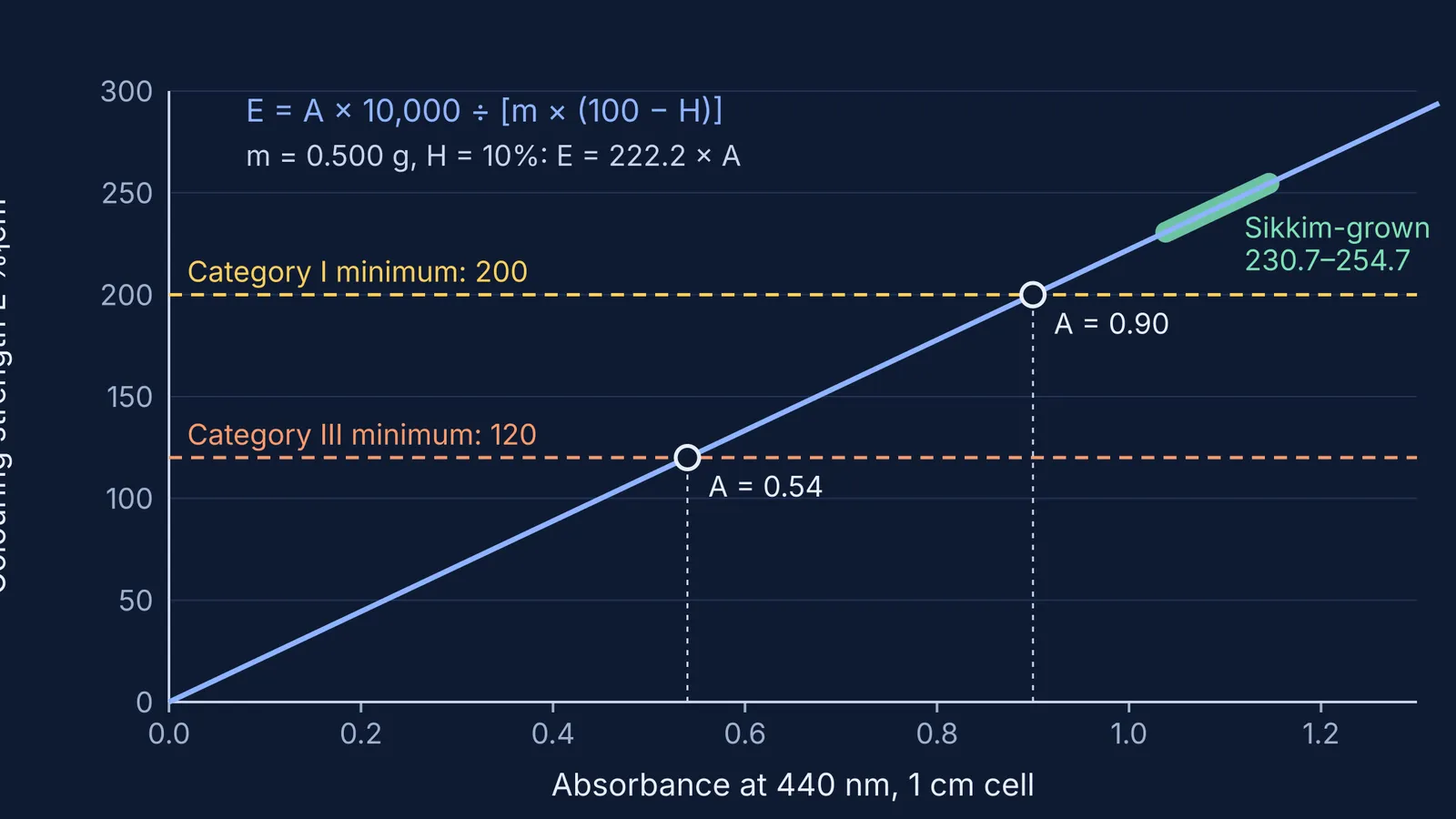
A 2022 review in Foods gives the colour cut-offs: Category I needs a colouring strength of at least 200, and Category III at least 120. In the Sikkim study, samples were tested at the quality lab of the India International Kashmir Saffron Trading Centre (IIKSTC) in Pampore, following ISO 3632-2:2010.
For why saffron costs so much in the first place (hand-picked stigmas, drying), see the biology behind saffron's price.
Why is saffron's colour measured at 440 nm?
The colour comes from crocin. PubChem's crocin record gives C₄₄H₆₄O₂₄, 977.0 g/mol. It is crocetin (C₂₀H₂₄O₄) joined at each end, as an ester, to gentiobiose, a disaccharide (C₁₂H₂₂O₁₁). Check the formula: C₂₀H₂₄O₄ + 2 C₁₂H₂₂O₁₁ − 2 H₂O = C₄₄H₆₄O₂₄. The sugars make crocin water-soluble, so the ISO test can use plain water.
PubChem names crocetin (2E,4E,6E,8E,10E,12E,14E)-2,6,11,15-tetramethylhexadeca-2,4,6,8,10,12,14-heptaenedioic acid. That is seven C=C bonds in a row, all E, with a C=O at each end: nine conjugated double bonds. Its double bond equivalent, (2 × 20 + 2 − 24) ÷ 2 = 9, agrees.
The longer the conjugated chain, the smaller the gap between the π and π* orbitals, and the longer the wavelength absorbed. Crocetin's chain is long enough to absorb in the visible, in the blue near 440 nm, so you see the complementary colour, yellow-orange.
What does E¹%₁cm mean, and how is it related to A = εcl?
Beer–Lambert says A = εcl, with c in mol/L. Saffron holds a family of crocins, so no single molar concentration exists. Analysts use a mass basis instead: E¹%₁cm is the absorbance of a 1% solution (1 g per 100 mL) in a 1 cm cell. Since A is proportional to c, you measure a dilute solution and scale up:
E¹%₁cm = A ÷ (concentration in g per 100 mL)
For a pure compound, 1 g per 100 mL is 10 g/L, or 10/M mol/L, so ε = E¹%₁cm × M ÷ 10.
IS 5453 (Part 2) spells out the dilution:
Weigh exactly 500 mg of powdered sample into a 1000 mL volumetric flask with about 900 mL of distilled water.
Stir for 1 hour, away from light, then make up to the mark.
Pipette 20 mL into a 200 mL flask and make up to the mark.
Filter quickly, away from light, through a 0.45 µm membrane, and record the spectrum from 220 to 480 nm in a 1 cm silica cell against water.
So the cell holds 0.500 g/L × 20/200 = 0.0500 g/L, which is 0.00500 g per 100 mL. Results are reported on dry matter, so multiply by (100 − H)/100, where H is the % moisture. Put together, E¹%₁cm = A × 10,000 ÷ [m × (100 − H)], with m in grams. That is the Foods review's equation, reproduced from the dilution.
To see a straight line form as concentration changes, try the predictions in our colorimeter simulation guide, or open the Simulation Lab, which has interactive simulations for ideas that are easier to see than read.
Worked example: does this sample make Category I?
Question. 0.500 g of saffron with 10% moisture is extracted and diluted as above. The absorbance at 440 nm is 0.90. What is its colouring strength, and does it meet Category I?
Concentration as weighed. 0.500 g in 1000 mL, then 20 → 200 mL: 0.00500 g per 100 mL.
Dry basis. 0.00500 × 90/100 = 0.00450 g per 100 mL.
Colouring strength. E¹%₁cm = 0.90 ÷ 0.00450 = 200. The formula gives the same: 0.90 × 10,000 ÷ (0.500 × 90) = 200.0.
Grade. Category I needs at least 200, so this sample just makes it.
The Category III line. E = 120 needs A = 120 × 0.00450 = 0.54. Below that, the sample misses Category III.
Why dilute tenfold? Undiluted, the sample would read A = 9.0, far too dark to measure. At A = 0.90, T = 10^(−0.90) ≈ 12.6%.
Real samples. Sikkim-grown stigmas (Kashmir corms) read 230.71 to 254.65 in year one at IIKSTC, all Grade 1. With our m and H, that range would be A ≈ 1.04 to 1.15.
Storage. The Foods review says colouring strength "decreases by nearly 30 to 40 units per year". A sample at 230 would drop to 200 in about 30 ÷ 40 = 0.75 to 30 ÷ 30 = 1 year.
The rule to carry into the exam: E¹%₁cm is the absorbance divided by the concentration in g per 100 mL (1 cm path), and ε = E¹%₁cm × M ÷ 10.
Why can a cis isomer fake the aroma reading?
Each C=C in crocetin could in principle be E or Z, and saffron contains both trans- and cis-crocins. A 2023 review in Food Chemistry: X notes that both kinds absorb around 440 nm with a second band at 260–264 nm, and that "the cis-crocins exhibit an extra peak at 326–327 nm". The Foods review puts this third band at 328 nm.
That band sits almost on top of 330 nm, where safranal is read. The spectrophotometer cannot tell which molecule absorbed the light: absorbances simply add, A = ε₁c₁l + ε₂c₂l. So a sample richer in cis-crocins shows a higher "flavour" number than its safranal alone would give. The Foods review reports that studies comparing ISO 3632 with HPLC found safranal overestimated because of cis-crocetin esters.
If you want more spectrophotometry numericals, the Fermi Problem Library has a step-by-step solver that explains the reasoning. For how the law itself was found, read how August Beer linked absorption to concentration.
Quick checklist
ISO 3632 reads saffron extracts at about 257 nm (picrocrocin), 330 nm (safranal) and 440 nm (crocin).
Dilution: 500 mg in 1000 mL, then 20 mL to 200 mL, giving 0.00500 g per 100 mL.
E¹%₁cm = A × 10,000 ÷ [m × (100 − H)]; for 0.500 g and 10% moisture, A = 0.90 gives 200 (Category I) and A = 0.54 gives 120 (Category III).
Crocin, C₄₄H₆₄O₂₄, is crocetin (seven conjugated all-E C=C plus two C=O) with two gentiobiose esters; it absorbs blue and looks yellow-orange.
cis-Crocins add a band at 326–328 nm, which inflates the 330 nm safranal reading.