

On this page
Saffron, vanilla and cardamom are among the most expensive spices in an Indian kitchen. India's spice research institute calls small cardamom the world's third most expensive spice, after saffron and vanilla (ICAR-Indian Institute of Spices Research). The reason is mostly biology. In each one, the part we eat is small, hard to reach or slow to develop, and much of the work is still done by hand. Their flavour also has to be made or protected after harvest, through drying or curing.
Why is saffron so expensive?
Saffron is the dried stigma of the *Crocus sativus* flower, and each flower has three stigmas (Pharmacognosy Reviews, 2010). The stigma is the tip of the female part of the flower, where pollen lands.
The plant cannot spread by seed. Saffron flowers are sterile, so farmers propagate them by planting corms, the bulb-like stems that grow underground (Foods, 2022).
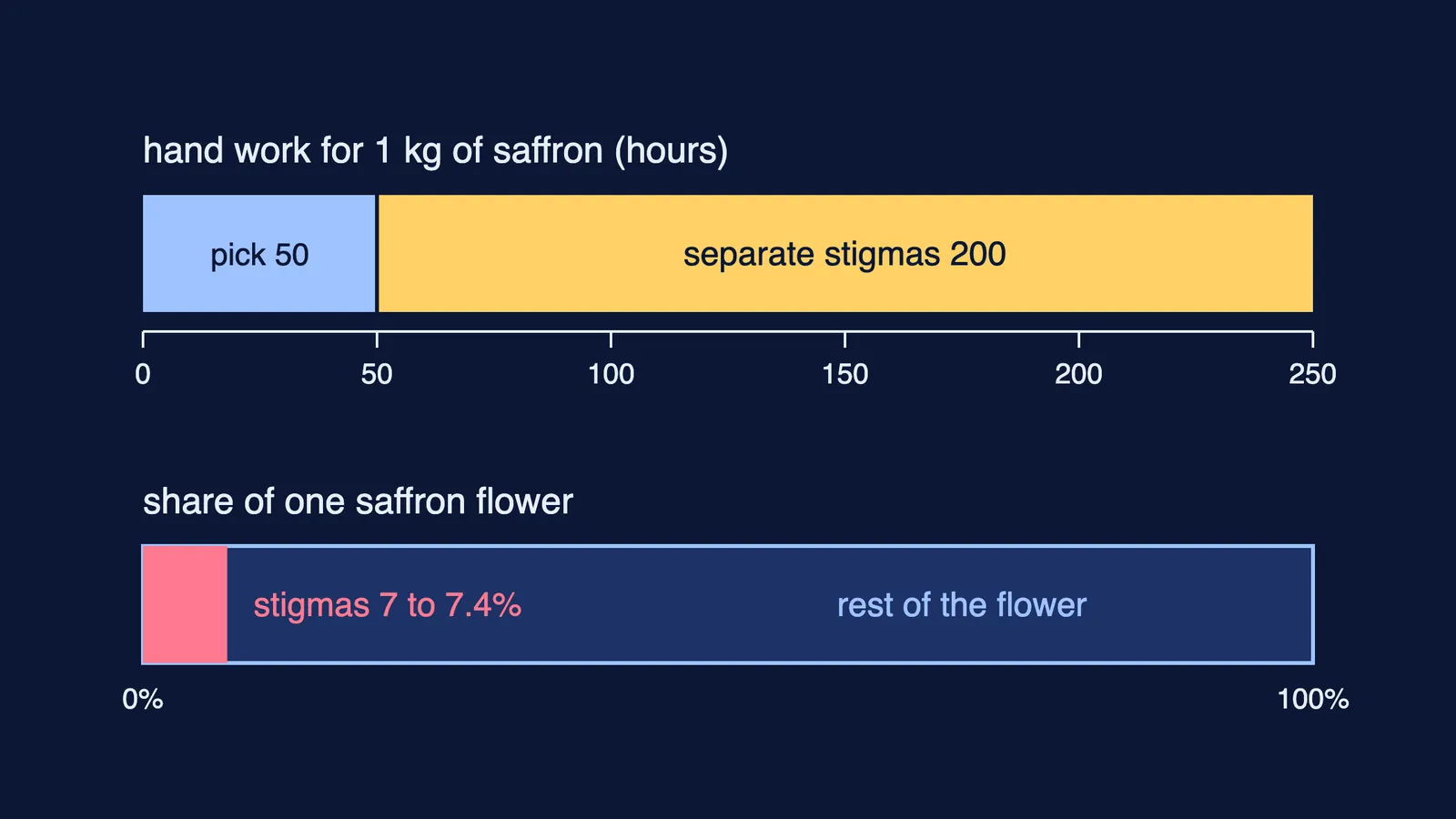
The same review gives the key numbers. One kilogram of dry saffron needs between 110,000 and 165,000 flowers. That means about 50 hours of picking flowers plus 200 hours of peeling out stigmas. The stigma is only 7 to 7.4% of the flower, so most of what is picked is thrown away.
There is little time to do it. The saffron blooming period lasts about a month in autumn (CSA News, 2024).
Which molecules give saffron its colour, taste and smell?
Three molecules do most of the work: crocin gives the colour, picrocrocin the bitter taste, and safranal the aroma (Pharmacognosy Reviews, 2010).
Safranal is absent before drying. One proposed route is that the enzyme β-glucosidase, helped by heat, converts picrocrocin into safranal as the stigmas dry (Foods, 2022). So drying is not just preservation; it is where the smell is made. For a different aroma molecule, see our post on why basmati rice smells special.
Why does vanilla have to be pollinated by hand?
Vanilla flowers open in the early morning and, for most varieties, are viable for only a day (UF/IFAS Extension, 2025). A flap called the rostellum sits between the stigma and the pollinia, the packets of pollen, and stops the flower from pollinating itself. Because effective natural pollinators are lacking, growers pollinate each flower by hand. The pods then need 7 to 8 months to mature, and curing adds blanching in hot water, 2 to 3 days of sweating at 45 to 50 °C, 2 to 4 weeks of slow drying, and weeks or months of conditioning.
The hand method has a history. In 1841, Edmond Albius, a 12-year-old enslaved boy on the island of Réunion, lifted the rostellum with a thin stick or blade and crushed the pollen and stigma together with his thumbs (New York Botanical Garden). Some plants rely on one specialist partner instead, like the yucca and its moth.
Curing also makes the flavour. Fresh beans hold glucovanillin, a vanillin molecule bound to a sugar. During curing, a β-glucosidase enzyme splits it, and a 2015 study found that bacteria living on the beans, mainly *Bacillus*, help supply that enzyme (Applied and Environmental Microbiology, 2015).
Why is cardamom costly to harvest?
Small cardamom, *Elettaria cardamomum*, is native to the evergreen forests of the Western Ghats and is called the queen of spices (ICAR-Indian Institute of Spices Research). The institute lists 1,8-cineole as its major volatile oil component and alpha-terpinyl acetate as its characteristic aroma.
A government training manual explains the work (NIFTEM, Ministry of Food Processing Industries). The flowering shoots grow from the base of the plant, flowering runs from April to August, and fruit takes up to 120 days to mature after flowering. Harvesting starts in August or September and continues into February or March, so pickers take capsules as they mature, over months. A healthy plant gives about 2,000 capsules a year, weighing about 900 g. Drying must stay below 50 °C to protect colour and flavour, taking moisture from about 85% down to 10%.
If terms like stigma and capsule are hazy, the Fermi Concept Library has every concept in biology and chemistry, each with its own lesson.
How much work is in one gram of saffron?
Here is a quick estimate for a 1 g packet, using the figures from Foods, 2022 above.
Flowers: 110,000 to 165,000 per kilogram is 110 to 165 flowers per gram.
Stigmas: three per flower gives 330 to 495 stigmas.
Hand work: 250 hours per kilogram is 250 × 60 ÷ 1,000 = 15 minutes per gram.
Multiply 15 minutes by a farm wage you know, and you see why the price is high before transport, grading or profit.
Saffron trips the first, third and fifth, vanilla the second and fifth, cardamom the fourth. These spices were valuable long before modern farms; our post on the spice route and monsoon winds shows how traders carried them across the sea.


