On this page
On 7 January 1862, Marcellin Berthelot and L. Péan de Saint-Gilles weighed out acetic acid and alcohol in matching amounts, mixed them and left the flask in a cellar. Months later the reaction was still creeping forward. Their bigger result came from running the reaction both ways: acid plus alcohol stopped at about two-thirds ester, and ester plus water stopped at the same point from the other side. That two-sided test is the experimental core of chemical equilibrium, and Guldberg and Waage used these numbers to check their law of mass action.
Quotes are from their paper in the Annales de chimie et de physique, 3rd series, volume 66 (1862), pages 5 onwards, which you can read as a scan on the Internet Archive. It is in French; the translations are ours. In 1862 French, "éther" meant what we call an ester.
Who were Berthelot and Péan de Saint-Gilles?
Berthelot is the chemist who made organic compounds from the elements and later built the bomb calorimeter, covered in how Marcellin Berthelot built the bomb calorimeter. His co-author signed as L. Péan de Saint-Gilles. We could not confirm his dates from a source we read, so we leave them out.
The paper is part two of their "Recherches sur les affinités"; part one appeared in volume 65.
What were their three rules of esterification?
The paper opens with three "essential phenomena" of an acid combining with an alcohol:
"The combination takes place slowly and progressively, with a speed that depends on the influences to which the system is subjected; it is never immediate."
"The combination is never complete, whatever the duration of contact."
"The proportion of neutral ester formed under defined conditions tends towards a fixed limit."
Then the key line: "These three phenomena are observed equally in the decomposition of neutral esters by water, that is, in the reverse reaction."
In today's equations, for the two systems they used most:
CH₃COOH + C₂H₅OH ⇌ CH₃COOC₂H₅ + H₂O
C₆H₅COOH + C₂H₅OH ⇌ C₆H₅COOC₂H₅ + H₂O
Both balance: the benzoic system has C₉H₁₂O₃ on each side.
How slow was the cellar experiment?
They weighed 241.4 g of acetic acid and 185.0 g of alcohol, which they called "equivalent weights". In moles that is 241.4 ÷ 60.05 = 4.02 mol of acid and 185.0 ÷ 46.07 = 4.02 mol of ethanol, a 1 : 1 mixture. The cellar stayed between 6 and 9 °C.
Their table gives the percentage of acid turned into ester: 0.9% after 1 day, 7.3% after 8 days, 16.2% after 34 days, 26.0% after 72 days and 30.0% after 95 days. A similar mixture kept at ordinary temperature for 277 days reached only 53.7%.
Heat speeds it up. At 100 °C, 150 hours gave 65.0%. They wrote: "Five hours at 180° are enough to reach the same point as 150 hours at 100°, and to go further than a year at ordinary temperature." Yet the end point hardly moved: around 66.5% at the highest temperatures, which they called "the limit of stable equilibrium".
What happened when they started from the ester?
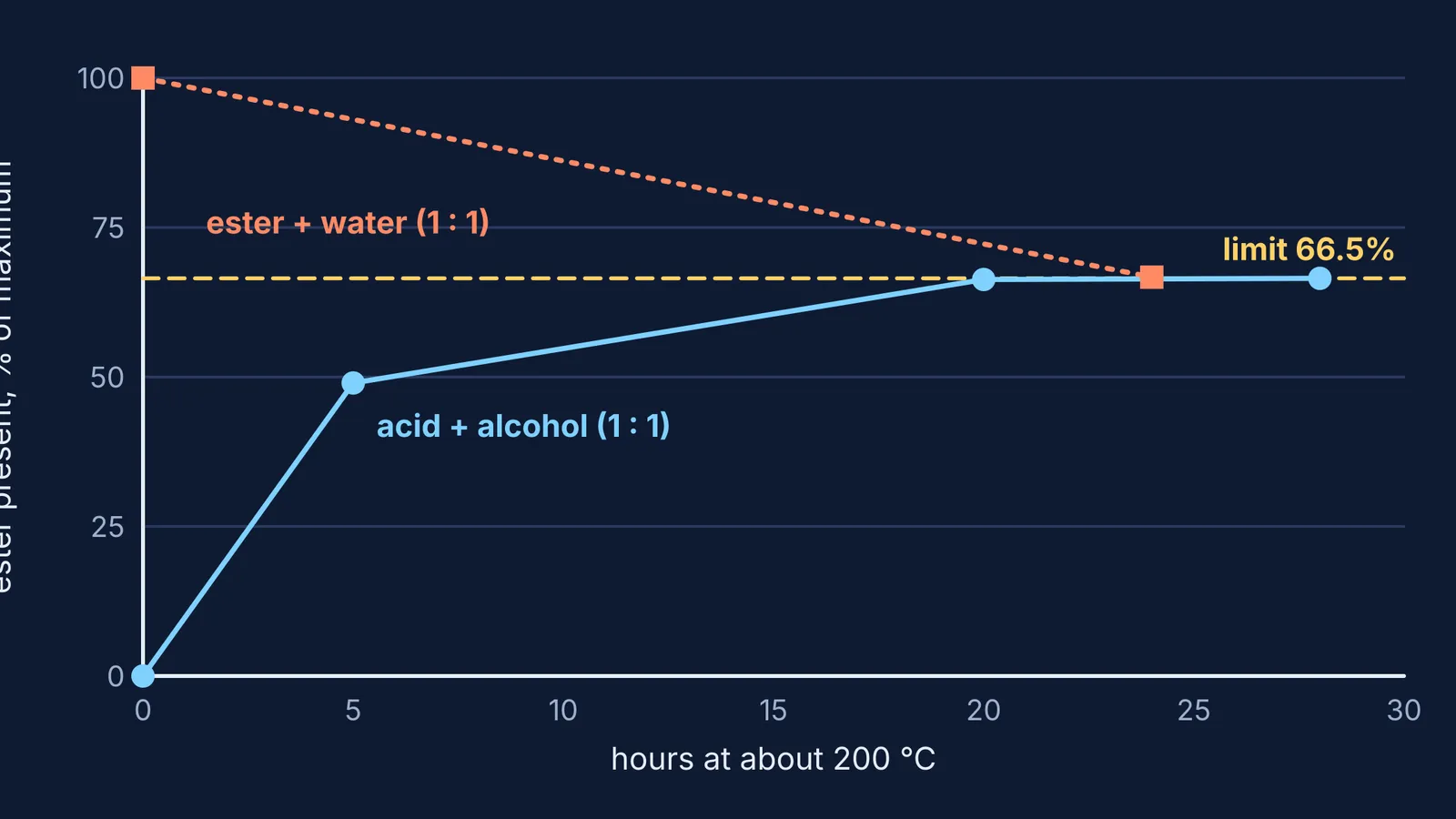
They used benzoic acid at about 200 °C, where the reaction is fast enough to finish. From the acid side, 1 equivalent of alcohol and 1 of benzoic acid gave 49.0% ester after 5 hours, 66.3% after 20 hours and 66.5% after 28 hours.
From the ester side, ethyl benzoate with "2 equivalents of water" was 33.3% decomposed after 24 hours. They wrote that "this number cannot be appreciably exceeded", because the most acid that can stay free in the forward experiment is 100 − 66.5 = 33.5. The two experiments end at the same mixture from opposite directions.
Watch the old units. They wrote water as "HO" in a system where O = 8, so 2 HO is 2 × 9 = 18 g, one modern mole of H₂O. So the reverse run was 1 mol ester + 1 mol water, the exact mirror of 1 mol acid + 1 mol alcohol.
They also tried more water. With 6 equivalents (3 mol), 54.6% of the ester was decomposed after 20 hours. With 166 equivalents (83 mol), it reached 88.8% and "this last figure was not exceeded".
Worked example: K from the limit, tested from both sides
Use the benzoic acid data at about 200 °C. The volume cancels because there are two concentration terms on each side.
K from the forward limit. Start with 1 mol acid and 1 mol alcohol; 0.665 mol react. K = (0.665 × 0.665) ÷ (0.335 × 0.335) = 3.94.
Predict the reverse run. Start with 1 mol ester and 1 mol water; let y mol hydrolyse. Then y² ÷ (1 − y)² = 1 ÷ 3.94, so y ÷ (1 − y) = 0.504 and y = 0.335. Predicted 33.5% against their 33.3%.
K from the reverse side. 66.7% ester left gives K = 0.667² ÷ 0.333² = 4.01. Both directions give K close to 4.
Predict the 3 mol water run. 3.94 y² = (1 − y)(3 − y), which becomes 2.94y² + 4y − 3 = 0. The positive root is y = 0.538, so 53.8% predicted against 54.6% observed.
Check the 83 mol water run. The same method predicts 95.6%, but they measured 88.8%. Guldberg and Waage noticed this kind of gap: calculated values do not agree exactly, "especially for systems that contain a lot of ester or water", because ester and water do not mix into one phase and their active masses are uncertain.
Use Q on the slow run. After 277 days at room temperature, 53.7% ester gives Q = 0.537² ÷ 0.463² = 1.35. Q is less than K, so the mixture was still moving forward.
For the mechanism and excess-alcohol yields, see Fischer esterification: mechanism and how to push the equilibrium.
Did they discover the equilibrium constant?
No. They measured limits and rates but did not write a constant. That step came from Cato Guldberg and Peter Waage in Christiania. In their 1867 Études sur les affinités chimiques they wrote: "The excellent work of MM. Berthelot and Péan de Saint-Gilles provides us with numerous quantitative experiments that can give an interesting proof of the probability of our theory." They quoted the three rules word for word. You can read how their law grew in Guldberg and Waage: how the law of mass action began.
Guldberg and Waage also read the data as saying the limit "is independent of temperature". That is close but not exact: 65.0% at 100 °C and about 66.5% near 200 °C. Temperature changed the rate by a huge factor and the limit only slightly, which fits a reaction with a small ΔH.
For Q-versus-K and ICE-table practice in JEE style, Fermi Test Prep is JEE Main and Advanced preparation with an AI tutor.
Quick checklist
Esterification is slow, never complete, and tends to a fixed limit, in both directions.
1 : 1 acid and alcohol stops near 66.5% ester; 1 : 1 ester and water stops near 33.3% hydrolysed.
In 1862 notation, 2 HO is one H₂O.
K ≈ 4 from either side; excess water pushes hydrolysis further.
Q less than K means the reaction has not finished, however long it has run.
Berthelot and Péan de Saint-Gilles gave the data; Guldberg and Waage gave the constant.