On this page
These pairs and questions follow NCERT Class 11 Biology, Chapter 15, Body Fluids and Circulation (Reprint 2026-27), which the NEET (UG) 2026 syllabus places in Unit 5, Human Physiology. No question is a past-paper item or a prediction.
What are the NCERT exceptions in Body Fluids and Circulation?
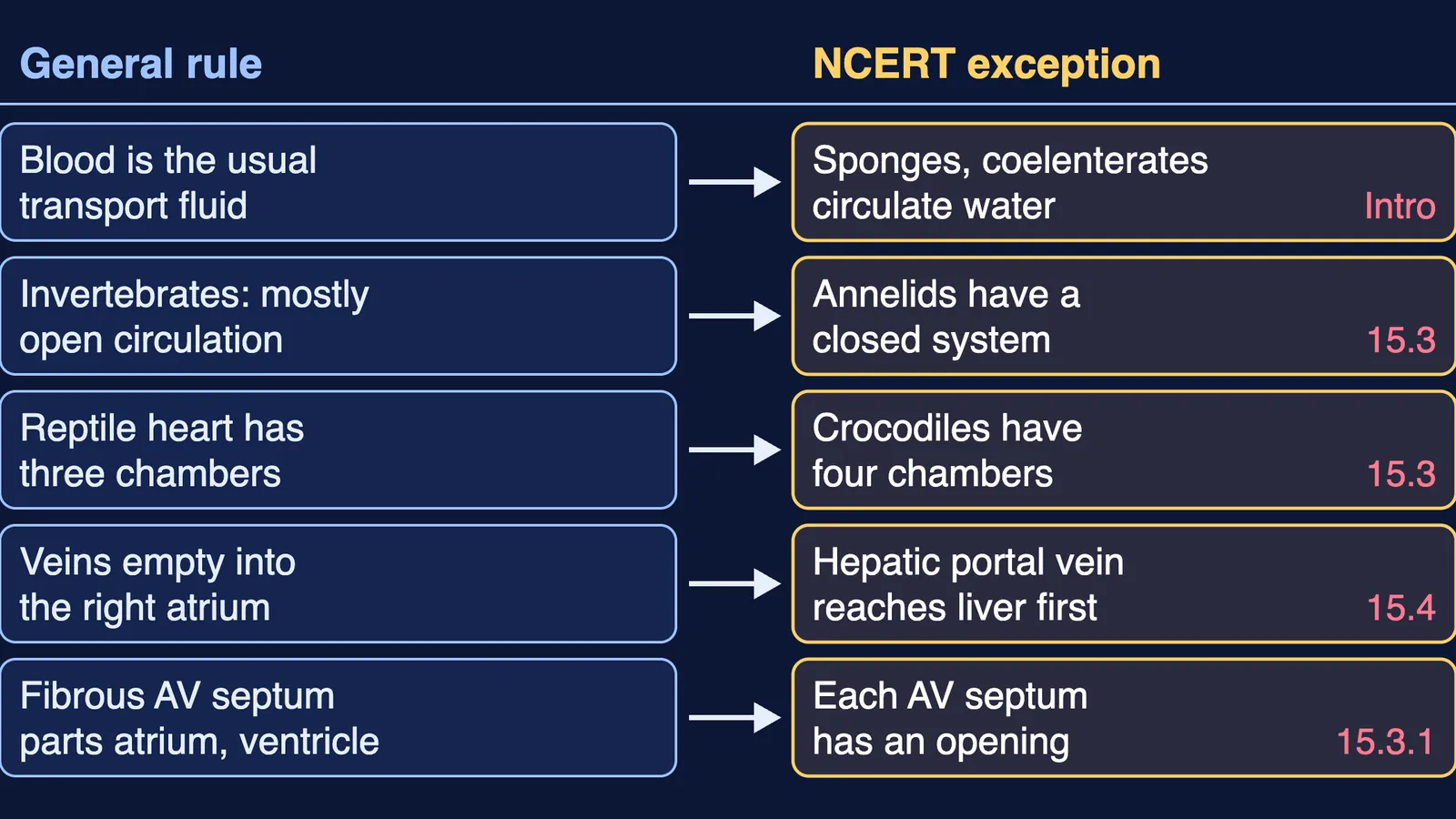
Each line gives a pattern the chapter states, then the case NCERT itself sets apart.
Higher organisms mostly move materials in blood; sponges and coelenterates instead pass surrounding water through body cavities (introduction).
The summary gives closed circulation to all vertebrates but only "a few" invertebrates; annelids are the ones NCERT names, while arthropods and molluscs are open (15.3, Summary).
Amphibians and reptiles have a three-chambered heart with one ventricle; crocodiles are the stated exception, with four chambers (15.3).
In amphibians and reptiles the left atrium takes oxygenated and the right atrium deoxygenated blood; however, both mix in the single ventricle, giving incomplete double circulation (15.3).
Systemic blood returns through veins and the vena cava to the right atrium; the "unique" hepatic portal vein first sends intestinal blood to the liver (15.4).
A thick fibrous atrio-ventricular septum separates each atrium from its ventricle; however, each septum has an opening joining the two chambers of that side (15.3.1).
Donor blood must be matched to the recipient's; still, group O can go to any group, and AB accepts from all (15.1.3.1).
When Rh-negative blood meets Rh-positive blood, anti-Rh antibodies form; in a first pregnancy, though, the placenta keeps foetal Rh antigens away from the mother's blood (15.1.3.2).
Tissue fluid carries the same mineral distribution as plasma; the exceptions are the larger proteins and most formed elements, which stay in the vessels (15.2, Summary).
Nodal tissue runs the heart on its own, so it is myogenic; yet a medulla oblongata centre and adrenal medullary hormones can moderate it (15.5, Summary).
How do you handle odd-one-out and exception questions?
Name the basis the stem gives: fluid used, plasma or cells, chamber count.
Test every option on that basis, then on other features, such as animal group or function; a sound item has one outsider throughout.
In "NOT an exception" items, pick the option that simply obeys its group's rule.
Odd-one-out and "NOT an exception" questions
Q1. Judged by the fluid that carries materials to the cells, which is the odd one out? (1) Annelids (2) Coelenterates (3) Fishes (4) Amphibians
Answer: (2). Coelenterates circulate surrounding water through body cavities; the other three pump blood through a closed system.
Q2. Judged by whether it sits in plasma or among the formed elements, which is the odd one out? (1) Fibrinogen (2) Prothrombin (3) Platelets (4) Inactive clotting factors
Answer: (3). Platelets are cell fragments from megakaryocytes; NCERT places the other three in plasma, all in an inactive form until clotting starts.
Q3. Which is NOT a case NCERT sets apart? (1) Crocodiles' four-chambered heart (2) The hepatic portal vein taking intestinal blood to the liver first (3) Double circulation in birds (4) Closed circulation in annelids
Answer: (3). Birds follow their group's rule: two separate pathways, no mixing.
Q4. Which pairs a rule with the wrong exception? (1) Reptiles have three chambers: crocodiles (2) Blood is the usual transport fluid: arthropods (3) Tissue fluid matches plasma's minerals: larger proteins (4) The atrio-ventricular septum divides chambers: its opening
Answer: (2). Arthropods pump blood through an open system; the exception is sponges and coelenterates.
Two-statement and single-correct questions
For two-statement items, judge each statement alone and test every "all" or "every" against NCERT's hedges.
Options for Q5 to Q7: (1) both right (2) both wrong (3) only I is right (4) only II is right.
Q5. Statement I: Sponges and coelenterates pass surrounding water through body cavities so cells can exchange substances. Statement II: NCERT says every higher organism uses blood as its transport fluid.
Answer: (3). NCERT says blood is the most commonly used fluid among most higher organisms, not all.
Q6. Statement I: Nearly 80 per cent of humans lack the Rh antigen. Statement II: The Rh antigen takes its name from a similar antigen found in Rhesus monkeys.
Answer: (4). NCERT says nearly 80 per cent of humans carry it.
Q7. Statement I: The atrio-ventricular septum is thick fibrous tissue. Statement II: Each atrio-ventricular septum has an opening joining the atrium and ventricle of that side.
Answer: (1). NCERT describes the fibrous septum, then the opening in it.
For single-correct items, find the general rule hidden in the stem, then pick the option NCERT treats differently.
Q8. Donor and recipient blood must normally match. By NCERT Table 15.1, which group can receive blood from A, B, AB and O donors? (1) O (2) A (3) AB (4) B
Answer: (3). AB plasma has neither anti-A nor anti-B, so NCERT calls AB the universal recipient.
Q9. Platelet factors usually start clotting after an injury. What else can start it, per NCERT? (1) Factors released by tissues at the injury site (2) Albumins (3) Serum (4) Histamine from basophils
Answer: (1). NCERT names tissue factors at the site of injury as a second trigger.
Q10. Which system does NCERT describe as serving only the cardiac musculature? (1) Hepatic portal system (2) Coronary system (3) Lymphatic system (4) Pulmonary circulation
Answer: (2). NCERT says the coronary system exists exclusively for the heart muscle.
Q11. NCERT says red blood cells lack a nucleus in: (1) all vertebrates (2) all mammals (3) most mammals (4) birds and mammals
Answer: (3). The chapter hedges with "most of the mammals", so the absolute options fail.
What should you do after this set?
Redo all 11 with answers covered, noting the basis for each odd-one-out item.
Add each miss to your rule-and-exception list.
Then switch formats: the statement and match-the-list set on this chapter, the diagram-based circulation questions and the assertion-reason questions on body fluids.
Which exception keeps slipping away? Fermi's AI tutor works out what you already know and builds a plan for the session.