On this page
Kokum, the dried rind of Garcinia indica, is a souring agent in Indian west-coast cooking. The main acid behind that taste is not citric acid but its close relative, hydroxycitric acid (HCA). One extra OH group turns an achiral molecule into one with two stereocentres, four stereoisomers and an easy five-membered lactone. That makes kokum a compact revision set for three exam topics: counting stereoisomers, enantiomers versus diastereomers, and acid–base titration of a cyclic ester.
What makes kokum sour?
A 2022 review in ACS Omega on Garcinia, a genus whose species it says are "commonly called" names including kokum, states that "(−)-hydroxycitric acid (HCA) and its lactone are responsible for its sour taste", followed by citric and malic acids. It also reports that, in an HPLC comparison of four Garcinia species, G. cambogia and G. indica contained the most (−)-HCA and HCA lactone.
Compare the two acids:
Citric acid: HOOC–CH₂–C(OH)(COOH)–CH₂–COOH. The central carbon carries two identical CH₂COOH arms, so citric acid has no stereocentre.
Hydroxycitric acid: HOOC–CH(OH)–C(OH)(COOH)–CH₂–COOH, C₆H₈O₈, 208.12 g/mol (PubChem CID 185620). One CH₂ has become CH(OH).
How many stereoisomers does hydroxycitric acid have?
Number the five-carbon chain from the CH(OH) end: C1 is that end's COOH, C2 is CH(OH), C3 is C(OH)(COOH), C4 is CH₂ and C5 is the far COOH.
C2 carries H, OH, COOH and C3: four different groups.
C3 carries OH, COOH, CH₂COOH and C2: four different groups.
Symmetry check. One end of the molecule is CH(OH)COOH, the other CH₂COOH. The halves are different, so no internal mirror plane is possible and there is no meso form.
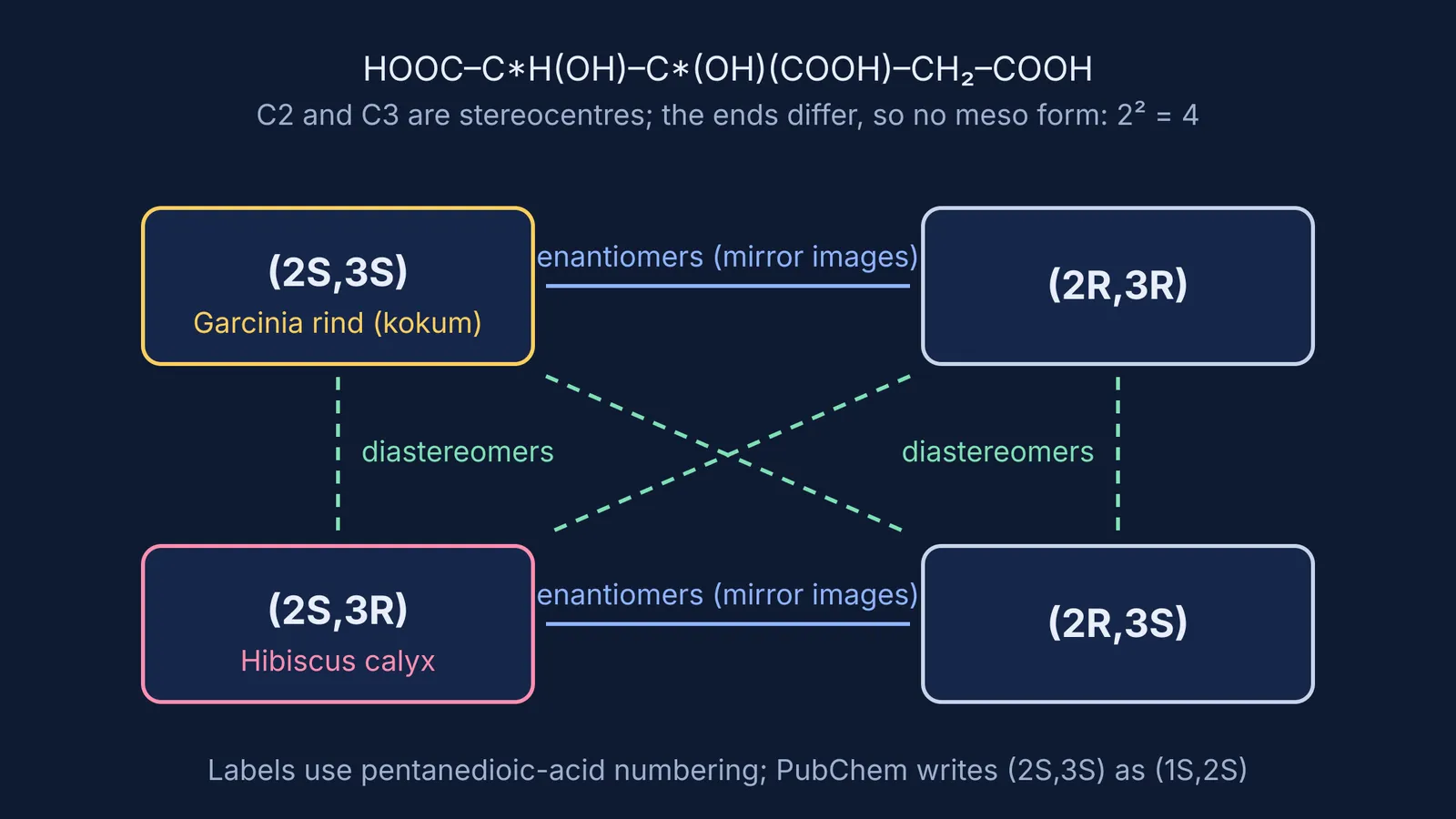
Count. n = 2 and nothing cancels, so 2² = 4 stereoisomers: (2S,3S), (2R,3R), (2S,3R) and (2R,3S), which form two pairs of enantiomers.
Contrast tartaric acid, HOOC–CH(OH)–CH(OH)–COOH. Its two ends are identical, so one combination is meso and the count drops to 3, as explained in what a meso compound is. For the general method, see counting stereoisomers from chiral centres.
A naming trap. Two numbering schemes are in use. The ACS Omega review writes Garcinia's acid as (2S,3S), numbering the pentanedioic acid chain as above. PubChem's IUPAC name numbers a propane chain instead: (1S,2S)-1,2-dihydroxypropane-1,2,3-tricarboxylic acid. Same molecule, same S at each centre, different locants. This post uses (2S,3S).
Why are Garcinia and Hibiscus acids diastereomers, not enantiomers?
The review states that "fruit rinds of G. cambogia, G. indica, and G. atroviridis contain (2S,3S)-HCA", while the calyx of Hibiscus sabdariffa and H. rosa-sinensis produces (2S,3R)-HCA.
Compare the labels centre by centre:
C2: S in both.
C3: S in Garcinia, R in Hibiscus.
Enantiomers are mirror images, so every stereocentre must be inverted: the enantiomer of (2S,3S) is (2R,3R). The Garcinia and Hibiscus acids differ at only one of two centres, so they are diastereomers. Because they differ at exactly one centre, they are also called epimers at C3.
This matters in practice. Enantiomers have identical physical properties in an achiral setting: the same melting point, solubility and NMR spectrum. Diastereomers do not. The review notes that ¹H NMR spectroscopy distinguishes the (2S,3S) and (2S,3R) diastereomers. An NMR in an ordinary solvent could never separate a pair of enantiomers that way.
The rule to carry into the exam: invert every stereocentre and you get the enantiomer; invert only some and you get a diastereomer.
How does hydroxycitric acid form a lactone?
A lactone is a cyclic ester: an OH and a COOH in the same molecule join and lose water. HCA has two OH groups and three COOH groups, so check every pairing by ring size (ring atoms = the O, the carbons between, and the C=O carbon):
OH on C2 with the C1 COOH: 3-membered ring.
OH on C2 with the COOH on C3: 4-membered ring.
OH on C3 with C1 or with C5: 4-membered ring either way.
OH on C2 with the C5 COOH: O, C2, C3, C4, C5, a 5-membered ring.
Only one pairing gives a strain-free five-membered ring, the same ring-size logic as in what hydroxy acids give on heating. The product is (2S,3S)-3-hydroxy-5-oxooxolane-2,3-dicarboxylic acid, C₆H₆O₇, 190.11 g/mol (PubChem CID 9991606):
C₆H₈O₈ → C₆H₆O₇ + H₂O
Check: C 6 = 6, H 8 = 6 + 2, O 8 = 7 + 1, and 208.12 = 190.11 + 18.01. The ring closes through the oxygen already on C2, so no bond to a stereocentre breaks and both configurations are kept. The review records that early large-scale isolation took (−)-HCA from dried rinds in the form of its lactone, and that one extraction study set out to reduce lactonisation, so the ring forms readily during processing.
Worked example: telling acid from lactone by titration
A free COOH reacts with cold NaOH at once. The lactone's ester link does not, until you heat it with excess alkali (saponification), which opens the ring and frees a third COOH:
HCA: C₆H₈O₈ + 3NaOH → C₆H₅Na₃O₈ + 3H₂O
Lactone, cold: C₆H₆O₇ + 2NaOH → C₆H₄Na₂O₇ + 2H₂O
Lactone, hot: C₆H₆O₇ + 3NaOH → C₆H₅Na₃O₈ + 2H₂O
Per gram (NaOH = 39.997 g/mol): HCA needs 3 × 39.997 ÷ 208.12 = 0.577 g NaOH. The lactone needs 0.421 g cold but 0.631 g after heating.
Question. 0.400 g of a mixture of HCA and its lactone (no other acids) is titrated cold with 0.200 M NaOH to phenolphthalein: 26.88 mL. Then 20.00 mL more of the 0.200 M NaOH is added, the flask is heated, and the excess needs 17.37 mL of 0.200 M HCl. Find the mass of each.
Cold titre. 26.88 mL × 0.200 M = 5.376 mmol NaOH = 3n(HCA) + 2n(lactone).
NaOH added for heating. 20.00 × 0.200 = 4.000 mmol.
Left over. 17.37 × 0.200 = 3.474 mmol of HCl.
Used to open the ring. 4.000 − 3.474 = 0.526 mmol, one per lactone, so n(lactone) = 0.526 mmol.
Lactone mass. 0.526 × 190.11 = 100 mg.
HCA moles. (5.376 − 2 × 0.526) ÷ 3 = 1.441 mmol.
HCA mass. 1.441 × 208.12 = 300 mg. Check: 300 + 100 = 400 mg.
The trap. Treat the cold titre as all HCA and you get 5.376 ÷ 3 × 208.12 = 373 mg, and you miss that a quarter of the sample is lactone.
This is the same logic as an ester's saponification value. Real kokum also holds citric and malic acids, and the review notes that acid–base titration measures total acids, which is why labs use HPLC to pick out HCA itself. For more back-titration numericals, try the Fermi Problem Library, a step-by-step solver that explains the reasoning.
If stereochemistry and titration numericals are on your revision list, Fermi Test Prep supports JEE Main and Advanced preparation with an AI tutor.
Quick checklist
Hydroxycitric acid, C₆H₈O₈ (208.12), has two different stereocentres and no meso form: 4 stereoisomers.
Garcinia (kokum) rind: (2S,3S)-HCA. Hibiscus calyx: (2S,3R)-HCA. One centre differs, so they are diastereomers (C3 epimers).
PubChem writes (2S,3S) as (1S,2S); only the numbering changes.
The only five-membered lactone joins the C2 OH to the C5 COOH: C₆H₈O₈ → C₆H₆O₇ + H₂O.
NaOH per gram: HCA 0.577 g; lactone 0.421 g cold, 0.631 g after heating.