

On this page
What is a meso compound?
A molecule with n chiral centres usually has 2ⁿ distinct stereoisomers. However, this rule breaks down when a molecule has an internal plane of symmetry. A meso compound is an optically inactive member of a set of stereoisomers where at least two other members are optically active (Wikipedia).
Despite having chiral atoms, a meso molecule is superimposable on its mirror image. The clockwise rotation of plane-polarised light by one half of the molecule is exactly cancelled out by the counter-clockwise rotation of the other half—a phenomenon called internal compensation.
Why is meso-tartaric acid optically inactive?
Tartaric acid (2,3-dihydroxybutanedioic acid) is the classic textbook example of a meso compound. It has two chiral carbons, C2 and C3.
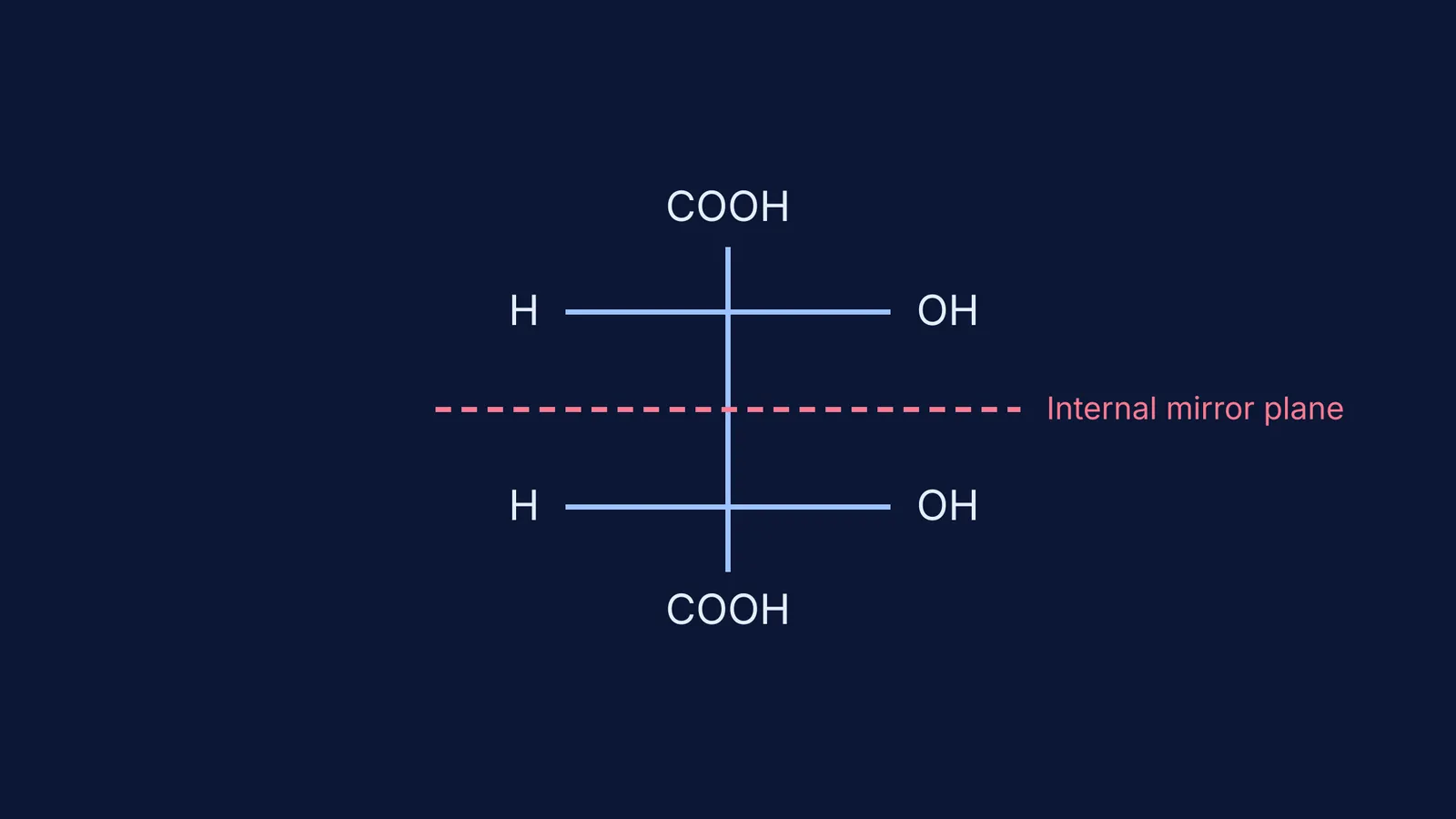
If you draw its Fischer projection, the meso form, which is (2R, 3S)-tartaric acid, reveals an internal mirror plane bisecting the C2–C3 bond. The top half of the molecule is a perfect mirror image of the bottom half. Because the two halves are identical but opposite in configuration (R and S), their optical rotations cancel out, leaving the molecule with a net optical rotation of 0° (Wikipedia).
Spotting a mirror plane on a flat page is one of the trickiest parts of organic chemistry. If you are struggling to map 2D drawings to 3D shapes, the Fermi Concept Library contains every concept in physics, chemistry, biology, mathematics and computing, each with its own lesson and its place in the map. Once you understand the rules, you can use the Fermi Problem Library, which has worked problems with a step-by-step solver that explains the reasoning rather than printing an answer.
What is the difference between a meso compound and a racemic mixture?
Both meso compounds and racemic mixtures are optically inactive, meaning they have a net optical rotation of 0°. However, the reasons behind their optical inactivity are entirely different.
A meso compound is a single, pure substance. Its optical inactivity is due to internal compensation. The molecule itself is achiral because its internal mirror plane causes the rotation from one half to perfectly cancel the rotation from the other half (Wikipedia). You cannot separate a meso compound into optically active parts.
A racemic mixture, on the other hand, is an equal mixture of two different enantiomers (like a blend of (+)-tartaric acid and (-)-tartaric acid). Its optical inactivity is due to external compensation. The clockwise rotation of the dextro enantiomer is cancelled out by the counter-clockwise rotation of the separate levo enantiomer in the same solution. Because a racemic mixture contains two distinct molecules, it can be separated (resolved) into its optically active components.
How do you spot a meso compound in a Fischer projection?
Finding an internal mirror plane can be difficult depending on how the molecule is drawn. The easiest way to spot a meso compound on paper is to draw its Fischer projection.
In a Fischer projection, horizontal lines represent bonds pointing towards you, and vertical lines represent bonds pointing away. For meso-tartaric acid, if you draw the carbon chain vertically, the top half (C1 and C2) is a perfect mirror reflection of the bottom half (C3 and C4) across the C2–C3 bond. The hydroxyl (-OH) groups and the hydrogen (-H) atoms on C2 and C3 point in the same direction on the horizontal lines.
If the groups on the stereocentres are identical but point in opposite directions across the horizontal lines, there is no mirror plane. That is why the (2R, 3R) and (2S, 3S) configurations of tartaric acid are optically active enantiomers, rather than meso forms.
How do you count stereoisomers when meso forms exist?
For a molecule without any symmetry, the number of stereoisomers is simply 2ⁿ, as explained in our guide to counting stereoisomers from the number of chiral centres.
However, when a molecule has an internal plane of symmetry, this rule breaks down. A compound with n chiral centres cannot reach the theoretical maximum of 2ⁿ stereoisomers if one of the stereoisomers is meso (Wikipedia).
Tartaric acid's three stereoisomers are (+)-tartaric acid, (-)-tartaric acid, and meso-tartaric acid. Knowing how to identify the internal mirror plane ensures you never overcount isomers when asked to find the total stereoisomers of a symmetric molecule. For a similar counting challenge, see our breakdown of C4H10O isomers.


