On this page
A tunnelling rig drills hard rock by hammering. Inside the rock drill a steel piston strikes the end of the drill steel many times a second. Each blow does not shove the rod forward as one rigid piece. It launches a short pulse of compression that runs down the steel at about 5 km/s and crushes the rock under the bit. Wave speed in a solid plus impulse and momentum explain that pulse, and why drill pistons are long and slim.
Rock drills are heavy machines run only by trained operators. This post explains the physics of the tool. It does not cover blasting.
How does a top-hammer rock drill hit the rock?
In a top-hammer drill the hammer sits outside the hole. The piston strikes a shank adapter, which passes the blow through the drill rods to a button bit at the rock face. A Karlstad University study of rock drill pistons, built around an Atlas Copco top-hammer crawler drill, lists typical conditions as an impact speed of 10 to 11 m/s at 10 to 50 blows per second.
Why a pile driver uses a heavy hammer and a short drop treats hammer and pile as rigid bodies and leaves wave effects aside. Here the waves are the whole story.
Why does a sudden push travel as a wave?
Push the end of a long bar suddenly at speed u. A compression front sets off along the bar at the bar wave speed
c = √(Y/ρ)
where Y is Young's modulus and ρ is the density. Behind the front the steel moves at u; ahead it is at rest. This is the longitudinal wave speed you meet in the speed of sound in steel, water and air.
Use impulse and momentum. In time t the front sets a length ct, of mass ρAct, moving at u. The force is the momentum given per second:
F = ρAct × u / t = ρAcu
Divide by the area A and the stress in the pulse is
σ = ρcu
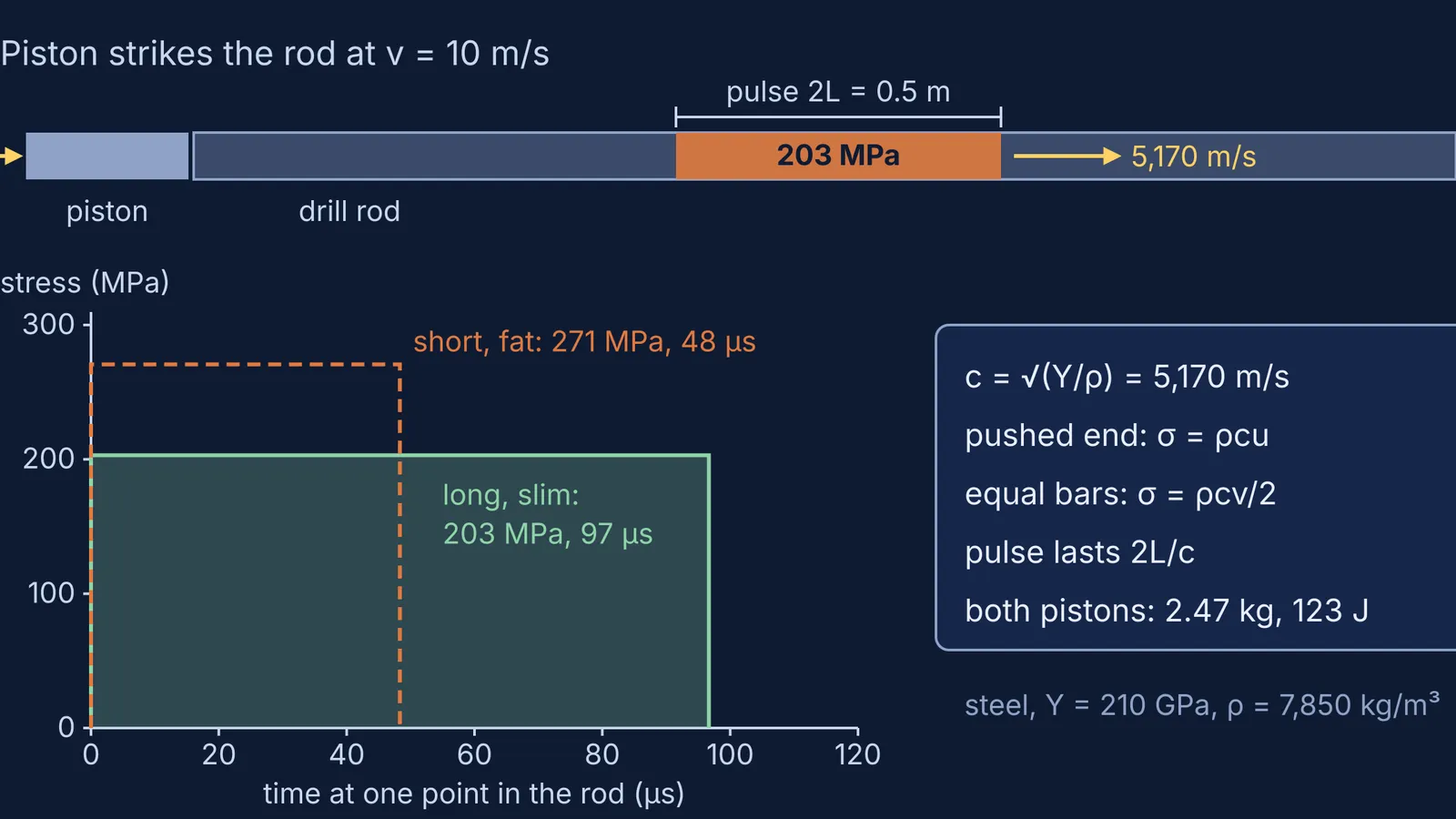
ρc is the steel's acoustic impedance. With Y = 210 GPa and ρ = 7,850 kg/m³, c = 5,170 m/s and ρc = 4.06 × 10⁷ kg m⁻² s⁻¹.
Why is the stress ρcv/2 when the piston hits the rod?
Take a piston of length L and a rod of the same steel and cross-section. At the contact face both move at the same speed and push on each other equally. The piston slows from v, the rod speeds up from 0, and with equal impedance they meet halfway: the face moves at v/2. A compression wave runs into each bar with
σ = ρc × v/2
The wave in the piston reflects from its free back end as tension. When that returns to the contact face, the piston is at rest and the blow is over. So the pulse lasts the round-trip time 2L/c and is 2L long in the rod. A Sandvik patent on percussive rock drilling says the same: the stress wave from a percussion piston is nearly rectangular and twice the length of the piston.
The LS-DYNA verification case for a striker hitting a steel bar uses a 300 mm striker at 15 m/s with ρ = 7,800 kg/m³ and c = 5,189 m/s. Then ρcv/2 = 7,800 × 5,189 × 15 ÷ 2 = 303.6 MPa and 2L/c = 116 µs, matching its analytical values.
How big is the stress pulse in a rock drill?
Take a steel piston 40 mm across and 0.25 m long, hitting a rod of the same diameter at 10 m/s. These sizes are illustrative.
Wave speed. c = √(210 × 10⁹ ÷ 7,850) = 5,170 m/s.
Stress. σ = ρcv/2 = 4.06 × 10⁷ × 10 ÷ 2 = 2.03 × 10⁸ Pa, about 203 MPa of compression. Units: kg m⁻² s⁻¹ × m/s = N/m².
Duration. 2L/c = 0.50 ÷ 5,170 = 9.7 × 10⁻⁵ s, about 97 µs. The pulse is 0.5 m long in the rod.
Piston mass and energy. A = π × 0.020² = 1.26 × 10⁻³ m², so m = ρAL = 2.47 kg and ½mv² = 123 J.
Energy check. The pulse stores σ²/Y per cubic metre (half strain, half kinetic energy): (2.03 × 10⁸)² ÷ (210 × 10⁹) × 1.26 × 10⁻³ × 0.5 = 123 J. All of it reaches the rod.
Step 2 has no piston mass in it. A heavier piston at the same speed and width makes a longer pulse, not a stronger one.
What changes with a short, fat piston?
Keep the mass at 2.47 kg but make the piston half as long (0.125 m) with twice the rod's area. With n = piston area ÷ rod area, the rod stress becomes
σ_rod = [n/(n + 1)] × ρcv
For n = 1 this gives ρcv/2 again. For n = 2 it gives (2/3) × 406 = 271 MPa. The main pulse lasts only 2 × 0.125 ÷ 5,170 = 48 µs and carries 8/9, about 89%, of the 123 J. The rest follows as a weaker tail. Same mass and energy, a third more peak stress.
Compare a blow at the end of a free rod, where the rod is rigid and only the total impulse matters. In a drill string the steel feels the peak stress, so the pulse shape matters.
What sets the limit on blow speed?
Rock drill parts usually fail by fatigue, not by a single overload. A 2021 failure analysis in Engineering Failure Analysis by Wang and co-workers studied a down-the-hole drill piston that hits its bit at 8 to 12 m/s. Its steel, 23CrNi3Mo, has a fatigue strength of 330 MPa, quoted from the maker's data. Use that as a rough ceiling for an equal-width blow:
v_max = 2σ/(ρc) = 2 × 330 × 10⁶ ÷ (4.06 × 10⁷) = 16.3 m/s
No piston mass changes this number. Real rods stay well below it, because threaded joints, bending and corrosion lower fatigue life. The Sandvik patent above puts typical peak amplitudes at 200 to 300 MPa (about 9.9 to 14.8 m/s by this formula) and says high amplitudes shorten the life of rods and bits.
More energy per blow therefore needs a longer piston. A 0.5 m piston of the same diameter at 10 m/s gives the same 203 MPa for 193 µs and delivers 247 J, twice as much. It is the pile driver's lesson again, heavy and slow beats light and fast, seen from the wave side.
Want more wave-speed and impulse problems in the JEE style? The Fermi Problem Library has a step-by-step solver that explains the reasoning. For a full plan, Fermi Test Prep offers personalised preparation for JEE Main & Advanced with an AI tutor, live classes, adaptive mocks, mentorship and a study plan that updates based on mastery.
Quick checklist
Bar wave speed: c = √(Y/ρ), about 5,170 m/s in steel.
A suddenly pushed end at speed u gives σ = ρcu (impulse = momentum change).
Equal piston and rod: σ = ρcv/2, pulse length 2L, duration 2L/c.
At 10 m/s: 203 MPa for 97 µs from a 0.25 m piston.
Peak stress depends on speed and area ratio, not piston mass.
Fatigue caps the speed (about 16 m/s for 330 MPa steel); more energy comes from a longer piston.