On this page
The NMC's NEET (UG) 2026 syllabus lists Locomotion and Movement under Unit 5, Human Physiology. Each rule and exception is taken from Chapter 17 of NCERT's Class 11 Biology textbook (Reprint 2026-27) and tagged with its section; "opening" is the text before 17.1. We wrote all 12 questions; none is a past-paper item or a prediction. The disorders in 17.5 are left out, and anything here on muscles, bones or joints is a study summary of NCERT, not medical advice.
What are the NCERT exceptions in Locomotion and Movement?
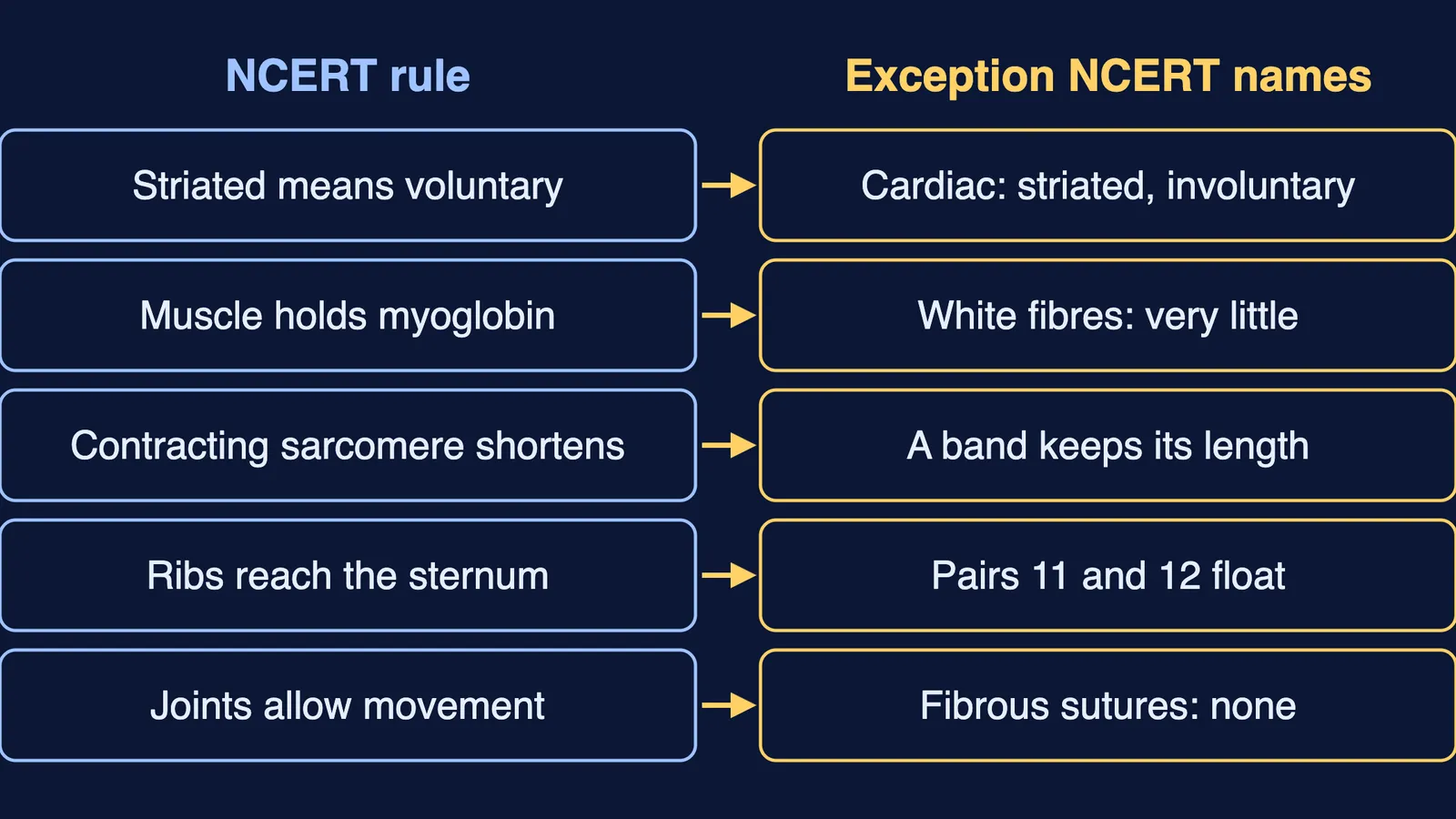
Skeletal muscle is striated and voluntary; visceral muscle is smooth and involuntary. Exception: cardiac muscle is striated yet involuntary (17.2).
Muscle contraction is started by a signal from the CNS through a motor neuron. Exception: the nervous system does not control cardiac muscle directly (17.2, 17.2.2).
Muscle contains myoglobin, a red oxygen-storing pigment. Exception: white fibres have very little and look pale (17.2.2).
During contraction the sarcomere shortens and the I bands get reduced. Exception: the A bands retain their length (17.2.2).
The vertebral column is built from 26 serially arranged vertebrae. Exception: the sacral and coccygeal units are each a single fused unit (17.3).
Each rib joins the vertebral column dorsally and the sternum ventrally. Exception: pairs 8 to 10 do not reach the sternum directly; they join the seventh rib through hyaline cartilage (17.3).
Same rule. Exception: pairs 11 and 12 have no ventral connection, hence "floating" ribs (17.3).
Joints are the points through which bony parts move, acting as a fulcrum. Exception: fibrous joints, such as the sutures of the cranium, allow no movement (17.4).
How do you handle odd-one-out and exception questions?
Note the basis the stem gives and sort all four options on it alone. Then test two other features, such as location or organism; if either isolates a different option, the stem's basis still decides. In "NOT an exception" items, the answer obeys its rule or invents an exception absent from NCERT.
Odd-one-out questions
Q1. Judged by the type of cartilage NCERT names at the site, which is the odd one out? (1) Ventral end of the 1st rib (2) Ventral end of the 7th rib (3) Link between the 9th rib and the 7th rib (4) Pubic symphysis
Answer: (4). The rib links use hyaline cartilage; the pubic symphysis contains fibrous cartilage (17.3).
Q2. Judged by whether NCERT links the movement to flagella, which is the odd one out? (1) Swimming of spermatozoa (2) Keeping water flowing through a sponge's canals (3) Locomotion of *Euglena* (4) Prey capture by *Hydra*
Answer: (4). *Hydra* uses tentacles; the rest are NCERT's flagellar examples (opening, 17.2).
Q3. Judged by how much movement NCERT says the joint allows, which is the odd one out? (1) Between adjacent vertebrae in the column (2) Between the carpals (3) Knee joint (4) Between humerus and pectoral girdle
Answer: (1). That cartilaginous joint permits limited movement; the synovial three allow considerable movement (17.4).
Q4. Judged by whether NCERT gives it as a feature of white fibres, which is the odd one out? (1) Very little myoglobin (2) Few mitochondria (3) Dependence on an anaerobic process for energy (4) A small amount of sarcoplasmic reticulum
Answer: (4). NCERT says white fibres have a high amount of sarcoplasmic reticulum (17.2.2).
Which is NOT an exception?
Q5. Which is NOT a rule-exception pair NCERT states? (1) Muscle contains myoglobin; white fibres have very little (2) Contraction starts with a CNS signal; cardiac muscle is not directly under nervous control (3) Ribs reach the sternum; the 8th, 9th and 10th pairs end on the seventh rib (4) Visceral muscles are involuntary; genital tract muscles are voluntary
Answer: (4). NCERT lists the genital tract among the involuntary visceral muscles (17.2).
Q6. Which pair is NOT in NCERT's chapter? (1) The sarcomere shortens; the A band does not (2) The column has 26 vertebrae; the sacrum and coccyx are each one fused unit (3) Synovial joints allow considerable movement; the knee allows none (4) Muscle holds myoglobin; white fibres look pale
Answer: (3). NCERT gives the knee as its hinge joint, a synovial joint (17.4).
Two-statement and single-correct questions
Options for Q7 to Q10: (1) I and II true (2) I true, II false (3) I false, II true (4) I and II false.
Q7. I: Contraction of a skeletal muscle fibre begins with a CNS signal carried by a motor neuron. II: NCERT's reason for calling cardiac muscle involuntary is its striated appearance.
Answer: (2). NCERT's reason is that the nervous system does not control cardiac muscle directly (17.2, 17.2.2).
Q8. I: NCERT names the mammals whose cervical count is not seven. II: Almost all mammals, humans included, have seven cervical vertebrae.
Answer: (3). The chapter gives the near-rule but names no exception (17.3).
Q9. I: Repeated activation can cause fatigue as lactic acid builds up from the anaerobic breakdown of glycogen. II: White fibres depend on an anaerobic process for energy.
Answer: (1). Both match NCERT (17.2.2).
Q10. I: In movement, a joint acts as a fulcrum for the force muscles generate. II: In fibrous joints, flat skull bones are fused end-to-end by hyaline cartilage.
Answer: (2). Sutures are formed by dense fibrous connective tissue (17.4).
Q11. NCERT classifies muscles by location, appearance and nature of regulation. On which criterion does cardiac muscle fall in the same group as skeletal muscle? (1) Location (2) Appearance (3) Regulation (4) None of them
Answer: (2). Both are striated; by regulation cardiac sits with visceral muscle (17.2).
Q12. How many of the 12 rib pairs does NCERT describe as not joining the sternum? (1) 2 (2) 3 (3) 5 (4) 7
Answer: (3). The 8th to 10th pairs end on the seventh rib, and pairs 11 and 12 float (17.3).
How should you review this set?
Missed Q4, Q7, Q9 or Q11? Reread 17.2. Missed Q1, Q5, Q8 or Q12? Reread 17.3. Missed Q2, Q3, Q6 or Q10? Reread the opening and 17.4. Then try our statement and match-the-list set for this chapter, the Locomotion and Movement diagram questions or the assertion-reason questions on muscles and bones.
Not sure which rows to revise first? Fermi's AI tutor works out what you already know and builds a plan for the session.