On this page
Every pair and question follows NCERT Class 11 Biology, Chapter 10, Cell Cycle and Cell Division (Reprint 2026-27). The NEET (UG) 2026 syllabus places cell division in Unit 3, Cell Structure and Function. No question is a past-paper item or a prediction.
What are the NCERT exceptions in Cell Cycle and Cell Division?
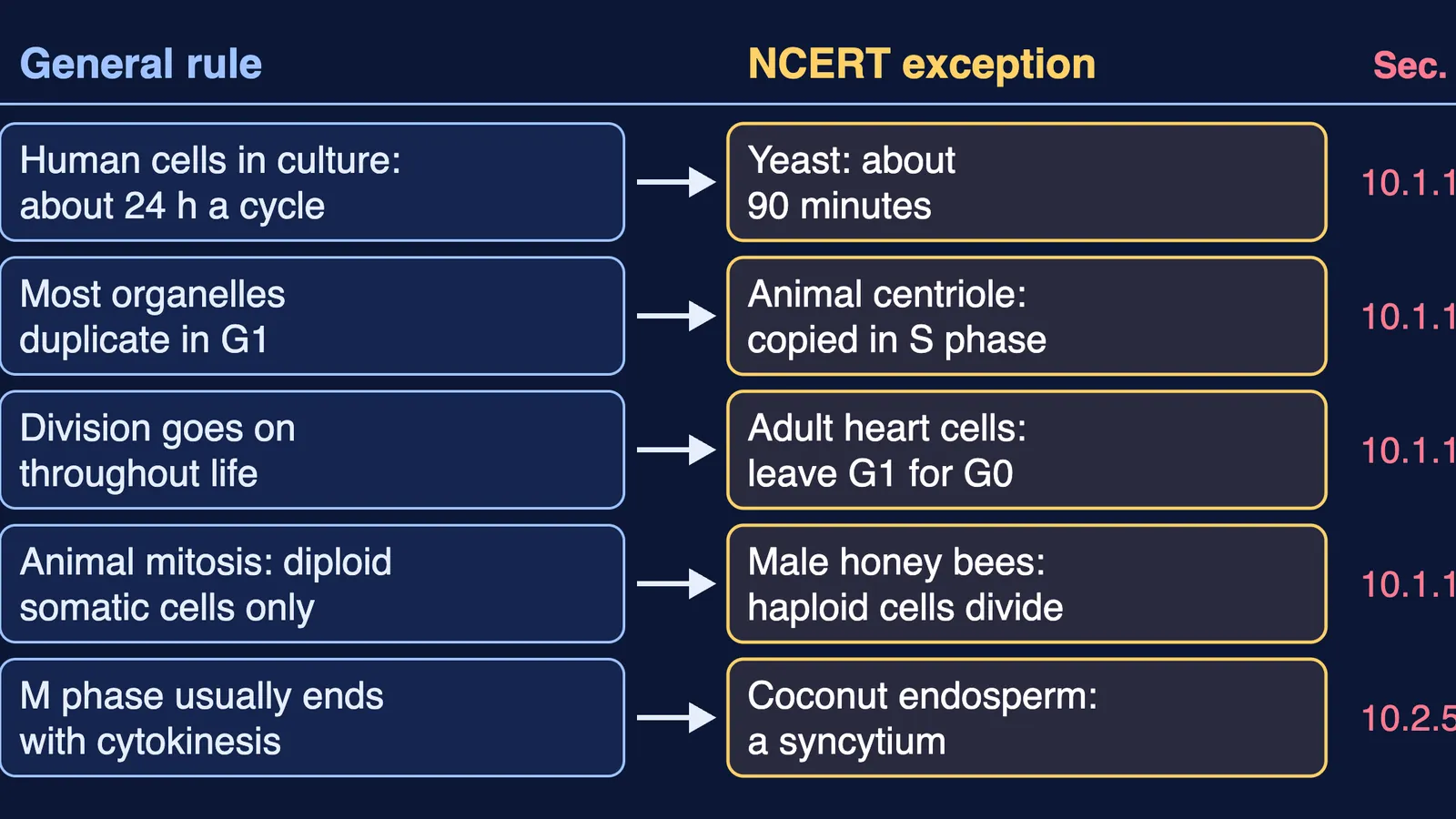
Each line gives a rule the chapter states, then the case NCERT itself sets apart, with its section.
Human cells in culture complete a cycle in about 24 hours, but the length varies by organism and cell type: yeast can finish in about 90 minutes (10.1.1).
Most organelle duplication happens in G1 (Summary); in animal cells, though, the centriole is copied in the cytoplasm in S phase (10.1.1).
Cell division carries on through the whole life cycle (Summary); yet some adult animal cells, such as heart cells, do not appear to divide and leave G1 for G0 (10.1.1).
Cells in G0 stop proliferating, unless the organism calls on them; many cells divide only now and then, to replace cells lost to injury or death (10.1.1).
In animals, mitosis is seen only in diploid somatic cells; NCERT's named exception is male honey bees, in which haploid cells undergo mitosis. Section 10.3 repeats the point: mitosis is usually limited to diploid cells, but haploid cells divide by mitosis in some lower plants and some social insects (10.1.1, 10.3).
M phase usually ends with cytokinesis; in some organisms it does not, leaving a multinucleate syncytium, as in coconut's liquid endosperm (10.2.5).
In diplotene, recombined homologues tend to move apart everywhere except at the crossover sites, the X-shaped chiasmata (10.4.1).
At mitotic telophase, chromosomes decondense and lose their individuality (10.2.4); after telophase I they disperse only partly, never reaching the extended interphase state (10.4.1).
How do you handle odd-one-out and exception questions?
Find the basis in the stem (stage, ploidy, hedge word) and judge every option on that basis alone.
Then re-sort the options by other features, such as mitosis or meiosis; a fair item still has one outsider.
In "NOT an exception" items, look for a plain rule dressed up as a special case.
In wrong-pairing items, check that the exception belongs to the same group as its rule.
Odd-one-out and "NOT an exception" questions
Q1. Judged by whether NCERT states it with a hedge word such as usually, which is the odd one out? (1) Mitosis gives diploid daughter cells (2) Mitosis is restricted to diploid cells (3) M phase ends with cytokinesis (4) Meiosis copies its DNA just once
Answer: (4). NCERT hedges the first three with usually; the single round of replication is stated flatly.
Q2. Judged by whether NCERT describes it only in meiosis, which is the odd one out? (1) Synaptonemal complex (2) Kinetochores (3) Recombination nodules (4) Chiasmata
Answer: (2). Kinetochores take spindle fibres in mitotic metaphase and in both meiotic metaphases; the other three belong to prophase I.
Q3. Judged by the chromosome number of the daughter cells compared with the cell that enters that division, which is the odd one out? (1) Mitosis in a diploid onion root tip cell (2) Mitosis in a haploid cell of a lower plant (3) Meiosis I (4) Meiosis II
Answer: (3). Only meiosis I halves the number; meiosis II, like mitosis, gives cells with the same number as the cell that divided.
Q4. Which is NOT a case NCERT sets apart from a general rule? (1) Chromosomes condensing during mitotic prophase (2) Haploid cells of male honey bees dividing by mitosis (3) Coconut's liquid endosperm forming without cytokinesis (4) The animal centriole duplicating in S phase, not G1
Answer: (1). Condensation in prophase is the ordinary rule of mitosis.
Q5. Which pairs a rule with the wrong exception? (1) About 24 hours per human cell cycle: yeast in about 90 minutes (2) Most organelles duplicate in G1: the centriole duplicates in S (3) Recombined homologues separate in diplotene: they stay joined at crossover sites (4) In animals, mitosis only in diploid somatic cells: haploid onion root tip cells
Answer: (4). Onion is a plant, and NCERT's animal exception is male honey bees.
Two-statement and single-correct questions
Judge each statement alone; absolute words like always or only are where the trap usually sits.
Options for Q6 to Q9: (1) both right (2) both wrong (3) only I is right (4) only II is right.
Q6. Statement I: Prophase I is typically longer and more complex than mitotic prophase. Statement II: NCERT calls prophase II much simpler than prophase I.
Answer: (1). Section 10.4.1 says both.
Q7. Statement I: NCERT's "only diploid somatic cells" rule for mitosis is stated for animals. Statement II: Plants, per NCERT, show mitosis only in diploid cells.
Answer: (3). NCERT says plants can show mitosis in both haploid and diploid cells.
Q8. Statement I: NCERT says a bivalent first forms in pachytene. Statement II: Bivalents formed in zygotene are seen more clearly in the stage after it.
Answer: (4). Bivalents form in zygotene and are clearer in pachytene.
Q9. Statement I: Like cell growth, DNA synthesis continues through every stage of interphase. Statement II: In S and G2, the new DNA molecules are already distinct from one another.
Answer: (2). DNA synthesis is confined to S phase, and in S and G2 the new molecules are intertwined, not distinct.
For single-correct items, spot the rule in the stem first, then the option NCERT treats as its special case.
Q10. NCERT's summary places most organelle duplication in: (1) G1 (2) S (3) G2 (4) M
Answer: (1). The animal centriole, which duplicates in S phase, is the exception.
Q11. Which two stages of prophase I does NCERT call relatively short-lived compared with pachytene? (1) Leptotene and zygotene (2) Zygotene and diplotene (3) Diplotene and diakinesis (4) Leptotene and diakinesis
Answer: (1). NCERT names the first two stages of prophase I.
What should you do after this set?
Redo all 11 with answers covered, naming each odd-one-out basis aloud.
Log every miss next to its row in the rule-and-exception list.
Then switch formats: the statement and match-the-list set on cell division, the diagram-based cell cycle questions and the cell cycle assertion-reason questions.
Which exception keeps slipping away? Fermi's AI tutor works out what you already know and builds a plan for the session.