On this page
The integral you learn in Class 12 is the Riemann integral: cut the x-axis into thin strips, put a rectangle on each, add them up. It fails on some functions mathematicians need, and the fix, due to Henri Lebesgue, is to cut the other axis instead.
What is the Lebesgue integral, in plain words?
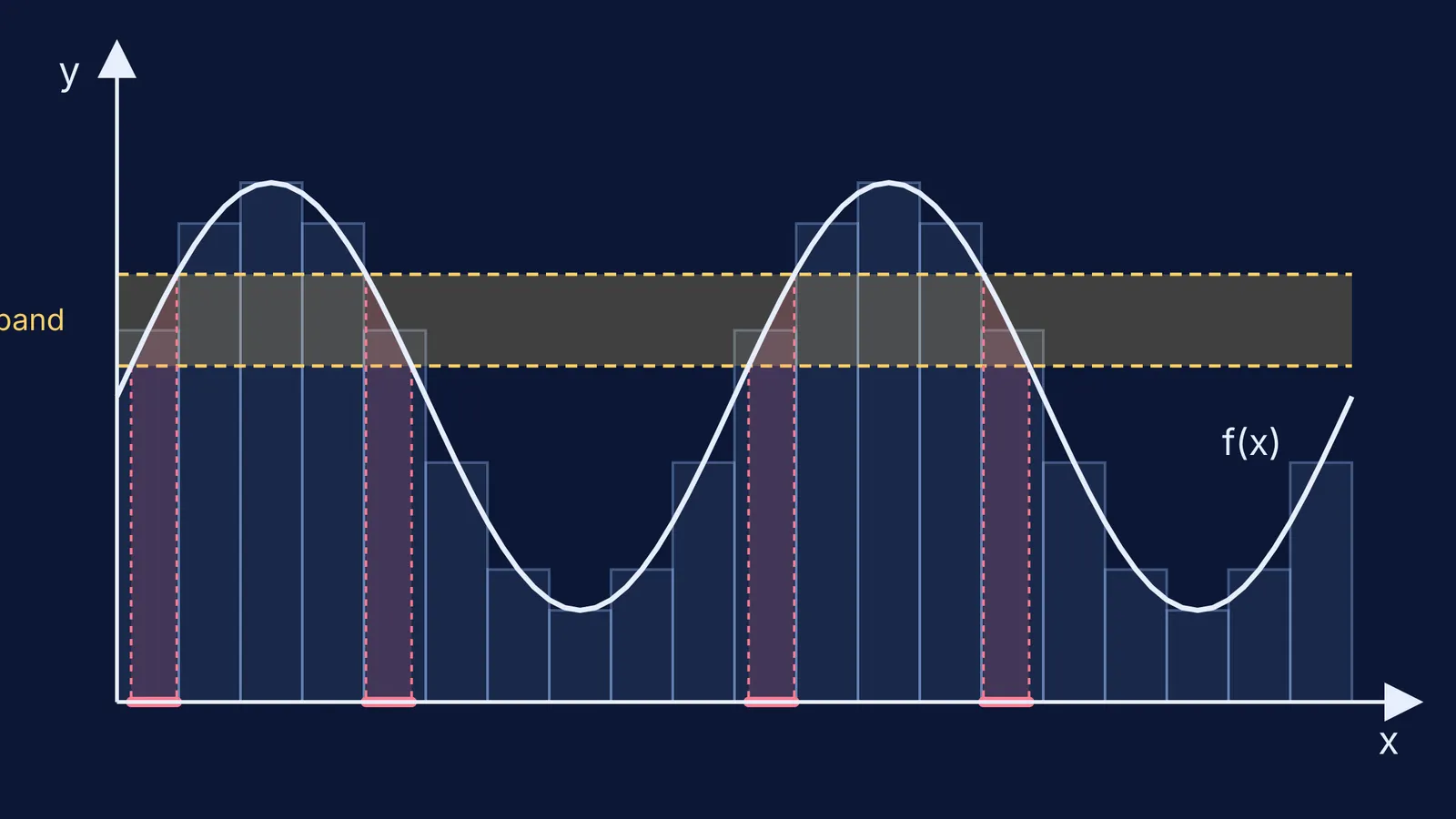
For the Riemann integral you partition the domain [a, b]; for the Lebesgue integral you are in effect partitioning the range of f, as the Wikipedia article on the Lebesgue integral puts it. The recipe:
Pick a band of output values, say every y between 0.55 and 0.70.
Find every x where f(x) lands in that band. It can be several separate pieces, like the pink intervals in the diagram above.
Measure the total length of those pieces.
Multiply that length by a value in the band, add over all bands, and let the bands get thinner.
Lebesgue compared it to paying out money in a letter to Paul Montel, quoted in the same article: sort the coins into heaps of equal value first, then pay heap by heap.
Lebesgue's note Sur une généralisation de l'intégrale définie appeared in the Comptes Rendus on 29 April 1901, and his thesis Intégrale, longueur, aire was presented in Paris in 1902, according to the MacTutor biography of Lebesgue.
What does measure mean?
Measure is length, extended to sets that are not neat intervals. The Lebesgue measure of an interval [a, b] is its length b − a, and any countable set of real numbers has Lebesgue measure 0 (Wikipedia: Lebesgue measure).
Why a countable set has measure zero: list the rationals as q1, q2, q3, and so on. Cover q1 with an interval of length ε/2, q2 with one of length ε/4, q_n with one of length ε/2^n. Every rational is covered, and the total length is at most ε. Since ε can be as small as you like, the rationals take up no length at all.
A simple function takes only finitely many values, each on a measurable set; simple functions generalise the step functions of Riemann integration (Lebesgue integral). Its integral is the sum of each value times the measure of the set where it takes that value. A general non-negative function is approximated from below by simple functions, and you take the limit.
Why does the Dirichlet function integrate to 0?
The Dirichlet function D(x) is 1 when x is rational and 0 when x is irrational. It is not Riemann integrable on any interval: over [a, b] its upper Darboux integral is b − a and its lower one is 0, because every strip, however thin, contains both kinds of number (Wikipedia: Dirichlet function).
Lebesgue's method has no trouble, because D is a simple function with just two values. On [0, 1]:
value 1, on the rationals, measure 0: contributes 1 × 0 = 0
value 0, on the irrationals, measure 1: contributes 0 × 1 = 0
So the Lebesgue integral of D over [0, 1] is 0, as the same article states.
Worked example: x² on [0, 1] by slicing the range
Try it on a function you know. For a level t between 0 and 1, x² > t exactly when x > √t, so the set of x above the level has length 1 − √t. Stacking thin horizontal layers of thickness dt:
Area = ∫ from 0 to 1 of (1 − √t) dt
= [t − (2/3)t^(3/2)] evaluated from 0 to 1
= 1 − 2/3 = 1/3
The Riemann answer, x³/3 from 0 to 1, is also 1/3.
Why does the Lebesgue integral handle limits better?
List the rationals in [0, 1] as q1, q2, q3, and so on, and let f_n be 1 at q1 to q_n and 0 everywhere else. Each f_n is zero except at n points, so its Riemann integral is 0. As n grows, f_n climbs towards the Dirichlet function, which Riemann cannot integrate at all.
Lebesgue's theory comes with the monotone convergence theorem and the dominated convergence theorem, both named in the Lebesgue integral article. They give simple conditions under which the integral of a limit equals the limit of the integrals. Here the f_n are non-negative and increase towards D, so monotone convergence makes the integral of D the limit of 0, 0, 0, and so on, which is 0. If you have seen how a Fourier series builds a square wave, you have met a limit of functions too.
How should a Class 11 or 12 student study this?
This is beyond school calculus, but it deepens it:
Get Riemann sums solid first; see our guide to definite integrals and area for JEE Main.
Redo the worked example for x and for x³.
Read about the Cantor set, which has length zero yet uncountably many points.
If words like countable, limit or measure are where you get stuck, the Fermi Concept Library gives every concept in mathematics its own lesson and its place in the map, so you can see what each idea rests on. To practise the Riemann-sum side, the Fermi Problem Library has worked problems with a step-by-step solver that explains the reasoning rather than printing an answer.
Next time you draw strips under a curve, turn the page sideways and try layers instead.