On this page
These pairs and questions follow NCERT Class 12 Biology, Chapter 7, Human Health and Disease (Reprint 2026-27), which the NEET (UG) 2026 syllabus places in Unit 8, Biology and Human Welfare. No question is a past-paper item or a prediction. This is a study summary, not medical advice.
What are the NCERT exceptions in Human Health and Disease?
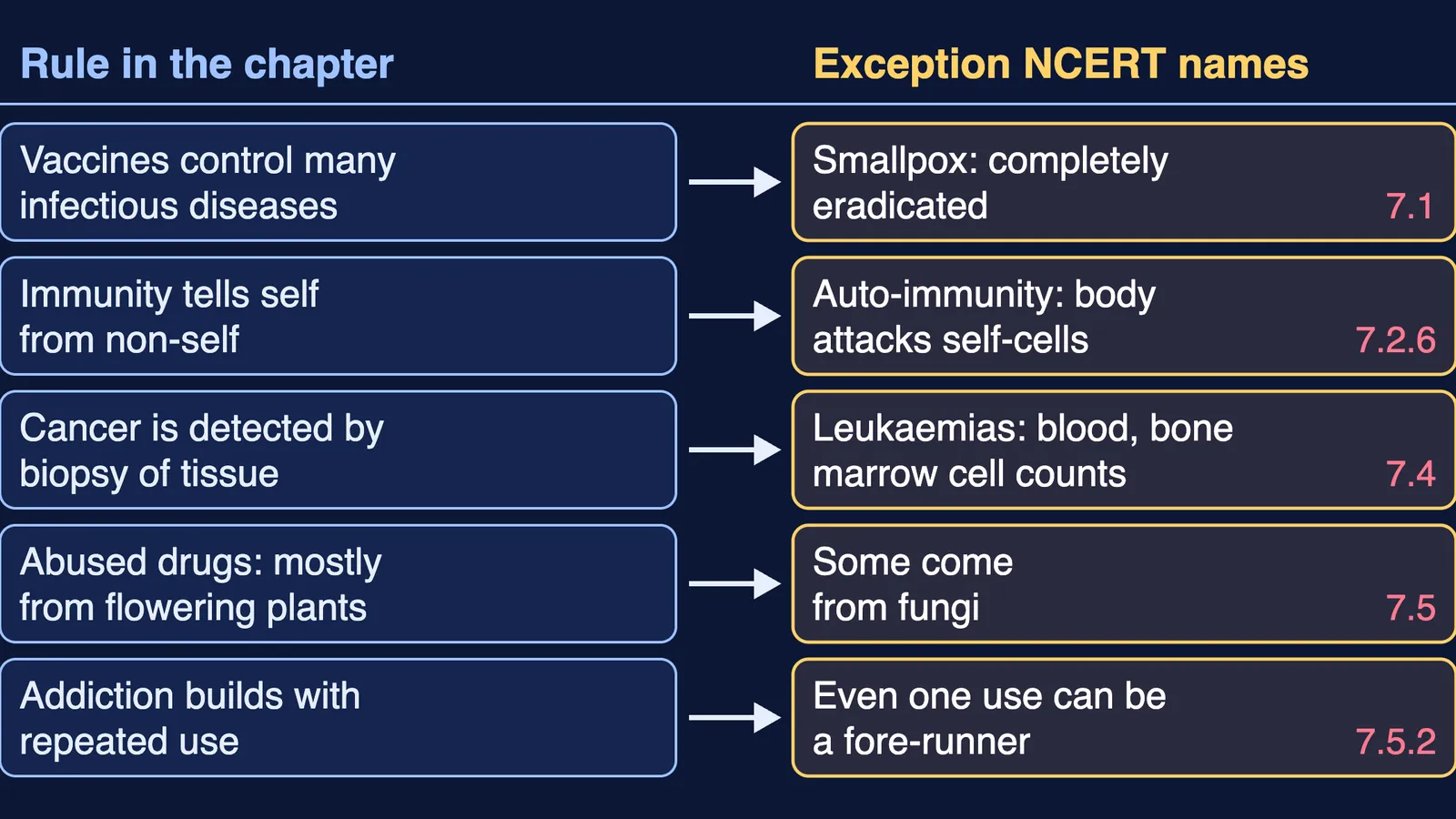
Each line gives a rule, then the case NCERT sets apart.
Pathogens entering the body can cause damage (7.1); yet of our many daily exposures, only a few end in disease, as the body defends itself (7.2).
Vaccines have controlled polio, diphtheria, pneumonia and tetanus to a large extent; smallpox alone was eradicated completely (7.1).
Acquired immunity rests on telling self from foreign; sometimes the body attacks self-cells, for genetic and other unknown reasons (7.2.6).
Cancer detection rests on biopsy and histopathology of tissue; for leukaemias, blood and bone marrow are tested for raised cell counts (7.4).
The immune system fights foreign agents; tumour cells avoid its detection and destruction, so patients are given biological response modifiers such as α-interferon (7.2, 7.4).
The majority of commonly abused drugs come from flowering plants; some come from fungi (7.5).
NCERT's main abused groups are opioids, cannabinoids and coca alkaloids; it adds that barbiturates, amphetamines and benzodiazepines, normally medicines for depression and insomnia, are often abused too (7.5).
Addiction grows with repeated use as receptor tolerance rises; yet even one use can be a fore-runner to addiction (7.5.2).
Withdrawal brings anxiety, shakiness, nausea and sweating; in some cases it is severe, even life threatening (7.5.2).
HIV more often spreads through conscious behaviour; in transfusion patients and new-borns, infection may follow poor monitoring (7.3).
How do you handle odd-one-out and exception questions?
Read the basis in the stem first.
Test all four options on it, then on two other features; the stated basis decides.
For "NOT an exception", find the option that restates a rule.
Odd-one-out questions
How to attack this format: sort the options into two piles by the stated basis; the pile of one wins.
Q1. Judged by what NCERT says vaccines have achieved, which is the odd one out? (1) Polio (2) Smallpox (3) Diphtheria (4) Pneumonia
Answer: (2). Smallpox was eradicated completely; the others are controlled to a large extent.
Q2. Judged by how NCERT says the infection reaches a healthy person, which is the odd one out? (1) Malaria (2) Typhoid (3) Amoebiasis (4) Ascariasis
Answer: (1). Malaria comes by the bite of an infected female *Anopheles*; the others through contaminated food and water.
Q3. Judged by NCERT's note that a drug is normally used as a medicine, which is the odd one out? (1) Barbiturates (2) Benzodiazepines (3) Amphetamines (4) Cocaine
Answer: (4). NCERT calls the other three medicines that are often abused.
Which is NOT an exception?
How to attack this format: the option that breaks no rule is the answer.
Q4. Which is NOT a case NCERT sets apart? (1) Smallpox eradicated completely by vaccines (2) Some abused drugs coming from fungi (3) Cancer detected by biopsy and histopathology of tissue (4) The body attacking its own cells
Answer: (3). That is the rule itself (7.4).
Q5. Which option pairs a rule with the wrong exception? (1) Abused drugs mostly come from flowering plants: cocaine comes from fungi (2) Addiction builds with repeated use: one use can be a fore-runner (3) The body tells self from foreign: sometimes it attacks self-cells (4) Withdrawal symptoms are unpleasant: in some cases they are life threatening
Answer: (1). NCERT gives the coca plant, *Erythroxylum coca*, as cocaine's source.
Two-statement questions
How to attack this format: judge each statement alone; test most, always and only against NCERT's hedges.
Options for Q6 to Q8: (1) both right (2) both wrong (3) only I is right (4) only II is right.
Q6. Statement I: NCERT says most exposures to infectious agents end in disease. Statement II: NCERT says early detection lets cancer be treated successfully in many cases.
Answer: (4). NCERT says only a few exposures cause disease.
Q7. Statement I: For leukaemias, NCERT says detection checks blood and bone marrow for raised cell counts. Statement II: NCERT says the immune system readily detects and destroys tumour cells.
Answer: (3). NCERT says tumour cells avoid detection and destruction by the immune system.
Q8. Statement I: NCERT says only repeated use, never a single use, can lead to addiction. Statement II: NCERT says withdrawal symptoms are always mild.
Answer: (2). Even one use can be a fore-runner, and withdrawal can be severe in some cases.
Single-correct questions
How to attack this format: spot the rule in the stem, then the case NCERT treats differently.
Q9. NCERT says HIV more often spreads through conscious behaviour. Which case does it link to poor monitoring instead? (1) Multiple sexual partners (2) Sharing needles while injecting drugs (3) A patient who receives repeated blood transfusions (4) Sharing utensils with an infected person
Answer: (3). Option (4) is NCERT's pneumonia route, not an HIV route.
Q10. Most abused drugs come from flowering plants. What other source does NCERT name? (1) Bacteria (2) Fungi (3) Algae (4) Snake venom
Answer: (2). NCERT says some are obtained from fungi.
Q11. NCERT names three *Plasmodium* species. Which causes the malaria it calls the most serious, one that can even be fatal? (1) *P. vivax* (2) *P. malariae* (3) *P. falciparum* (4) All three equally
Answer: (3). NCERT calls this malignant malaria.
Q12. NCERT contrasts HIV, which more often spreads through conscious behaviour, with diseases that happen inadvertently. Which pair does it name? (1) Malaria and filariasis (2) Pneumonia and typhoid (3) Ringworm and amoebiasis (4) Hepatitis B and tetanus
Answer: (2). Section 7.3 names pneumonia and typhoid.
What should you do after this set?
Redo all 12 with answers covered; log each miss.
Then switch formats: the statement and match-the-list set on this chapter, the assertion-reason questions on human health and disease and the chapter's key terms.
Which hedge word keeps catching you out? Fermi's AI tutor works out what you already know and builds a plan for the session.