On this page
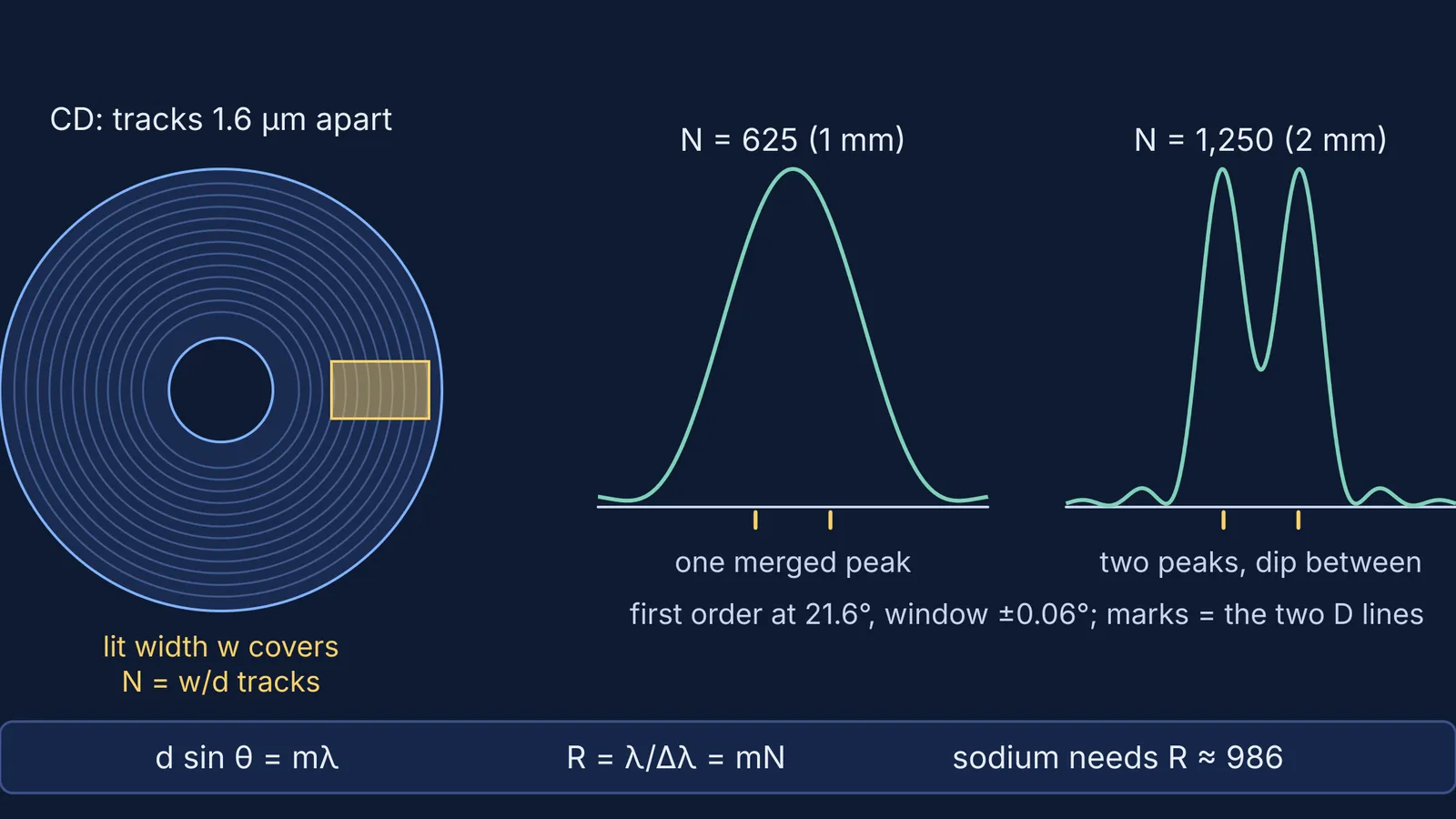
Shine yellow sodium light on a CD and the first-order spectrum shows a bright yellow line. Look closely with a telescope and that line may be two lines, sodium's famous D pair, or just one fat smudge. What decides it is not how finely the CD's tracks are spaced. It is how many tracks the light falls on. Light about 1,000 tracks and the pair separates; light 600 and it does not. The rule behind this is short: resolving power R = mN.
How close are sodium's two yellow lines?
The NIST Handbook of Basic Atomic Spectroscopic Data lists the two strong neutral-sodium lines at 5889.950 Å and 5895.924 Å in air, that is 588.995 nm and 589.592 nm. They are only Δλ = 0.597 nm apart.
The resolving power an instrument needs is R = λ/Δλ:
R = 589.0 / 0.597 ≈ 986.
Our post on Norman Lockyer and helium reaches the same figure for this pair. The question here is what gives a grating that resolving power.
What decides how sharp a grating's bright lines are?
A grating's bright lines (principal maxima) sit where d sin θ = mλ, with d the spacing and m the order. That equation contains no N, the number of lines. As our post on why more slits make sharper grating lines shows with phasors, N does not move the bright lines; it narrows them. The first dark point beside a maximum is 1/N of the way to the next order.
So two gratings with the same spacing put sodium's lines in the same places. The one with more lines lit makes each line thinner, and thin lines can sit side by side without merging.
Why is the resolving power of a grating R = mN?
Use the Rayleigh criterion: two wavelengths are just resolved when the maximum of one falls on the first minimum of the other. HyperPhysics sets out the argument.
The m-th order maximum of λ is where the path difference between neighbouring lines is mλ.
Its first minimum is where that path difference is mλ + λ/N. Across all N lines this adds one extra whole wavelength, and the N waves cancel.
The m-th maximum of λ + Δλ is where the path difference is m(λ + Δλ).
Set these equal: mΔλ = λ/N, so λ/Δλ = mN.
Here N is the number of lines actually lit, not lines per millimetre. Spacing sets where the lines go; N and the order m set how finely they can be split.
Worked example: can a CD split the sodium pair?
The ECMA-130 standard for CD-ROM, whose audio tracks follow IEC 908 (now IEC 60908), sets the spiral's pitch at 1.6 µm ± 0.1 µm. So d = 1.6 µm, about 625 tracks per millimetre. Our post on why a CD shows rainbow colours covers the grating angles; here we add N.
Where does the light go? Light falls straight on the disc.
First order: sin θ = 589.3/1600 = 0.368, so θ = 21.6°.
The two lines land at 21.60° and 21.62°, only 0.023° apart (about 1.4 minutes of arc).
Second order: sin θ = 0.737, θ = 47.4°, with the pair 0.063° apart. There is no third order, since 3 × 589 nm is more than 1600 nm.
How many tracks are lit? If the collimated sodium light covers a width w of the disc across the tracks, N = w/d.
w = 1 mm: N = 1.0 × 10⁻³ / 1.6 × 10⁻⁶ = 625. First order, R = 625. That is less than 986, so the pair merges into one line.
w = 2 mm: N = 1,250. First order, R = 1,250. More than 986, so the pair is resolved.
The smallest width that works in first order is 986 × 1.6 µm ≈ 1.6 mm.
In second order, R = 2N. The same 1 mm patch gives R = 1,250 and splits the pair. You need only about 0.8 mm.
A DVD. The ECMA-267 standard for DVD sets the track pitch at 0.74 µm ± 0.03 µm. A 1 mm patch lights about 1,351 tracks. Sodium's first order is at 52.7°, and since 2 × 589 nm is more than 740 nm there is no second order. The DVD splits the pair in first order with only 0.73 mm lit, because its lines are packed more tightly into the same width.
Why does a real CD do a little worse?
The tracks curve. A CD's track is a spiral, so across a few millimetres the lines are slightly curved arcs, not perfectly straight, parallel rulings.
The light is uneven. A beam is usually brighter in the middle than at the edges, so the outer tracks count for less than the centre ones, and the effective N is smaller than w/d.
Rayleigh is a convention. At exactly R = 986 the combined pattern still shows a small dip between the peaks. Better or worse detectors can see slightly more or less.
Grating spectra and resolving power are not named in the current JEE Main syllabus, so treat this as an extension of Class 12 diffraction, built on d sin θ = mλ and the N-slit result.
Can you try this at home?
Measuring the CD's track pitch is a common lab activity: shine a laser pointer on the disc and measure the angle of the first-order spot. Never look into a laser beam or its reflection off the disc, and never point a laser at anyone's eyes. A disc can bounce the beam in unexpected directions, so keep your eyes above the beam's plane and use a low-power pointer. A laser has a single colour, so it cannot show the sodium pair. For that you need a sodium lamp, a slit and a telescope, as in a school spectrometer.
To see how adding slits narrows each line, try the Simulation Lab, which has interactive simulations for ideas that are easier to see than read. For step-by-step help with grating numericals, the Fermi Problem Library is a step-by-step solver that explains the reasoning.
Quick checklist
Needed resolving power: R = λ/Δλ, about 986 for sodium's D pair.
A grating gives R = mN, with N the number of lines lit.
Spacing d sets the angles; N and m set the sharpness.
On a CD (1.6 µm pitch), first order needs about 1.6 mm lit; second order about 0.8 mm.
Real discs fall a little short because of curved tracks and uneven light.
Never look into a laser or point it at anyone.