On this page
On 10 September 1818 Friedrich Stromeyer reported to the Royal Society of Göttingen on "the new metal which he discovered in zinc and its oxides, and to which he has given the name of cadmium". An English summary, "New Details respecting Cadmium", appeared in Annals of Philosophy, volume 14, pages 269 to 274, in October 1819, translated from Annalen der Physik. The scan is free on the Internet Archive. Read today, his list of cadmium's reactions looks like a salt analysis card. All quotations below are from that report.
Who discovered cadmium, and when?
The report credits Stromeyer, "assisted by two of his pupils, M. Mahner, of Brunswick, and M. Siemens, of Hamburgh". It also says he explained "the part which M. Hermann, of Schoenbeck, and Dr. Roloff, of Magdeburg, had in it", without giving that part. Many histories date the discovery to 1817 and tell a story about a zinc oxide sample. Neither appears in the report we read, so we leave them out. What the report does say is where cadmium hides: only "a very small proportion in some blendes", except some radiated blende from Příbram (Przibram in the text), "which contains two or three per cent of it".
How did Stromeyer separate cadmium from zinc and copper?
His purification is a short qualitative analysis scheme.
Dissolve the sample in sulphuric acid. The solution "must contain a sufficient excess of acid".
Pass H₂S. Cadmium sulphide comes down; zinc stays in solution because the medium is acidic.
Dissolve the precipitate in concentrated hydrochloric acid and drive off the excess acid.
Add ammonium carbonate in excess. This redissolves "the zinc and the copper that may have been precipitated", while cadmium carbonate stays behind.
Heat the carbonate to the oxide, then reduce it with lamp-black (carbon) at a moderate red heat.
Step 2 is the reason you pass H₂S in acid for Group II, explained in why H₂S is passed in acidic medium for Group II.
Which reactions of cadmium did Stromeyer record?
He listed eight tests for cadmium salts. Five matter for your practical.
Fixed alkalies (NaOH, KOH). A white hydrate forms. "When added in excess, they do not redissolve the precipitate, as is the case with the oxide of zinc."
Cd²⁺ + 2OH⁻ → Cd(OH)₂ (white) Zinc behaves differently: Zn(OH)₂ + 2OH⁻ → [Zn(OH)₄]²⁻. Zinc hydroxide is amphoteric; cadmium hydroxide is not. See amphoteric oxides with Al₂O₃ and ZnO examples.
Ammonia. A white precipitate first, "but an excess of the alkali immediately redissolves the precipitate."
Cd(OH)₂ + 4NH₃ → [Cd(NH₃)₄]²⁺ + 2OH⁻ Check the charge: 0 on the left, (+2) + 2(−1) = 0 on the right.
H₂S. It precipitates cadmium "yellow or orange". The precipitate "resembles orpiment" (As₂S₃), but it "differs particularly in its easy solubility in muriatic acid".
Cd²⁺ + H₂S → CdS (yellow) + 2H⁺ CdS + 2HCl → CdCl₂ + H₂S
Zinc metal. "Zinc precipitates cadmium in the metallic state in the form of dendritical leaves." Zn + Cd²⁺ → Zn²⁺ + Cd. With E° values of −0.76 V for Zn²⁺/Zn and −0.40 V for Cd²⁺/Cd, E°cell = +0.36 V, so the reaction is spontaneous.
Ammonium carbonate. The cadmium precipitate "is not soluble in an excess", but zinc's is. That is the reason step 4 above works.
Today's scheme separates CdS from As₂S₃ with yellow ammonium sulphide, which dissolves the arsenic group as thio-salts: see Group IIA vs IIB with yellow ammonium sulphide. Stromeyer's acid test points the same way. CdS is a basic sulphide that dissolves in strong acid. As₂S₃ is an acidic sulphide that does not.
Worked example: cadmium's atomic mass from Stromeyer's oxide
The report says: "Cadmium forms only a single oxide; 100 parts of the metal combine with 14.352 of oxygen." Find the atomic mass.
Equivalent mass. The equivalent mass is the mass of metal that combines with 8 parts of oxygen. E = 100 × 8 ÷ 14.352 = 55.74.
Valency. There is only one oxide, CdO, so cadmium has valency 2.
Atomic mass. A = E × valency = 55.74 × 2 = 111.5.
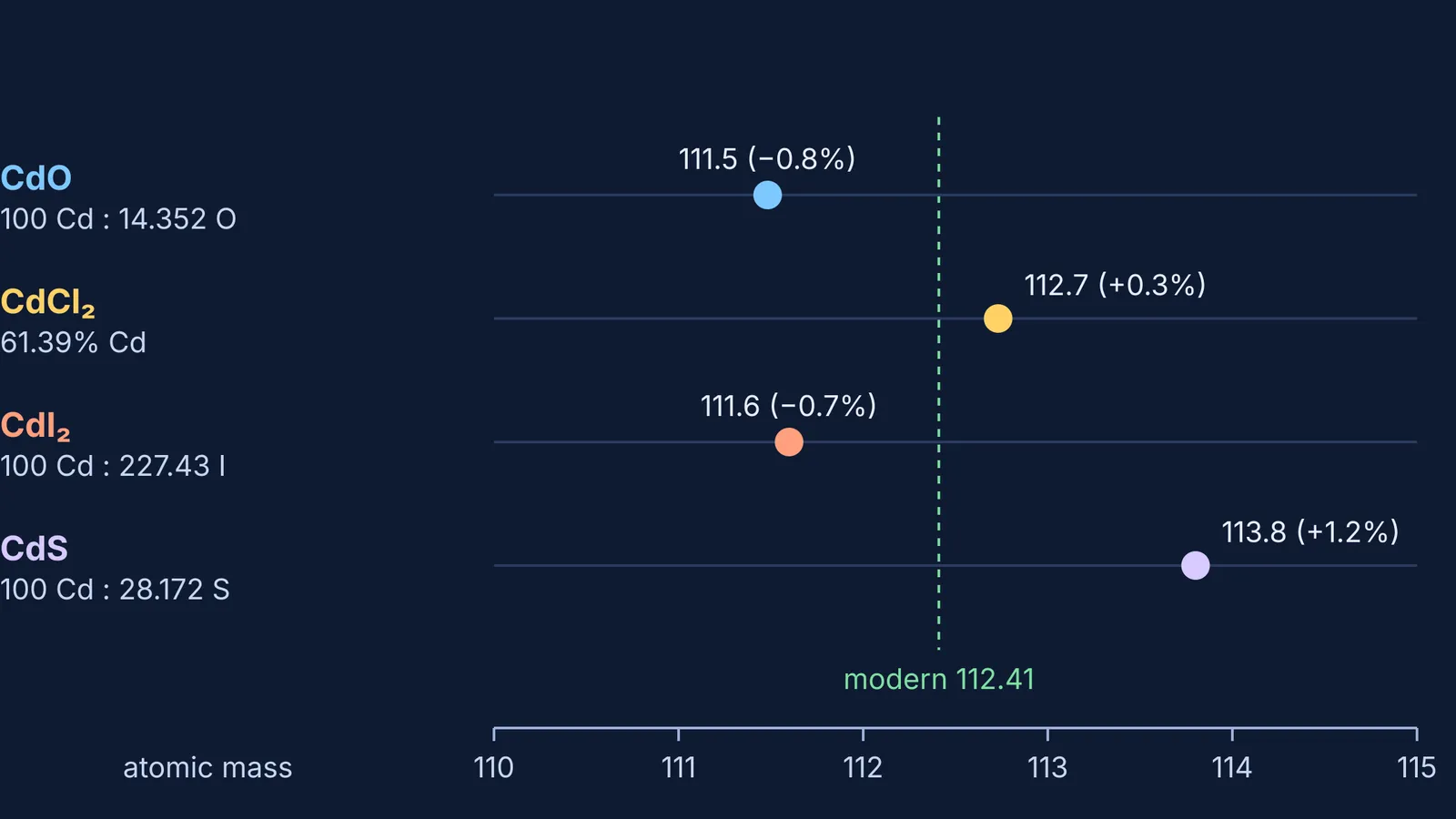
Compare. The modern value is 112.41, so his figure is about 0.8% low.
His printed "equivalent number for cadmium is 69.677" uses a different scale, with oxygen = 10. Check: 100 × 10 ÷ 14.352 = 69.68. Divide by 10 and multiply by 8 to get 55.74.
He did not stop at the oxide. Three other analyses in the same report give the same answer within about 1%:
Chloride. Fused CdCl₂ is 61.39% Cd and 38.61% Cl. A = 2 × 35.45 × 61.39 ÷ 38.61 = 112.7. Today's composition is 61.32% Cd.
Iodide. 100 parts Cd take 227.43 parts iodine. For CdI₂, A = 2 × 126.90 × 100 ÷ 227.43 = 111.6.
Sulphide. 100 parts Cd take 28.172 parts sulphur. For CdS, A = 32.06 × 100 ÷ 28.172 = 113.8.
Four salts gave 111.5, 112.7, 111.6 and 113.8 when we work them out with today's values for O, Cl, I and S. They sit on both sides of 112.41. The step-by-step method for oxide data is in how to find the equivalent mass of a metal from oxide data.
What else did Stromeyer notice about cadmium?
Specific gravity 8.6040 cast and 8.6944 hammered. The modern value is about 8.65.
It volatilises "at a heat not much greater than what is necessary to volatilize mercury".
The sulphide has "a yellow colour, with a shade of orange". Heated, it "becomes first brown, and then crimson, but it loses these colours on cooling". He gave no explanation, and we do not offer one here. Do not borrow the metal excess defect used for zinc oxide; that is a separate case.
The sulphide "promises to be useful in painting", the start of cadmium yellow.
A copper–cadmium alloy loses all its cadmium as vapour at the melting point of copper. That, he says, is why "tutty usually contains oxide of cadmium". Tutty was the impure zinc oxide collected from the flues of brass furnaces.
For salt analysis before the exam, Fermi Test Prep is JEE Main and Advanced preparation with an AI tutor, and you can revise the theory in its Concept Library.
Quick checklist
Cadmium was reported by Stromeyer to the Göttingen society on 10 September 1818.
Cd²⁺ + H₂S in acid gives yellow CdS, which dissolves in concentrated HCl. As₂S₃ does not.
Excess NaOH: Cd(OH)₂ stays; Zn(OH)₂ dissolves as [Zn(OH)₄]²⁻.
Excess NH₃: Cd(OH)₂ dissolves as [Cd(NH₃)₄]²⁺.
Zinc displaces cadmium: E°cell = +0.36 V.
100 Cd : 14.352 O gives E = 55.74 and A = 111.5. Modern A = 112.41.