On this page
These pairs and questions are built on NCERT Class 12 Biology, Chapter 12, Ecosystem (Reprint 2026-27). The NEET (UG) 2026 syllabus places Ecosystem in Unit 10, Ecology and Environment. All questions are original, not past-paper items or predictions.
What are the NCERT exceptions in the Ecosystem chapter?
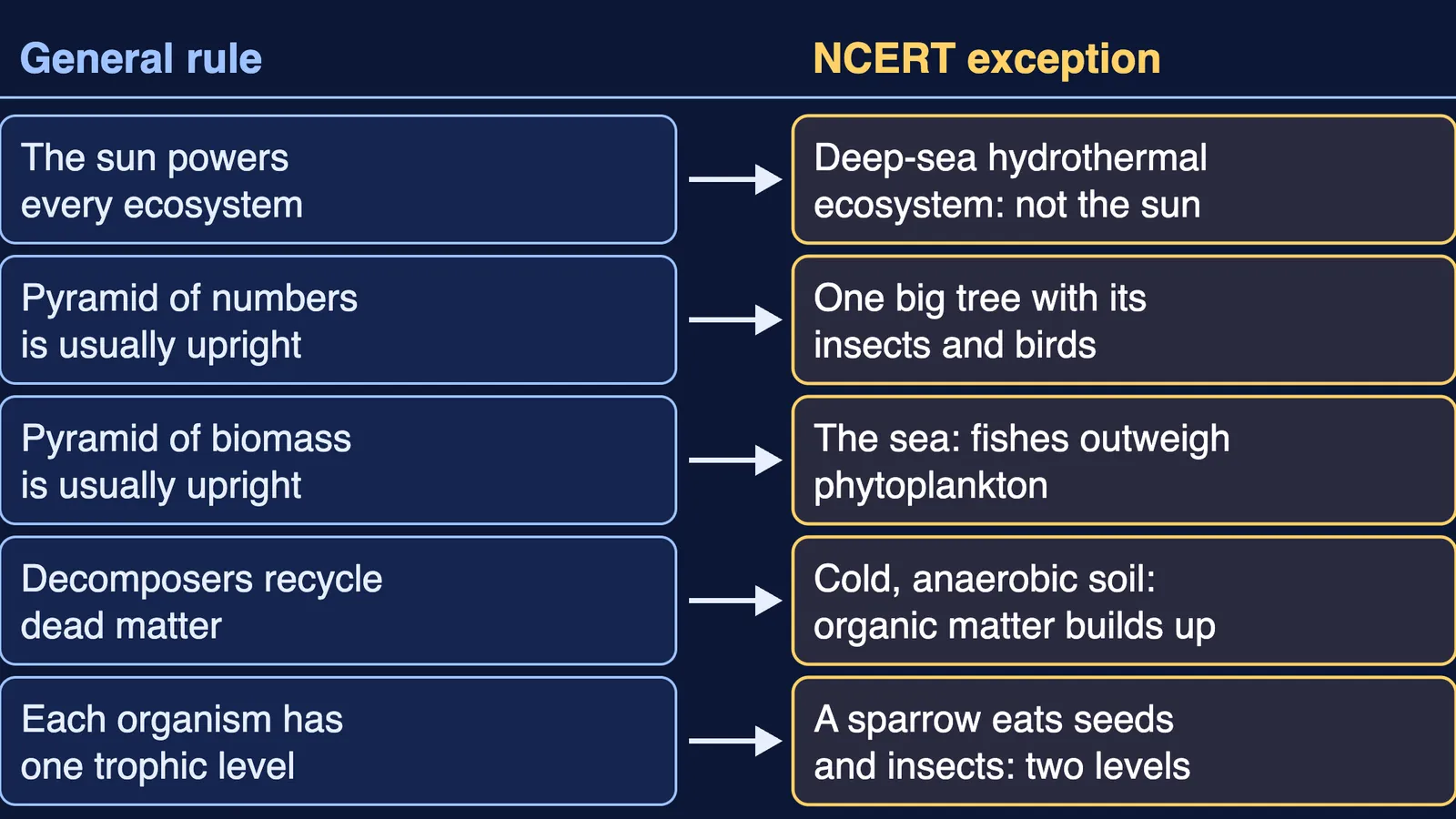
Each line: a rule the chapter states, then the exception or limitation NCERT names.
Every ecosystem needs constant solar input (12.2), and the sun is the only energy source, except for the deep-sea hydrothermal ecosystem (12.4).
In most ecosystems the pyramid of numbers is upright; NCERT's exception is a single big tree, the insects feeding on it, and the small and larger birds above them (12.5).
In most ecosystems producers outweigh herbivores; the sea's biomass pyramid is generally inverted, as fishes far outweigh the phytoplankton there (12.5, Figure 12.4c).
Organisms take a specific trophic level from their source of food (12.4); yet one species can hold two levels at once, as a sparrow does when it eats seeds and also insects and worms, and pyramids cannot show this (12.5).
A food chain runs from producers to consumers, each animal eating a plant or another animal (12.4); yet cockroaches and crows are omnivores, and some detritus-chain organisms are prey to grazing-chain animals, so the chains join into a web (12.4).
Pyramids are meant to show an ecosystem's food and energy relationships (12.5); yet saprophytes get no place in them, though NCERT calls their role vital (12.5).
A pyramid stacks trophic levels as one simple food chain; NCERT notes such a chain almost never exists in nature, and the pyramid cannot show a food web (12.5).
Dead matter is decomposed and mineralised, and its nutrients go back to the autotrophs again and again (12.1); under low temperature and anaerobiosis decomposition is inhibited and organic material piles up (12.3).
How do you handle odd-one-out and exception questions?
Write the stem's basis in the margin, then mark each option yes or no against that basis only.
If two options seem to break the pattern, you have switched to a second feature; go back to the stated basis.
In "NOT an exception" items, look for the ordinary case: the option that simply follows the rule.
Ecosystem odd-one-out questions
Q1. Judged only on whether NCERT gives it as an example of a terrestrial ecosystem, which is the odd one out? (1) Forest (2) Desert (3) Wetland (4) Grassland
Answer: (3). NCERT lists the wetland with pond, lake, river and estuary as aquatic.
Q2. Judged on whether NCERT counts it among the autotrophs that fix the sun's energy, which is the odd one out? (1) Phytoplankton (2) Photosynthetic bacteria (3) Woody plants (4) Flagellates
Answer: (4). NCERT lists flagellates with fungi and bacteria as the pond's decomposers.
Q3. Judged on whether NCERT lists it as detritus, the raw material of decomposition, which is the odd one out? (1) Humus (2) Bark (3) Flowers (4) Fallen leaves
Answer: (1). Humus is a product of humification, not dead remains.
Q4. Judged on whether NCERT defines it as a rate, which is the odd one out? (1) Gross primary productivity (2) Standing crop (3) Net primary productivity (4) Secondary productivity
Answer: (2). Standing crop is the mass of living material at a level at a particular time.
Q5. Judged on whether NCERT credits the step to an organism or its enzymes, which is the odd one out? (1) Fragmentation (2) Leaching (3) Catabolism (4) Mineralisation
Answer: (2). Detritivores, enzymes and microbes drive the other three; leaching is soluble nutrients sinking through the soil.
Which is NOT an exception?
Q6. Which is NOT a case NCERT sets against one of its own general statements? (1) The energy source of the deep-sea hydrothermal ecosystem (2) The sea's pyramid of biomass (3) Insects on one big tree in a pyramid of numbers (4) Trees forming the top stratum of a forest
Answer: (4). That is NCERT's ordinary account of stratification, with no exception attached.
Q7. Which does NCERT NOT give as a case of an animal feeding at more than one trophic level? (1) A sparrow eating seeds as well as insects (2) Crows as omnivores (3) Cockroaches as omnivores (4) The goat in grass, goat, man
Answer: (4). The goat is simply the primary consumer in NCERT's grazing chain.
Two-statement and single-correct questions
Options for Q8 to Q10: (1) I and II true (2) I and II false (3) I true, II false (4) I false, II true.
Q8. I: NCERT says pyramid calculations must include all organisms at a trophic level, since a few individuals cannot support a generalisation. II: Standing crop can be measured as biomass or as the number of organisms in a unit area.
Answer: (1). Both are NCERT's statements on pyramids and standing crop.
Q9. I: NCERT calls the pond too big and complex to study as one unit. II: NCERT says crop fields and an aquarium may be treated as man-made ecosystems.
Answer: (4). NCERT says this of the whole biosphere; it calls the pond fairly self-sustainable and simple.
Q10. I: The death of an organism begins the detritus food chain. II: Detritus food chain organisms are never eaten by grazing food chain animals.
Answer: (3). NCERT says some detritus-chain organisms are prey to grazing-chain animals.
Q11. In NCERT's grassland pyramid of numbers, production by nearly 6 million plants supports how many top carnivores? (1) 3 (2) 30 (3) 300 (4) 3,000
Answer: (1). The Figure 12.4(a) caption gives just three.
Q12. Which does NCERT NOT list as something primary productivity depends on? (1) The plant species in the area (2) Availability of nutrients (3) Photosynthetic capacity of plants (4) The number of top carnivores
Answer: (4). NCERT names species, environmental factors, nutrients and photosynthetic capacity.
What should you do after this set?
Redo all 12 with answers covered, writing each odd-one-out basis first.
Turn every miss into a one-line rule and exception in your notes.
Then switch formats: the statement and match-the-list questions on Ecosystem, the Ecosystem diagram-based questions on soil and pyramids and the Ecosystem assertion-reason questions.
Which exception in this chapter keeps slipping away? Fermi's AI tutor works out what you already know and builds a plan for the session.