On this page
A betatron is a ring-shaped vacuum tube between the poles of an electromagnet. Electrons go round inside it, and every turn they gain a few tens of electronvolts from the induced electric field. After a few milliseconds they have gone round hundreds of thousands of times and reached tens of MeV. The design rests on one surprising condition: the average magnetic field inside the orbit must be exactly twice the field at the orbit. This post derives the 2:1 rule and works a JEE Advanced-style example with it.
What drives the electrons round a betatron?
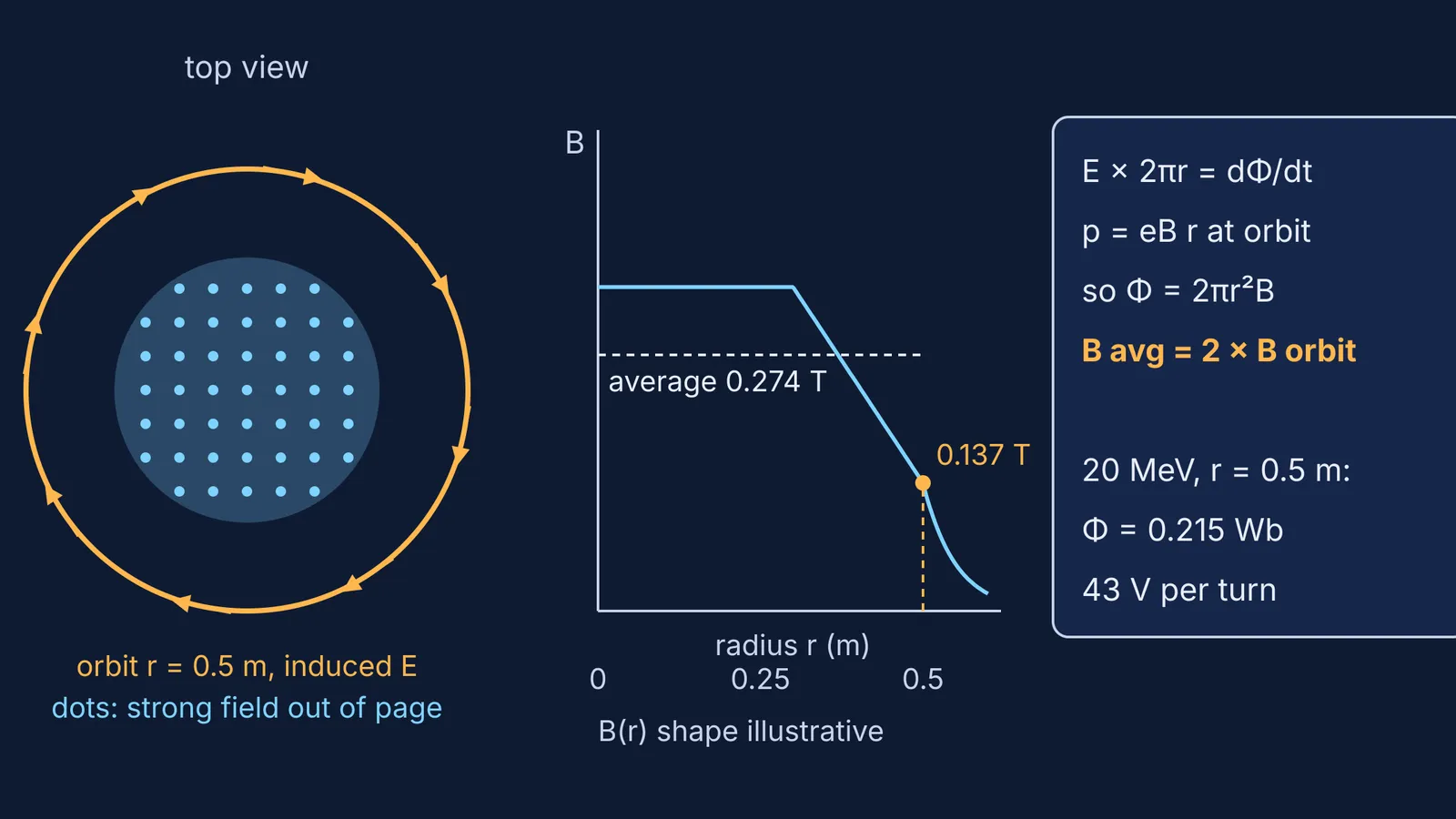
Nothing touches the electrons and there are no electrodes. The magnet's current rises, so the magnetic flux Φ through the orbit rises, and Faraday's law says a changing flux produces an electric field round any loop:
∮E·dl = dΦ/dt, in magnitude. On a circular orbit of radius r, by symmetry, E × 2πr = dΦ/dt.
This is the induced electric field, which exists even when there is no wire. It is the same field explained in is an emf induced in an open circuit without current?. The field pushes along the orbit, so it does work on them every turn.
The induced field has no potential: go once round and you gain energy, which could never happen in an electrostatic field. So "43 volts per turn" is an emf, not a voltage between two points.
Why must the field inside the orbit be twice the field at the orbit?
The electrons must stay on the same circle while they speed up, because the vacuum tube is a fixed ring. Two conditions must hold together.
Speeding up. The tangential force is eE, so the rate of change of momentum is dp/dt = eE = (e/2πr) dΦ/dt.
Staying on the circle. The magnetic force supplies the centripetal force: p = eB₀r, where B₀ is the field at the orbit. With r fixed, dp/dt = er dB₀/dt.
Set the two equal: (e/2πr) dΦ/dt = er dB₀/dt, so dΦ/dt = 2πr² dB₀/dt. Starting from zero field and zero flux:
Φ = 2πr²B₀
The flux through the orbit is Φ = πr² × B_avg, where B_avg is the average field over the area inside the orbit. So B_avg = 2B₀.
Note that p = eBr is true at any speed, provided p is the relativistic momentum, and dp/dt = eE is Newton's second law in its relativistic form. So the 2:1 rule holds all the way up to speeds close to c. The rule is met by shaping the magnet so the field is stronger near the centre than at the orbit.
If the average field were only equal to the orbit field, the electrons would gain only half the momentum needed for that orbit at each moment. The magnetic force would then bend them into a tighter circle, and they would spiral inwards.
Worked example: a 0.5 m betatron for 20 MeV electrons
Problem (JEE Advanced style, illustrative numbers): a betatron has an orbit of radius 0.50 m. The magnet is fed from a 50 Hz supply, and electrons are accelerated from rest during one quarter-cycle, as the field rises from zero to its peak. They leave with 20 MeV of kinetic energy. Find the field at the orbit, the flux through it, the average emf per turn and the number of turns. Take mc² = 0.511 MeV for the electron.
Momentum: total energy E = 20 + 0.511 = 20.511 MeV. Then pc = √(E² − (mc²)²) = √(20.511² − 0.511²) = 20.50 MeV.
Field at the orbit: B₀ = p/(er). In SI units, p = 20.50 × 10⁶ × 1.602 × 10⁻¹⁹/(3.00 × 10⁸) = 1.095 × 10⁻²⁰ kg m/s, so B₀ = 1.095 × 10⁻²⁰/(1.602 × 10⁻¹⁹ × 0.50) = 0.137 T. A handy shortcut: B (in T) × r (in m) = p (in MeV/c)/300.
Flux needed: Φ = 2πr²B₀ = 2π × 0.25 × 0.137 = 0.215 Wb. The average field inside the orbit is Φ/πr² = 0.274 T, twice 0.137 T.
Time: a quarter-cycle at 50 Hz is 1/200 s = 5 ms.
Emf per turn: ΔΦ/Δt = 0.215/0.005 = 43 V on average. The induced field at the orbit is 43/(2π × 0.5) = 13.7 V/m.
Number of turns: each turn gives an electron about 43 eV, so reaching 20 MeV takes 20 × 10⁶/43 ≈ 465,000 turns.
Distance: 465,000 × 2π × 0.5 m ≈ 1,460 km. As a check, light travels 1,500 km in 5 ms, and the electrons move at almost c for nearly the whole time.
Final speed: γ = E/mc² = 40.1, so v = c√(1 − 1/γ²) = 0.9997c.
How is a betatron different from a cyclotron?
A cyclotron uses a steady magnetic field and an alternating voltage across a gap between two dees. Its particles spiral outwards, and the frequency is the same at every radius only while the particle is not relativistic; see why cyclotron frequency does not depend on speed and how the dee radius sets the maximum energy. Electrons become relativistic at well under 1 MeV, so a cyclotron cannot keep in step with them for long.
A betatron does it the other way round. The field changes in time, the orbit stays at one radius, and the accelerating field comes from induction, not from electrodes. There is no frequency to match, which is why it suits electrons.
Who built the first betatron?
Donald Kerst built the first working betatron at the University of Illinois. His letter of 17 July 1940 to the head of department, held by the University of Illinois Archives, reports that "Monday afternoon the electron accelerator started to work". He announced it in Physical Review 58, 841 (1940), and his full paper, Physical Review 60, 47 (1941), describes electrons accelerated to 2.3 MeV by the electric field of a changing magnetic field. With Robert Serber he worked out the theory of stable orbits: real betatrons shape the pole faces so the field falls off gently with radius, which pulls a stray electron back to its orbit both sideways and up and down. In 1942 Kerst reported a new machine generating 20 MeV.
Betatron electrons striking a target produce intense X-rays, which have been used to treat cancer and to examine metal parts for flaws. Particle accelerators are run only by trained staff behind radiation shielding.
Prepare for JEE problems on the induced electric field
Induced-field questions in JEE Advanced often combine E × 2πr = dΦ/dt with circular motion, exactly as the 2:1 rule does. If you are preparing for JEE Main & Advanced, Fermi Test Prep offers personalised preparation with an AI tutor, live classes, adaptive mocks, mentorship and a study plan that updates based on mastery. To work more induction problems step by step, the Fermi Problem Library has a solver that explains the reasoning.
Quick checklist
Induced field round the orbit: E × 2πr = dΦ/dt.
Speeding up: dp/dt = eE. Staying on the circle: p = eB₀r.
Together: Φ = 2πr²B₀, so B_avg = 2B₀ at every moment.
Use relativistic momentum: 20 MeV electrons have p = 20.5 MeV/c.
0.5 m orbit, 20 MeV: B₀ = 0.137 T, Φ = 0.215 Wb, 43 V per turn over 5 ms.
Kerst's first betatron (1940) reached 2.3 MeV.