On this page
A cyclotron question in JEE Main often asks one thing in many disguises: how much energy does the particle have when it comes out? The answer hides in one length, the radius of the dees.
In 1932, Ernest Lawrence and M. Stanley Livingston described producing high-speed light ions without high voltages in Physical Review. If you want the full story of how the machine works, our explainer on how a charged particle moves in a cyclotron covers it, and the history is in our profile of Ernest Lawrence and the first cyclotron.
How do you derive the maximum kinetic energy in a cyclotron?
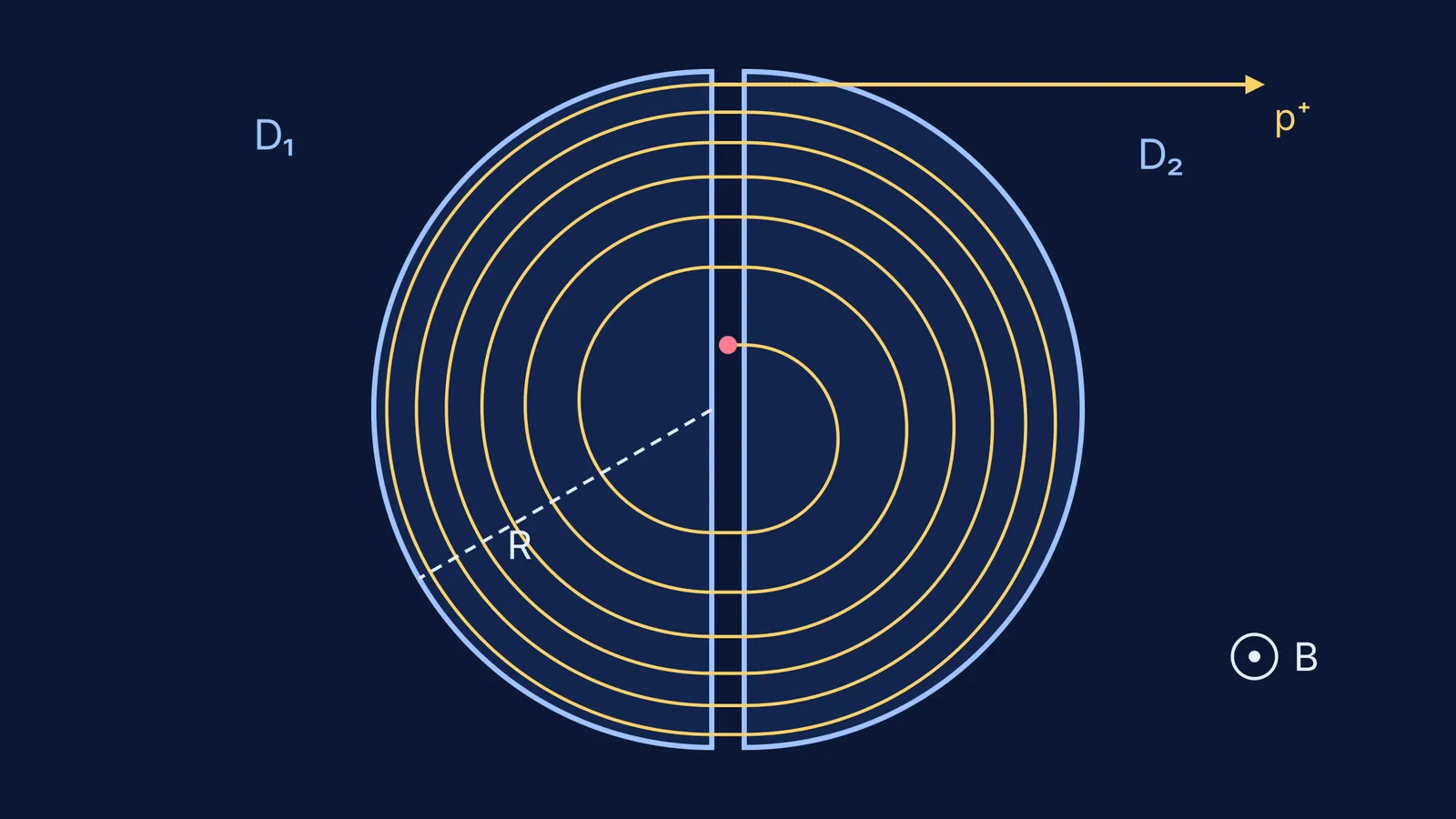
The particles move between two hollow, D-shaped metal halves called dees, and a uniform magnetic field B bends them into circles, as OpenStax University Physics describes. Each time a particle crosses the gap between the dees, an alternating voltage gives it a push. Inside a dee there is no electric field, so the magnetic force alone sets the path.
The magnetic force qvB supplies the centripetal force: qvB = mv²/r.
Solve for the radius: r = mv/qB. Faster particles move on bigger circles, which is why the path spirals outward.
The particle can only go round while r is less than the dee radius R. At the rim, r = R, so the exit speed is v = qBR/m.
Put that into K = ½mv². You get K = q²B²R²/2m.
That last line matches the result in OpenStax and in Boston University's cyclotron notes, which also point out that the final energy grows with the square of the field.
Why is cyclotron frequency independent of speed?
The time for one full circle is the circumference divided by speed: T = 2πr/v. Substitute r = mv/qB and the v cancels, leaving T = 2πm/qB. The frequency is f = qB/2πm.
In plain words: a faster particle runs a bigger circle, and the two effects cancel exactly. OpenStax states it directly: in a uniform magnetic field, a particle's orbital period is independent of its radius and its kinetic energy. That is why one fixed-frequency AC supply stays in step with the particle for every half-turn. The magnetic force never speeds the particle up, as our post on why the magnetic force does no work explains. All the energy comes from the gap.
Worked example: how much energy does a proton get?
Take a proton in a field B = 1.0 T, with dees of radius R = 0.50 m. Use the CODATA 2022 values from NIST: charge e = 1.602 176 634 × 10⁻¹⁹ C and proton mass m = 1.672 621 926 × 10⁻²⁷ kg.
Momentum at the rim: qBR = 1.602 × 10⁻¹⁹ × 1.0 × 0.50 = 8.01 × 10⁻²⁰ kg m/s.
Exit speed: v = qBR/m = 4.79 × 10⁷ m/s, about 16% of the speed of light.
Kinetic energy: K = (qBR)²/2m = 1.92 × 10⁻¹² J.
In electronvolts: divide by e to get 1.20 × 10⁷ eV, so about 12 MeV.
Frequency: f = qB/2πm = 1.52 × 10⁷ Hz, or 15.2 MHz, so one turn takes about 65.6 ns.
Now add a gap voltage of 50 kV. The proton crosses the gap twice per turn, so it gains 0.1 MeV per turn. To reach 12 MeV it needs about 120 turns, which takes roughly 120 × 65.6 ns, or about 7.9 microseconds. Halve the voltage and you double the number of turns, but the exit energy stays 12 MeV.
What do students get wrong?
Writing K in terms of V. The voltage only sets the number of turns.
Forgetting the squares. K grows with the square of B and of R, as the Boston University notes show, so doubling either makes K four times larger.
Mixing up f and ω. The angular frequency is qB/m; the frequency in hertz is qB/2πm.
Using the diameter for R. The formula needs the radius of the dees.
If you want to check each step of a problem like this one, the Fermi Problem Library has worked problems with a step-by-step solver that explains the reasoning rather than printing an answer.
Where does the formula stop working?
The speed-independent period assumes the mass stays constant. At high speeds that breaks down. OpenStax puts the practical limit of a simple cyclotron at about 30 MeV, above which relativistic effects matter. Our 12 MeV proton is well under it: compared with the proton's rest energy of 938.272 MeV, it is only about 1.3% heavier in the relativistic sense, so it falls slightly behind the AC supply over many turns.
Try it now: redo the example with R = 1.0 m and confirm the formula gives four times the energy, about 48 MeV. That is past the roughly 30 MeV limit, so a simple cyclotron could not actually deliver it.