On this page
A car is moving at 72 km/h when something appears ahead. Physics lets you compare two ideal moves: stop in a straight line, or turn away. With a simple model and a little circular motion you can work out how much road each one needs. The answer is not "always brake" or "always steer". It depends on how far sideways you would have to move.
Read this first. This post is a physics model, not driving advice, and it does not tell anyone what to do in an emergency. On the road, obey speed limits and keep a safe distance from the vehicle in front, so that you have room to stop. Real cars, tyres, roads and drivers differ from this model in many ways, listed below. The model's clearest lesson is about speed: stopping distance grows as v², so a lower speed buys you far more room than any choice of move.
How far does a car need to stop?
If the tyres can supply a friction force of at most μmg, the largest deceleration is μg. From v² = 2as, the shortest stopping distance is
s = v²/2μg
This is the formula worked through in does a heavier car take longer to stop: the mass cancels. Double the speed and the distance becomes four times larger.
How tight can a car turn at the same speed?
To go round a circle of radius R at speed v, the car needs a sideways (centripetal) force mv²/R. Friction supplies it, up to μmg, so the tightest turn has
R = v²/μg
This is the same limit as in when an accelerating car skids on a circular track. Notice that R is exactly twice the stopping distance.
The tyres have one budget of grip. Total horizontal friction, braking plus turning, cannot go above μmg. Engineers call this the friction circle. So you cannot brake at full strength and turn at full strength at the same time. Here we compare two pure moves: all of the grip used for braking, or all of it used for turning. Vehicle-dynamics researchers use the same kind of friction-limited point-mass model for planning emergency moves, for example Gao, Gordon and Lidberg in Vehicle System Dynamics.
Why is braking shorter for a wall across the whole road?
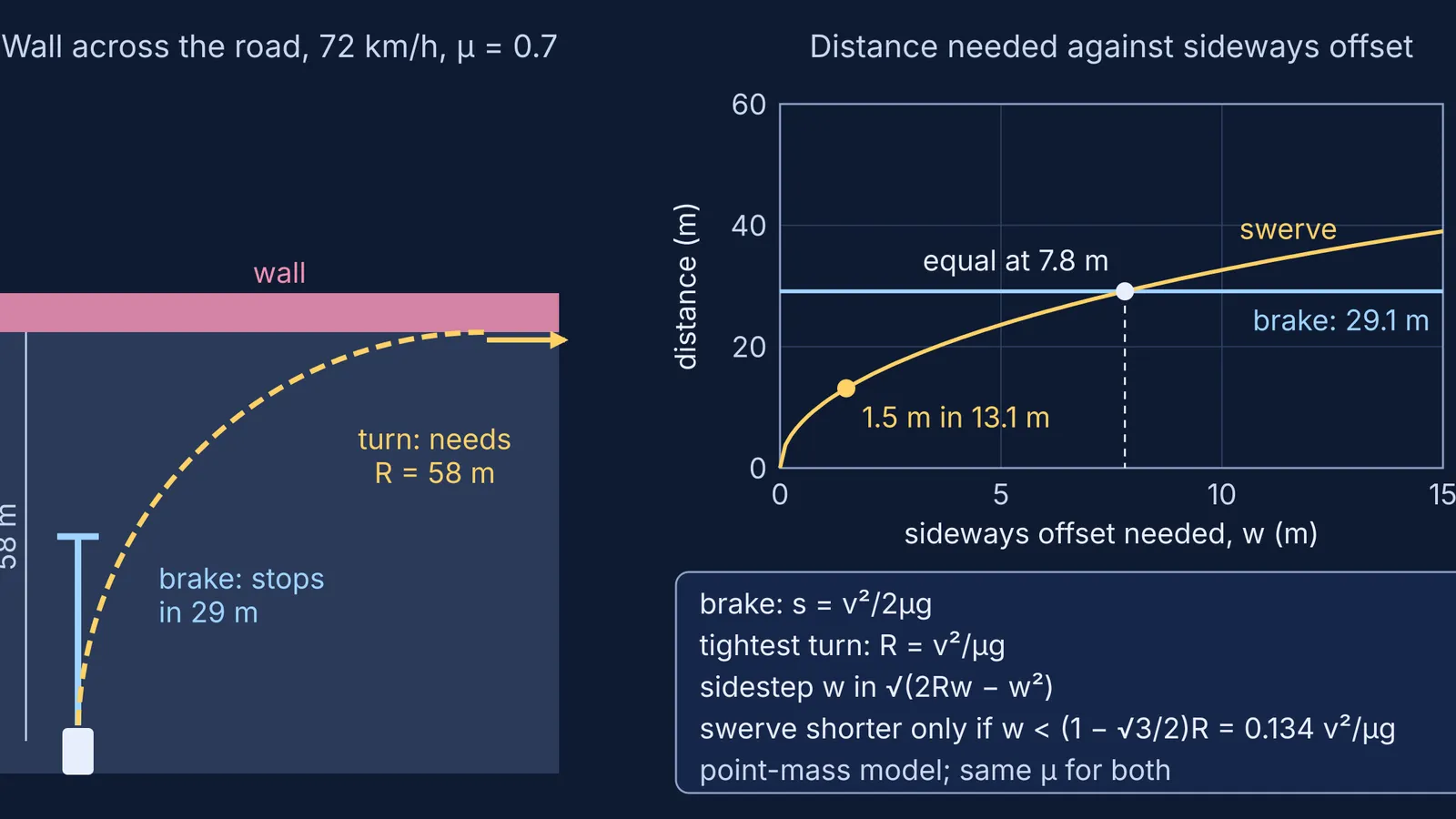
Suppose the obstacle blocks the full width, like a wall. Turning away means swinging the car through 90° before it reaches the wall. On the tightest circle, the car moves forward by a full radius R while it turns. Braking needs only R/2.
So with the same grip, turning away from a wall needs twice the distance that stopping does.
When does a small sideways step need less road than stopping?
Most obstacles are not walls. Suppose you only need to move sideways by a distance w. On a circle of radius R that starts straight ahead, the sideways offset after travelling forward a distance d is w = R − √(R² − d²). Solve for d:
d = √(2Rw − w²)
For small w this is close to √(2Rw) = v√(2w/μg). That grows only in proportion to v, while the stopping distance grows as v². At high speed, a small sidestep needs less road than a stop.
Set the two distances equal, √(2Rw − w²) = R/2. Square both sides: w² − 2Rw + R²/4 = 0, so
w = R(1 − √3/2) = 0.134 R = 0.134 v²/μg
For offsets smaller than this the sidestep needs less forward distance; for larger offsets, braking does. Studies of automated emergency braking and steering compare the same two distances against speed: Hattori, Ono and Hosoe computed a minimum distance for pure braking and for pure steering at each starting speed, as summarised in a 2021 review of emergency obstacle avoidance by Lowe and Guvenç.
Worked example: 72 km/h on a dry road
Take v = 72 km/h = 20.0 m/s, g = 9.81 m/s² and μ = 0.7. That μ is a round illustrative value for a dry road; real values depend on the tyres, the road surface and its condition.
Stopping distance. s = 20.0² ÷ (2 × 0.7 × 9.81) = 400 ÷ 13.73 = 29.1 m.
Tightest turn. R = 20.0² ÷ (0.7 × 9.81) = 58.2 m, twice the stopping distance.
A 1.5 m sidestep, say round a stalled scooter. d = √(2 × 58.2 × 1.5 − 1.5²) = √172.4 = 13.1 m.
Crossover. w = 0.134 × 58.2 = 7.8 m. Below this offset the model's sidestep needs less road; above it, stopping does.
Units. (m/s)² ÷ (m/s²) gives metres in every line.
Now change the conditions, keeping the 1.5 m offset:
100 km/h, μ = 0.7: stop in 56.2 m, R = 112.4 m, sidestep in 18.3 m, crossover 15.1 m.
72 km/h, wet road, μ = 0.4 (illustrative): stop in 51.0 m, R = 101.9 m, sidestep in 17.4 m, crossover 13.7 m.
50 km/h, μ = 0.7: stop in 14.0 m, sidestep in 9.1 m.
Look at what speed does. Going from 72 to 100 km/h almost doubles the stopping distance. Going from 72 down to 50 km/h halves it. The distance covered while the driver reacts is the same for both moves, so it drops out of the comparison, but it adds to the total in every case.
What does the model leave out?
A lot, and every item makes real life harder than the model.
The car is not a point. Its width adds to the offset w you need, and it must also not hit anything beside the obstacle.
Turning takes time to build. A real car does not reach its full sideways grip the instant the wheel is turned.
After the sidestep the car is still moving fast, now pointing at an angle, and needs more room to straighten up. Other traffic or the road edge may be there.
Grip is not one fixed number. μ changes with tyres, road, water, speed and load, and it differs between front and rear wheels.
Combined moves exist. Anti-lock brakes let a driver keep some steering while braking, as explained in how ABS brakes stop skidding, but the friction circle still limits the total.
People are not ideal. Reaction time, surprise and judgement all vary.
So treat the 7.8 m crossover as a result about circles and friction, not a rule for the road. The safest margin comes from speed and following distance, chosen long before anything appears ahead.
To practise friction and circular-motion problems like this one, the Fermi Problem Library has a step-by-step solver that explains the reasoning. For a full plan, Fermi Test Prep offers personalised preparation for JEE Main & Advanced with an AI tutor, live classes, adaptive mocks, mentorship and a study plan that updates based on mastery.
Quick checklist
Stopping distance with grip μ: v²/2μg.
Tightest turn at the same speed: R = v²/μg, twice the stopping distance.
Turning away from a full-width wall needs twice the road that stopping does.
A sideways step w needs √(2Rw − w²) of forward distance.
In the model, the sidestep needs less road only if w is below 0.134 v²/μg.
One grip budget: full braking and full turning cannot happen together.
Obey speed limits and keep a safe distance; real cars, tyres and drivers differ from this model.