On this page
On 11 December 1922 Niels Bohr gave his Nobel lecture. He ended it not with a summary but with a test of his own theory, carried out in Copenhagen. The question was simple: where in the periodic table does element 72 belong? Bohr's electron shells said it had to sit under titanium and zirconium. A rival report said it was a rare earth. By the time he spoke, Dirk Coster and George de Hevesy already had the answer, and the element they found, hafnium, is still the example NCERT uses for the lanthanoid contraction.
Why was element 72 still missing in 1922?
By 1922 atomic numbers were fixed by X-ray spectra, the method Henry Moseley used to put the periodic table in order. So chemists knew there was a gap at Z = 72. What they did not know was what kind of element would fill it.
In the lecture, Bohr describes the "hitherto unknown element with atomic number 72" and says "opinion has been divided". In many versions of the table, he notes, "a place is left open for this element in the rare-earth family". The rare earths (our lanthanoids) were notoriously hard to tell apart, so a missing one could hide among them.
What did Bohr's theory predict for element 72?
Bohr explained the rare earths as the filling of an inner electron group. In today's language, that is the 4f subshell, filled from lanthanum to lutetium. Once that inner group is complete at Z = 71, the next electron cannot go there. Element 72 must add its electron to the outer d shell, just as zirconium does.
In his words, the electron configurations of titanium and zirconium "show the same sort of resemblances and differences as the electron configurations for zirconium and the element with atomic number 72". He notes that Julius Thomsen's older table had put the element there too, and that Bury reached the same view.
In modern notation the prediction reads:
Ti: [Ar]3d²4s²
Zr: [Kr]4d²5s²
Hf: [Xe]4f¹⁴5d²6s²
All three have two d electrons and two s electrons outside a closed core. That is why they share the +4 state and form a family.
How did Coster and Hevesy find hafnium?
Then came a challenge. Bohr reports that Dauvillier had just published "some weak lines in the X-ray spectrum of a preparation containing rare-earths", ascribed to element 72 as a rare earth "presumed by Urbain many years ago". If that held, Bohr said, it would "place extraordinarily great, if not unsurmountable, difficulties in the way of the theory".
Coster, who Bohr says "has for some years worked in Siegbahn's laboratory" on X-ray spectra, and Hevesy were both working in Copenhagen. Instead of searching rare-earth samples, they tested "a preparation of zircon-bearing minerals by X-ray spectroscopic analysis". They found "appreciable quantities of an element with atomic number 72, the chemical properties of which show a great similarity to those of zirconium and a decided difference from those of the rare-earths".
A footnote adds that they "proposed the name hafnium" and points to their letters in Nature. Hevesy's Nobel biography dates the discovery to 1923. His later work, which won the 1943 chemistry prize, was on isotopic tracers, covered in George de Hevesy and radioactive tracers. Bohr's own 1922 prize was in physics.
The theory said where to look; X-ray lines, which depend on atomic number, said what was there. PubChem dates zirconium's discovery to 1789, yet chemistry alone had not picked out element 72 from its minerals, because the two behave so much alike.
Worked example: how much room does a hafnium atom take?
Hafnium atoms are about twice as heavy as zirconium atoms and carry 32 more electrons. You might expect them to be bigger. A density table shows they are not.
The quantity to use is molar volume: the volume taken up by one mole of the solid metal.
Molar volume = molar mass ÷ density
Data from the PubChem periodic table (densities in g/cm³, approximate):
Ti: M = 47.867 g/mol, d = 4.5
Zr: M = 91.22 g/mol, d = 6.52
Hf: M = 178.49 g/mol, d = 13.3
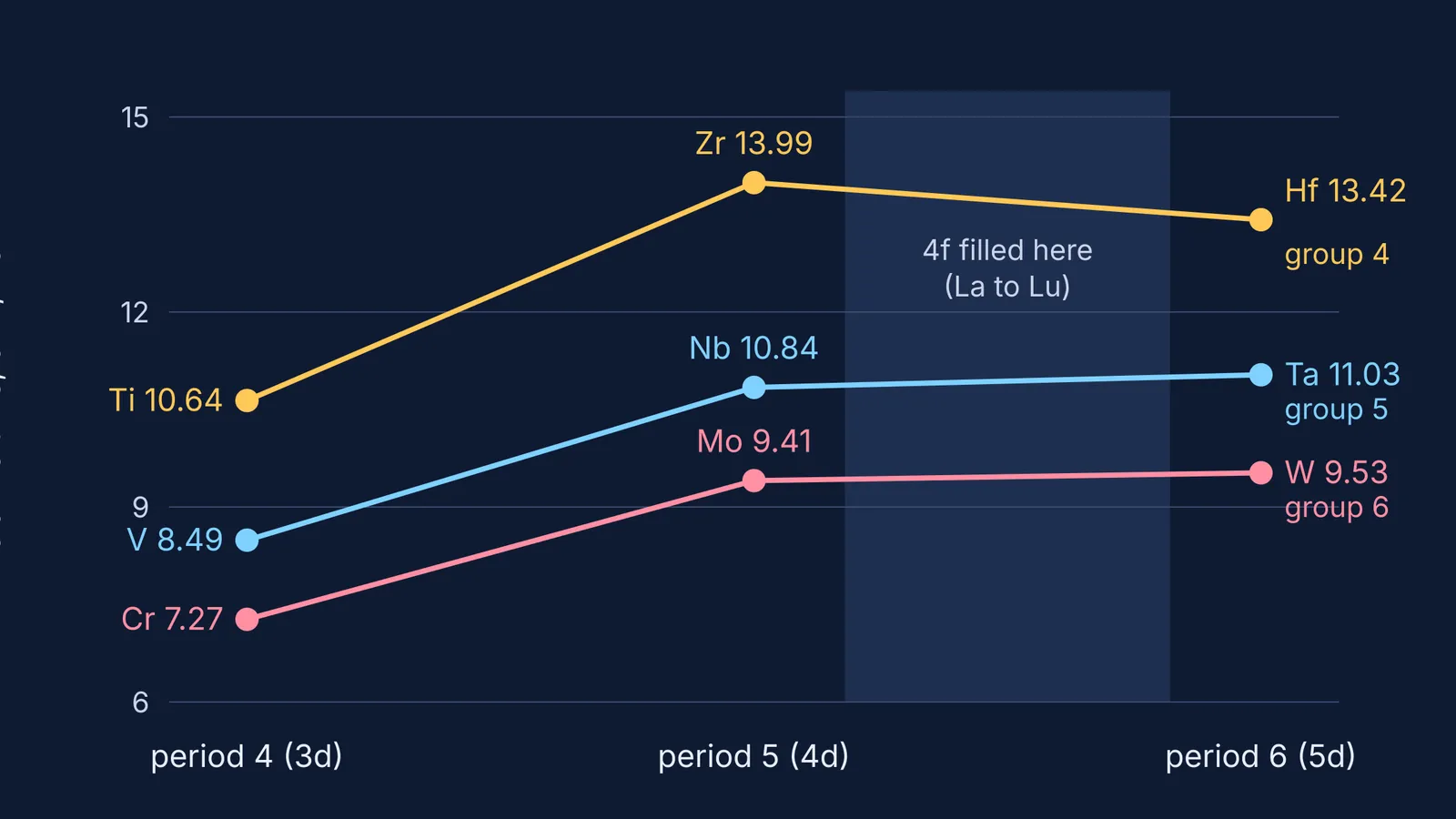
Titanium. 47.867 ÷ 4.5 = 10.64 cm³/mol.
Zirconium. 91.22 ÷ 6.52 = 13.99 cm³/mol.
Hafnium. 178.49 ÷ 13.3 = 13.42 cm³/mol.
Ti to Zr. 13.99 ÷ 10.64 = 1.315. The molar volume grows by about 31%, as you expect when a new shell is added.
Zr to Hf. 13.42 ÷ 13.99 = 0.959. The molar volume shrinks by about 4%, even though a whole new shell and the 4f subshell were added.
Per atom. Divide by 6.022 × 10²³: about 23.2 ų for Zr and 22.3 ų for Hf.
Check it the other way. The mass ratio Hf/Zr is 178.49 ÷ 91.22 = 1.957. If hafnium atoms took the same space as zirconium atoms, hafnium would have a density of 6.52 × 1.957 = 12.76 g/cm³. The real value is 13.3, about 4% higher. This comparison is fair because Ti, Zr and Hf all crystallise in the same hexagonal close-packed structure at room temperature, so molar volume tracks atom size. The same pattern repeats in the next two groups:
Nb 10.84 and Ta 11.03 cm³/mol (up less than 2%)
Mo 9.41 and W 9.53 cm³/mol (up about 1%)
From period 4 to period 5 each group grows by about 28–32%. From period 5 to period 6, after the fourteen lanthanoids, it barely changes.
Why does the lanthanoid contraction make Zr and Hf so alike?
From lanthanum to lutetium, fourteen protons and fourteen 4f electrons are added. The 4f electrons shield the outer electrons poorly, so the effective nuclear charge on the 5d and 6s electrons rises and pulls them in. The full cause and the radius data are set out in our post on the lanthanoid contraction. If shielding and effective nuclear charge are still shaky, the Concept Library has a lesson for each.
The result is two elements with the same outer configuration, the same usual charge (+4) and almost the same size. NCERT links this to two facts: zirconium and hafnium occur together in nature, and they are very difficult to separate. Coster and Hevesy's result explains why hafnium stayed hidden in zirconium minerals until someone looked with X-rays.
What should you write in the exam?
JEE and NEET questions here usually test one of three things:
Size order. Ti < Zr ≈ Hf. Never write Hf > Zr "because it is lower in the group".
Configuration. Hf is [Xe]4f¹⁴5d²6s², with a full 4f subshell.
Consequence. Zr and Hf have nearly equal radii, so their chemistry is very similar and they are hard to separate.
For mixed practice on d- and f-block questions like these, Fermi Test Prep covers JEE Main and Advanced preparation with an AI tutor.
Quick checklist
Bohr's theory placed element 72 under Ti and Zr, not among the rare earths.
Coster and Hevesy found it in zircon-bearing minerals by X-ray spectroscopy and named it hafnium.
Molar volume = M ÷ d: Ti 10.64, Zr 13.99, Hf 13.42 cm³/mol.
Up about 31% from Ti to Zr, down about 4% from Zr to Hf.
Exam line: Zr and Hf have almost the same size, so they occur together and are hard to separate.