On this page
Complex Numbers and Quadratic Equations is Unit 2 of the mathematics section in the JEE Main 2027 syllabus published by NTA. Its ideas come down to a few lines of algebra, so careful habits matter more than tricks. Below, each core idea gets a worked example and a second check.
What does the JEE Main syllabus include for complex numbers and quadratic equations?
The official JEE Main 2027 syllabus lists these topics under Unit 2:
complex numbers as ordered pairs of reals, and the form a + ib
representation in a plane, the Argand diagram, and the algebra of complex numbers
modulus and argument (or amplitude) of a complex number
quadratic equations in real and complex number systems and their solutions
relations between roots and coefficients, nature of roots, and forming quadratic equations with given roots
The matching NCERT chapter is Chapter 4 of the Class 11 Mathematics textbook. In its 2026-27 reprint, the section titled Argand Plane and Polar Representation stops at plotting points, modulus and conjugates; the chapter does not work through the modulus–argument form or solve quadratics with complex roots, so practise both beyond it. The discriminant and nature of roots are in Class 10 Chapter 4, Quadratic Equations, and the link between zeroes and coefficients is in Class 10 Chapter 2, Polynomials.
How do you master the core ideas?
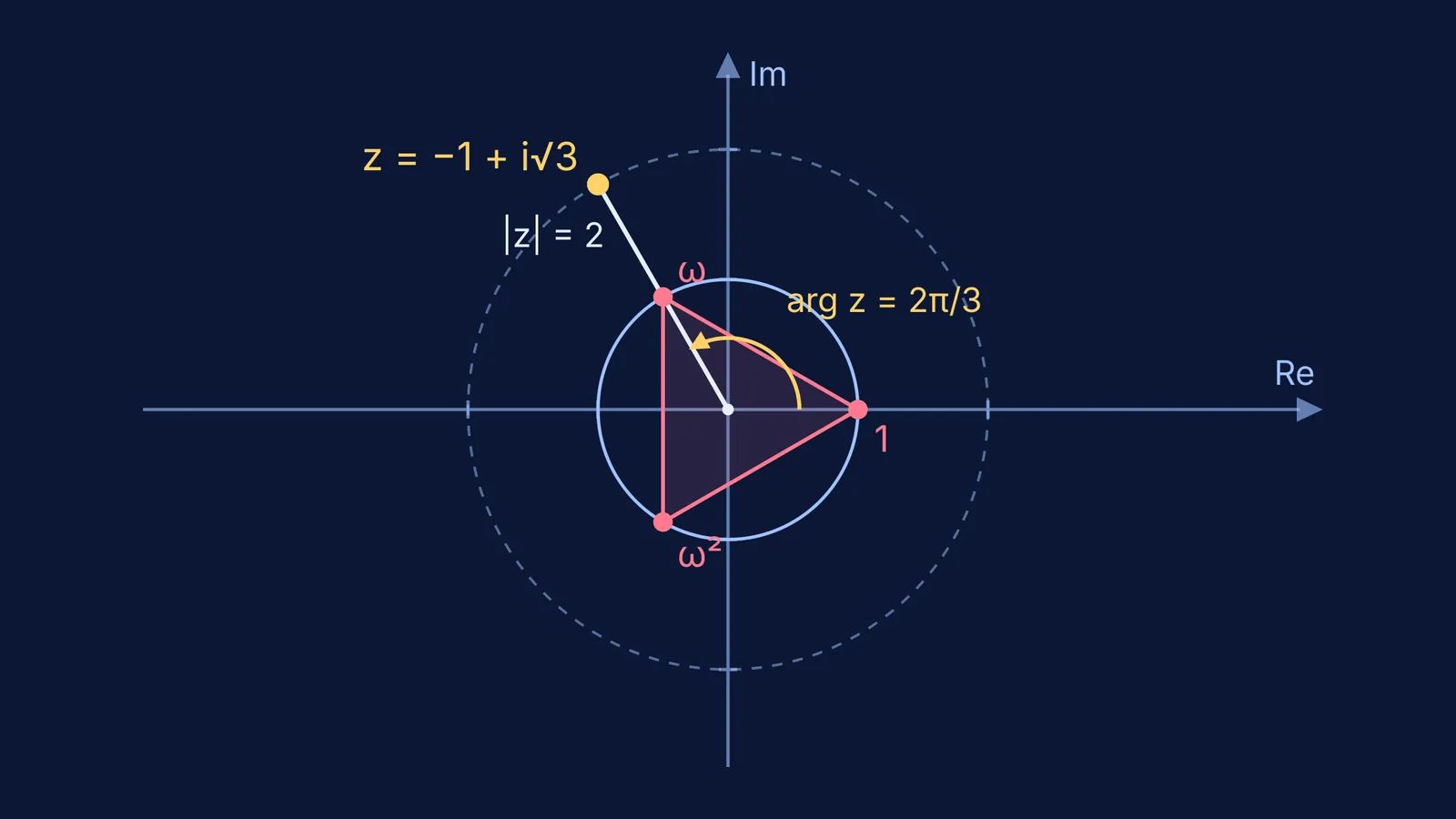
Start with modulus and argument. Write z = −1 + i√3 in modulus–argument form. The modulus is √(1 + 3) = 2. The point (−1, √3) lies in the second quadrant, where cos θ = −1/2 and sin θ = √3/2, so arg z = 2π/3 and z = 2(cos 2π/3 + i sin 2π/3).
Check one: expand it back. 2 cos 2π/3 = −1 and 2 sin 2π/3 = √3, which gives the original number. Check two: sketch the point. A calculator's tan⁻¹(√3/−1) returns −π/3, which points into the fourth quadrant, so it cannot be right.
Next, cube roots of unity. The JEE Main syllabus does not name roots of unity, but the two non-real cube roots of 1 are simply the roots of a quadratic. Since x³ − 1 = (x − 1)(x² + x + 1), they are ω = (−1 + i√3)/2 and ω², the roots of x² + x + 1 = 0. Notice that ω = z/2: modulus 1, argument 2π/3.
Three facts do most of the work: ω³ = 1, 1 + ω + ω² = 0, and ω² is the conjugate of ω. Example: ω²⁰²⁷. Since 2027 = 3 × 675 + 2, ω²⁰²⁷ = ω². Check another way: 2028 is a multiple of 3, so ω²⁰²⁷ = ω⁻¹ = conjugate of ω = ω².
Then nature of roots, sum and product. Take x² − 4x + 13 = 0. The discriminant is 16 − 52 = −36, which is negative, so the roots are non-real: (4 ± 6i)/2 = 2 ± 3i. Their sum is 4 = −b/a and their product is 4 + 9 = 13 = c/a.
Now find α² + β² without solving: (α + β)² − 2αβ = 16 − 26 = −10. Check directly: (2 + 3i)² = −5 + 12i and (2 − 3i)² = −5 − 12i, which add to −10. A negative sum of squares is fine: the roots are not real.
What are the common traps?
Wrong quadrant for the argument. Find the quadrant first; the principal argument lies in (−π, π].
Using the discriminant rule with complex coefficients. The rule D > 0, D = 0, D < 0 needs real a, b, c. For x² − (2 + i)x + 2i = 0, D = 3 − 4i, which is neither positive nor negative, and the roots 2 and i are not a conjugate pair.
Multiplying square roots of negatives. √(−4) × √(−9) = 2i × 3i = −6, not √36 = 6.
Forgetting that a ≠ 0. For kx² + 4x + 1 = 0 to have real roots, 16 − 4k ≥ 0 gives k ≤ 4, but k = 0 makes it linear, so a question about a quadratic also needs k ≠ 0.
How is JEE Advanced different?
The JEE Advanced 2026 syllabus names several things the JEE Main unit does not: polar representation, properties of the principal argument, the triangle inequality, cube roots of unity, geometric interpretations, the statement of the fundamental theorem of algebra and symmetric functions of roots. If you are sitting both, finish the Main list first, then give complex-number geometry its own time.
What does a two-week practice plan look like?
Days 1–2: NCERT Class 11 Chapter 4 and its exercises; revise the Class 10 discriminant and zeroes–coefficients sections.
Days 3–4: convert numbers from every quadrant and both axes to polar form and back.
Days 5–6: complex roots, forming equations from given roots, and expressions such as α² + β² and 1/α + 1/β.
Day 7: a timed mixed set from past JEE Main papers; log every error under one of the traps above.
Days 8–9: cube roots of unity, powers of i and ω.
Days 10–11: parameter questions, such as values of k for real, equal or non-real roots.
Days 12–13: two more timed sets, then redo only your error log.
Day 14: write a one-page sheet of formulas and traps, and rest.
When a step keeps going wrong, the Fermi Problem Library has worked problems with a step-by-step solver that explains the reasoning rather than printing an answer. For the rest of the exam, Fermi Test Prep is our JEE Main and Advanced preparation.
Start with the NCERT chapter today, and keep an error log from the first question.