On this page
On 1 July 2020, the Mars Colour Camera on India's Mars Orbiter Mission photographed Phobos, the larger moon of Mars, from about 4,200 km away. Phobos and its smaller partner Deimos are lumps of rock only a few kilometres to a few tens of kilometres across. That raises a fair question: on a world that small, could you jump right off it? The answer needs two things from Class 11 gravitation, escape speed and gravitational potential energy, and it shows where the familiar h = v²/2g stops working.
How fast do you leave the ground when you jump?
Take a standing jump that lifts your centre of mass 0.5 m on Earth. Treating the flight as free fall, your take-off speed is
v = √(2gh) = √(2 × 9.81 × 0.5) = 3.13 m/s
On a tiny world your legs push against almost no weight, so the same muscles give a slightly larger take-off speed. That push-off correction is worked out in how high you could jump on the Moon. Here we keep v = 3.13 m/s, which makes every answer below a little cautious. In very weak gravity the push also lasts longer, so treat 3.13 m/s as a round, illustrative take-off speed.
How small must an asteroid be for a jump to escape?
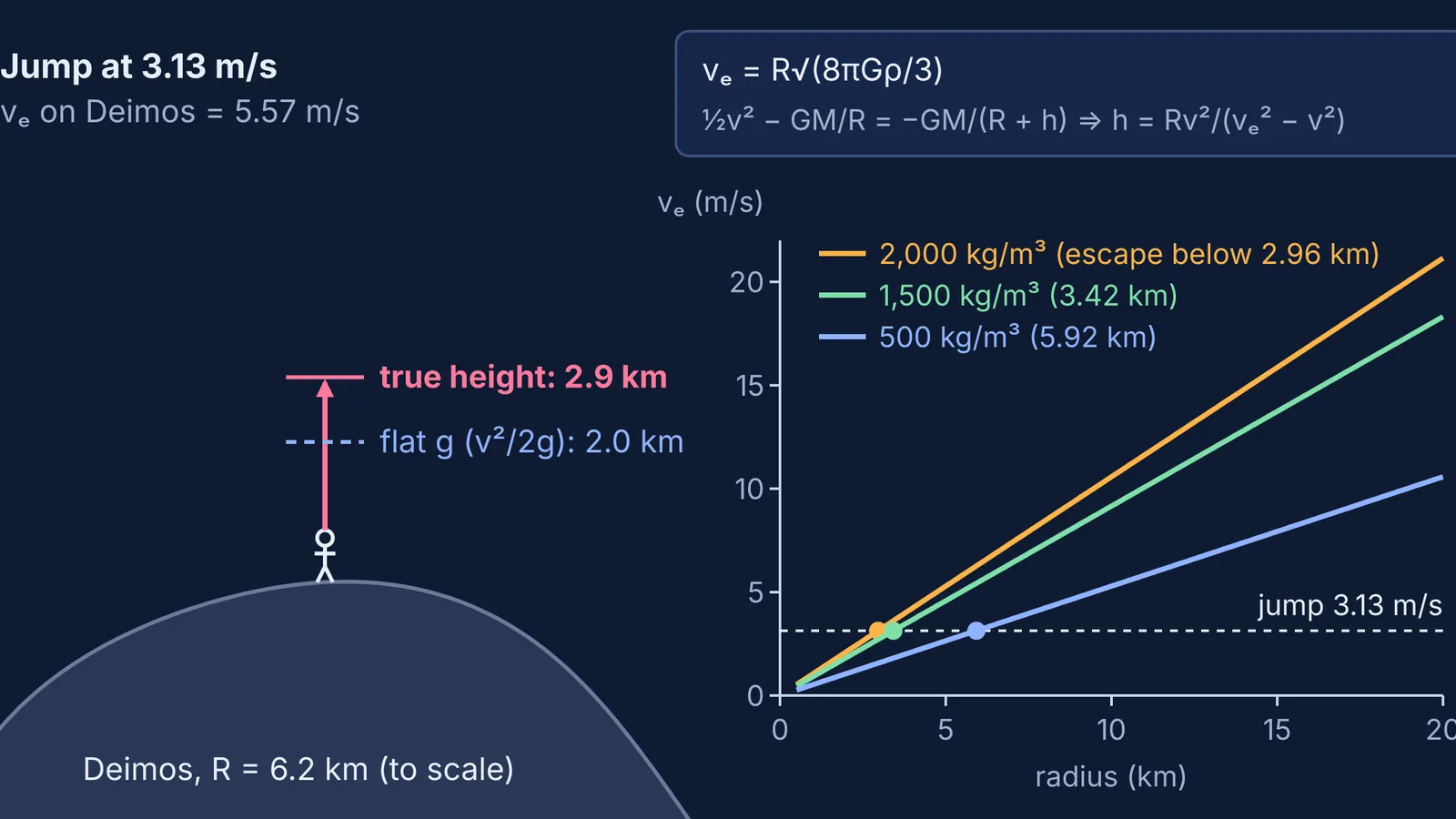
For a uniform sphere of radius R and density ρ, the mass is M = (4/3)πR³ρ, and the escape speed is
vₑ = √(2GM/R) = R√(8πGρ/3)
So at a fixed density, escape speed is proportional to radius. That scaling is the subject of escape velocity of a planet with double radius and same density. The new question is the reverse one: set vₑ = 3.13 m/s and solve for R.
Rₘₐₓ = v / √(8πGρ/3), with G = 6.674 × 10⁻¹¹ N m²/kg²
Using python3 for the arithmetic:
Rock at 2,000 kg/m³: Rₘₐₓ = 2.96 km.
Rubble at 1,500 kg/m³: Rₘₐₓ = 3.42 km.
A comet-like body at 500 kg/m³: Rₘₐₓ = 5.92 km.
So a good standing jump would carry you off any rocky asteroid less than about 3 km in radius, if you jumped straight up and nothing else pulled on you.
Why is h = v²/2g wrong on a small moon?
The formula h = v²/2g assumes g is the same all the way up. On Earth a jump changes your distance from the centre by a tiny fraction of 6,400 km, so that is fine. On a moon a few kilometres across, a jump can take you a large fraction of a radius up, and g drops noticeably as you rise.
Energy conservation with the full potential energy −GMm/r gives ½v² − GM/R = −GM/(R + h). That derivation, for a rocket leaving Earth, is in maximum height when projected below escape velocity. Written with vₑ² = 2GM/R, it becomes
h = Rv²/(vₑ² − v²)
Two checks. When v is much smaller than vₑ, this becomes h ≈ Rv²/vₑ² = v²/2g, the flat-gravity answer. When v reaches vₑ, h becomes infinite: you escape. The true height is always larger than v²/2g, because gravity weakens as you climb.
Worked example: a jump on Deimos
Data from NASA JPL's table of planetary satellite physical parameters: Deimos has GM = 9.62 × 10⁻⁵ km³/s², which is 9.62 × 10⁴ m³/s² (a mass of about 1.4 × 10¹⁵ kg), and a mean radius of 6.2 km. Deimos is lumpy, not round, so we treat it as an ideal sphere of that mean radius.
Surface gravity. g = GM/R² = 9.62 × 10⁴ / (6,200)² = 0.0025 m/s², about 1/3,900 of Earth's.
Escape speed. vₑ = √(2GM/R) = √(2 × 9.62 × 10⁴ / 6,200) = √31.0 = 5.57 m/s. Your 3.13 m/s jump does not escape.
Flat-gravity height. v²/2g = 9.81 / (2 × 0.0025) = 1.96 km.
True height. h = Rv²/(vₑ² − v²) = 6,200 × 9.81 / (31.0 − 9.81) = 2.87 km, about 46% higher.
Time in the air. The flat-gravity answer is 2v/g = 2 × 3.13 / 0.0025 = 2,500 s, about 42 minutes up and down. Stepping the motion through with python3 in the weakening field gives about 70 minutes.
Units check. Rv²/(vₑ² − v²) is m × (m/s)²/(m/s)² = m.
On Phobos (GM = 7.087 × 10⁵ m³/s², mean radius 11.08 km, same JPL table) the same jump gives g = 0.0058 m/s² and vₑ = 11.3 m/s. You rise 0.92 km instead of the flat 0.85 km and land after about 20 minutes. Phobos is bigger, so the correction is much smaller.
What about a comet like 67P?
ESA gives comet 67P/Churyumov–Gerasimenko a mass of slightly less than 10 billion tonnes and a volume of about 18.7 km³, a density of 533 kg/m³ (Inside Rosetta's comet). A sphere of that volume has a radius of 1.65 km, which gives vₑ ≈ 0.9 m/s. An ordinary walking pace is faster than that.
That weak hold showed when the Philae lander touched down in November 2014. It bounced. ESA's account says Philae first touched the surface at 15:35 GMT and next hit a cliff edge at 16:20 GMT, so it spent about 45 minutes in its first hop before finally settling. A small rebound speed was enough for a long flight on a body with such low gravity.
What does the idealised sphere leave out?
Shape. Deimos, Phobos and 67P are irregular, so g and vₑ change from place to place on the surface.
Spin. A spinning body helps you at its equator, where the ground is already moving.
Mars. Phobos orbits only about 6,000 km above the surface of Mars (NASA Mars fact sheet gives an orbit radius of 9,378 km), and Mars's pull matters for anything that rises off its surface.
Direction. We jumped straight up. A jump at an angle on a curved world needs the full orbit picture; at vₑ/√2 sideways you would skim the surface in orbit.
To see how a trajectory changes as gravity weakens with height, the Fermi Simulation Lab has interactive simulations for ideas that are easier to see than read.
Quick checklist
Earth jump of 0.5 m: take-off speed √(2gh) = 3.13 m/s.
For a uniform sphere, vₑ = R√(8πGρ/3), proportional to R at fixed density.
A 3.13 m/s jump escapes rock of 2,000 kg/m³ if R < 2.96 km.
When g weakens with height, h = Rv²/(vₑ² − v²), not v²/2g.
Deimos: g = 0.0025 m/s², vₑ = 5.57 m/s; the jump rises 2.87 km, not 1.96 km.
Small v gives back v²/2g; v = vₑ means escape.
Real small bodies are irregular and spin, so treat sphere answers as estimates.