

On this page
Gravitation is a core topic in high school physics. When you study gravitation for exams like JEE or NEET, you are often asked to compare the escape velocities of two different planets. If a question gives you the mass and radius, the standard formula works perfectly. But if the problem mentions a planet's *density*, you need a different approach. Understanding how these variables interact will save you valuable time during a timed exam.
Here is how to solve these ratio problems quickly, starting with the exact relationship between escape velocity, radius and density.
What is the standard formula for escape velocity?
Escape velocity is the minimum speed an object needs to break free from a planet's gravitational pull and never return. For a spherically symmetric body, the standard formula is:
v_e = √(2GM / R)
Where:
G is the universal gravitational constant.
M is the mass of the planet.
R is the radius of the planet.
This equation is useful when you know a planet's mass. However, in many exam problems, you are not given the mass. Instead, you are told how the planet's radius and density compare to Earth's. Using the standard formula directly would require you to calculate the new mass first, which takes time and introduces the risk of calculation errors.
How does escape velocity depend on density?
To find how escape velocity depends on density (ρ), we rewrite the mass (M) in terms of volume and density. Assuming the planet is a uniform sphere, its volume is (4/3)πR³, so its mass is:
M = (4/3)πR³ × ρ
Substitute this expression for mass into the standard escape velocity formula:
v_e = √(2G × (4/3)πR³ρ / R)
Simplify the terms inside the square root:
v_e = √( (8/3)πGρR² )
Pull the radius out of the square root:
v_e = R √((8/3)πGρ)
Since (8/3)πG is a constant, we can see that escape velocity is proportional to the radius multiplied by the square root of the density 1:
v_e ∝ R√ρ
This is the fastest formula to use for planet comparison problems, as it lets you ignore the constants completely. Because the constant terms never change, they cancel out when you compare two different bodies. This is a common pattern in competitive exam physics: rewriting the formula to isolate the variables that actually change, rather than plugging in large numbers and constants.
What is the escape velocity of a planet with double radius and same density?
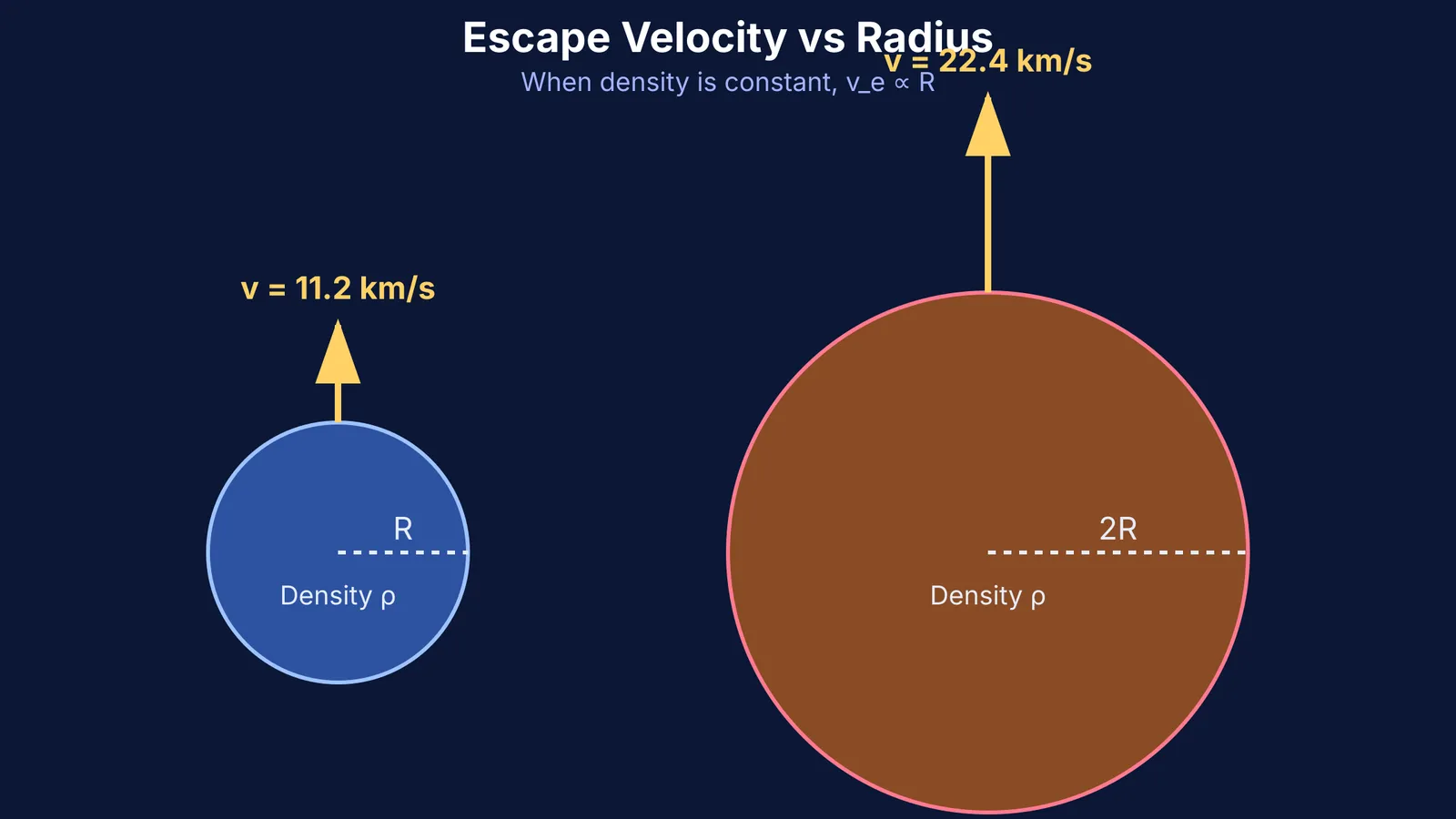
Let us apply this proportionality to a classic problem: finding the escape velocity of a hypothetical planet that has the same density as Earth but twice its radius.
For Earth, the escape velocity at the surface is approximately 11.2 km/s 1.
Using the relation v_e ∝ R√ρ, we set up a ratio between the new planet (Planet P) and Earth (Earth E). The constants drop out, leaving:
(v_p / v_e) = (R_p / R_e) × √(ρ_p / ρ_e)
The problem states that the planet has double the radius (R_p = 2R_e) and the same density (ρ_p = ρ_e). Plugging these values in:
(v_p / 11.2) = (2R_e / R_e) × √(1) (v_p / 11.2) = 2 × 1 v_p = 22.4 km/s
If a planet has the same density as Earth but double the radius, its escape velocity is exactly double, which is 22.4 km/s.
How do you solve other planet ratio problems?
You can use the v_e ∝ R√ρ framework to solve any comparison question without calculating the actual constants. Here is a checklist for your exam rough work:
Identify the constant: Does the problem keep mass constant, or density constant? Read the question carefully, as this dictates your approach.
Choose the correct proportionality:
If mass is constant: use v_e ∝ 1/√R
If density is constant: use v_e ∝ R√ρ
Write the ratio: Set up (v₂ / v₁) and cancel out the terms that do not change between the two planets.
Solve: Multiply by Earth's escape velocity (11.2 km/s) 1 if an exact number is needed.
Let us try a more complex example. Suppose a planet has half the radius of Earth but four times the density. What is its escape velocity?
Set up the ratio again: (v_p / v_e) = (R_p / R_e) × √(ρ_p / ρ_e)
Substitute the given multipliers (R_p = 0.5R_e, ρ_p = 4ρ_e): (v_p / 11.2) = (1/2) × √4 (v_p / 11.2) = (1/2) × 2 (v_p / 11.2) = 1
The new escape velocity would be exactly the same as Earth's (11.2 km/s). Even though the planet is much smaller, its extremely high density makes up for the lost volume, resulting in an identical gravitational hold on objects at its surface. This demonstrates why learning proportionalities is so powerful. Instead of doing two long calculations involving pi, big G, and large powers of ten, the entire problem reduces to simple arithmetic.
If you want to test this logic on other gravitation problems, like SHM through a tunnel across the Earth or Kepler's second law, you can explore the Fermi Concept Library. If you are stuck on a physics problem and do not know where to start, Fermi's AI tutor can work out what you already know and build a plan for the session, so you sit down to a clear next step.


