On this page
Indian apiaries sell honey and the wax left in the comb. The Indian standard for that wax, IS 1504:1996, sets the saponification value (SV) of refined beeswax at 90 to 105. Work out the SV of a typical fat such as tripalmitin and you get about 208. Both numbers come from the same reaction, an ester split by KOH, yet one is about half the other. The reason is a single structural fact, and the same numbers show how a lab spots paraffin in beeswax.
What does the Indian standard say about beeswax?
The full text of IS 1504:1996, Beeswax, Crude and Refined, with its 2007 amendment, is on the Internet Archive. Its foreword describes beeswax as "a wax secreted in form of scales by the worker bees through their wax glands", extracted from honeycombs after the honey is removed. The standard covers:
Crude beeswax, which "shall not contain any other added material, such as paraffin wax and starch".
Refined beeswax, in Grade A and Grade B. A note says Grade A comes from Apis cerana indica and A. mellifera bees; Grade B may be from other Apis species.
From Table 1 (crude / refined Grade A / refined Grade B):
Saponification value: not less than 80 / 90 to 105 / 90 to 105.
Acid value: 5 to 24 in all three columns. This is from Amendment No. 1 (June 2007), which replaced the old maximums of 12.0, 8.0 and 10.0.
Melting point: 58 to 64 / 63 to 66 / 59 to 63 °C.
Iodine value: printed as 5.5 to 10.0 for refined wax. That is low, so beeswax has few C=C bonds.
What is a wax, chemically?
In the textbook sense, a wax is an ester of a long-chain fatty acid with a long-chain monohydric alcohol, one with a single –OH. A fat is an ester of the same kind of acids with glycerol, which has three –OH groups.
Real beeswax is a mixture, and the standard gives no composition. Textbooks use myricyl palmitate as a model: palmitic acid, C₁₅H₃₁COOH, joined to myricyl alcohol (triacontan-1-ol), C₃₀H₆₁OH. Its formula is C₁₅H₃₁COOC₃₀H₆₁, or C₄₆H₉₂O₂. Treat it as a model compound, not as an analysis of real wax.
Why is the saponification value of beeswax so low?
SV is the number of milligrams of KOH needed to saponify 1 g of the material. For a pure ester with n ester links per molecule and molar mass M:
SV = 56,106 × n ÷ M
Here 56,106 is the molar mass of KOH (56.106 g/mol) written in milligrams. Compare the two splits:
C₁₅H₃₁COOC₃₀H₆₁ + KOH → C₁₅H₃₁COOK + C₃₀H₆₁OH
C₅₁H₉₈O₆ + 3KOH → C₃H₈O₃ + 3C₁₅H₃₁COOK
The first splits the wax ester into potassium palmitate and myricyl alcohol (C₄₆H₉₃O₃K on each side). The second splits tripalmitin into glycerol and potassium palmitate (C₅₁H₁₀₁O₉K₃ on each side).
Myricyl palmitate: M = 677.24 g/mol, n = 1. SV = 56,106 ÷ 677.24 = 82.8.
Tripalmitin: M = 807.34 g/mol, n = 3. SV = 3 × 56,106 ÷ 807.34 = 208.5.
Ratio: 208.5 ÷ 82.8 = 2.5. Per gram, the fat uses two and a half times as much KOH.
The two molecules are not very different in mass (677 against 807). The difference is the count of ester links: one against three. For the full triglyceride method, see our post on saponification value and iodine value of fats.
The model gives 82.8, below the refined range of 90 to 105. That gap is expected. The SV titration also neutralises any free fatty acid in the wax, and real wax is a mixture of esters, not one heavy compound.
How do acid value and ester value fit in?
Acid value (AV): mg KOH to neutralise the free acids in 1 g. It counts acids that are not tied up as esters.
Saponification value (SV): mg KOH for free acids plus esters together.
Ester value (EV): SV − AV. It counts the ester part alone.
Our post on acid value and free fatty acids in rice bran oil shows how the AV titration is done.
How does paraffin wax show up in the numbers?
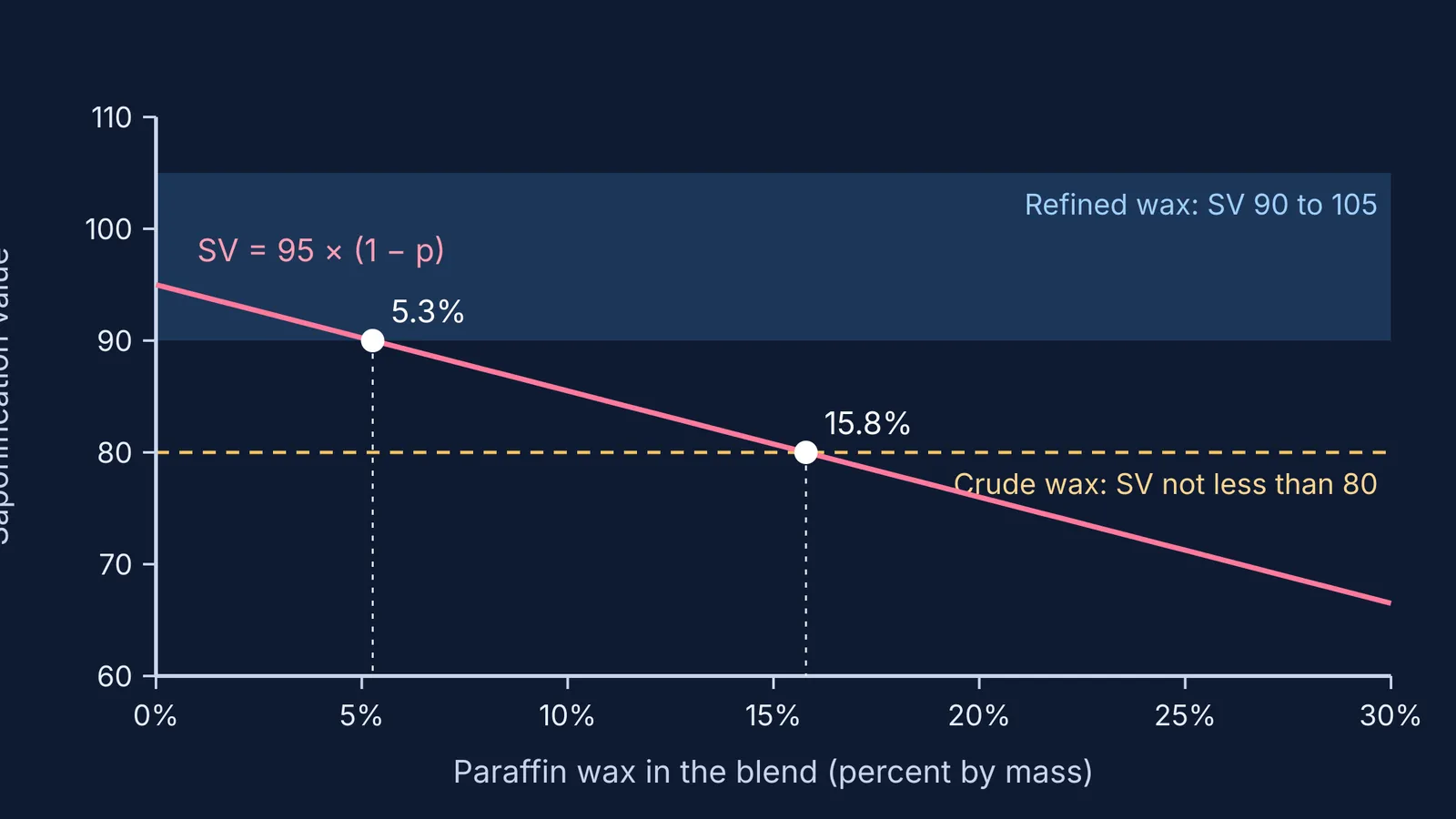
Paraffin wax is a mixture of alkanes. It has no ester link and no –COOH, so KOH has nothing to react with: its SV and AV are both zero. Mixing it into beeswax simply dilutes every value. If pure wax has SV = 95 and a fraction p of the blend is paraffin:
SV of blend = 95 × (1 − p)
To stay at 90 or above (refined minimum): p ≤ 1 − 90 ÷ 95 = 5.3%.
To stay at 80 or above (crude minimum): p ≤ 1 − 80 ÷ 95 = 15.8%.
So SV catches large additions, while a few percent can sit inside the range. The same logic, with paraffin surviving alkali, is behind unsaponifiable matter tests on edible oils.
Worked example: paraffin hidden by stearic acid
Suppose a refined wax tests at AV = 17 and SV = 95 (so EV = 78); these are example numbers inside the standard's limits. Someone mixes 84 g of it with 10 g of paraffin and 6 g of stearic acid. Does the blend pass?
Stearic acid's own value. C₁₇H₃₅COOH, M = 284.48 g/mol. One –COOH takes one KOH, so AV = 56,106 ÷ 284.48 = 197.2. A free acid adds the same amount to the SV, because the KOH in the SV test neutralises it too.
Acid value of the blend. 0.84 × 17 + 0.06 × 197.2 = 14.28 + 11.83 = 26.1. That is above 24: it fails.
Saponification value of the blend. 0.84 × 95 + 0.06 × 197.2 = 79.80 + 11.83 = 91.6. That is inside 90 to 105: it passes.
Ester value. 91.6 − 26.1 = 65.5, against 78 for the pure wax. That is exactly 0.84 × 78: only the beeswax brings esters.
The stearic acid propped up the SV and hid the paraffin; the acid value caught it. The tests work as a set.
Try this. Take cerotic acid, C₂₅H₅₁COOH (M = 396.70, AV = 141.4), as a model free acid. A wax with AV = 20 and EV = 75 would then be 14.1% "cerotic acid" and 90.5% "myricyl palmitate", which adds up to more than 100%. The models are too heavy: real wax esters and acids are a mixture with a lower average molar mass.
If you want more practice turning lab values into structure, the Fermi Problem Library has a step-by-step solver that explains the reasoning.
Where does this come up in your syllabus?
Class 12, Aldehydes, Ketones and Carboxylic Acids: esters and their hydrolysis by alkali.
Class 11, Some Basic Concepts of Chemistry: mole ratios, as in one KOH per ester link.
Lipids in NEET biology: the difference between a fat (glycerol ester) and a wax (long-chain alcohol ester).
Quick checklist
IS 1504:1996 sets SV ≥ 80 for crude and 90 to 105 for refined beeswax; AV is 5 to 24 since 2007.
Wax ester: one ester link, SV = 56,106 ÷ M. Fat: three, SV = 3 × 56,106 ÷ M.
Myricyl palmitate (model) has SV 82.8; tripalmitin has 208.5.
EV = SV − AV.
Paraffin has SV 0: it dilutes, and 5.3% paraffin brings SV 95 down to 90.
Added fatty acid raises AV and SV together; check AV as well as SV.