

On this page
Boil an edible oil with alcoholic potassium hydroxide and almost all of it turns into soap and glycerol, both happy in water. A small part stays oily, moves into ether, and can be weighed. That leftover is the unsaponifiable matter (UM) of the oil, and Indian oil standards cap it oil by oil. The calculation is short, but it uses ester hydrolysis, solvent extraction and polarity at once.
What is unsaponifiable matter in an oil?
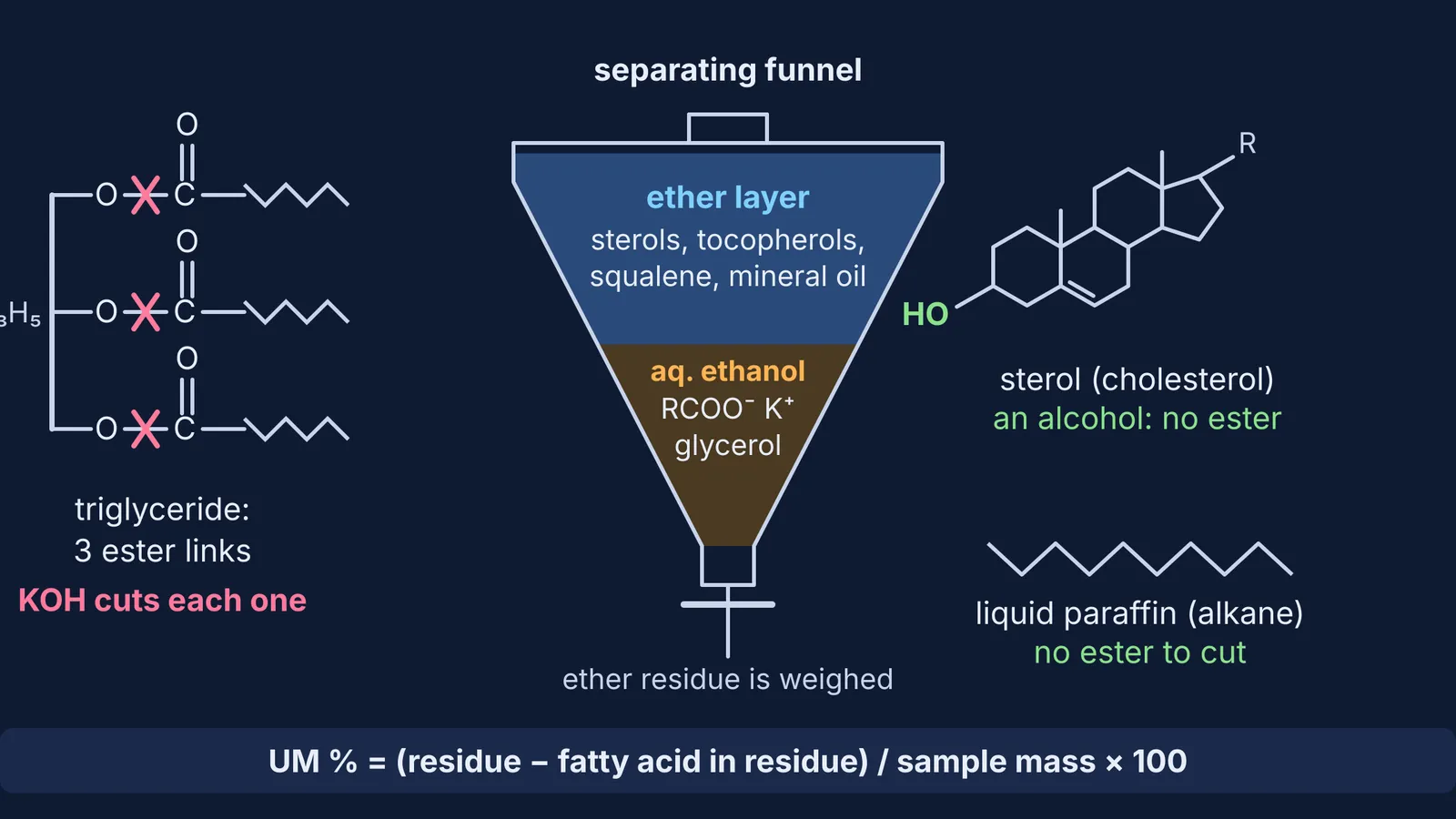
An oil is mostly triglycerides: three fatty acids joined to glycerol by three ester links. Hot alkali cuts every one of those links:
Triglyceride + 3KOH → glycerol + 3RCOO⁻K⁺
The saponification value counts those ester links (see the blank titrations behind saponification and iodine values). Unsaponifiable matter asks the opposite question: once every ester is cut, what is left that is still not water-soluble?
FSSAI's manual for oils and fats defines it as substances that are soluble in the oil, still insoluble in water after saponification, and soluble in the extracting solvent. In a normal vegetable oil that means:
Sterols, such as β-sitosterol in plant oils and cholesterol in animal fats
Tocopherols (vitamin E) and other fat-soluble vitamins
Squalene and other natural hydrocarbons
Higher aliphatic alcohols and pigments
None of these has an ester link to cut. A sterol is an alcohol with one –OH on a ring skeleton; squalene is a hydrocarbon. Alkali has nothing to attack. Do not call UM "impurity". Much of it is natural, and some of it, like tocopherols and plant sterols, is nutritionally valued.
How is unsaponifiable matter measured?
The FSSAI method (from its 2016 manual of methods for oils and fats, based on the ISI handbook and AOAC 933.08) goes like this:
Weigh about 5 g of oil into a flask and reflux it with 50 mL of alcoholic KOH for about an hour, until the solution is clear.
Transfer it to a separating funnel with 50 mL of water and cool to 20–25 °C.
Shake with 50 mL of petroleum ether (40–60 °C), run off the lower soap layer, and repeat; the manual specifies three extractions.
Wash the combined ether extract with 10% aqueous alcohol and then water until the washings are no longer alkaline to phenolphthalein.
Evaporate the ether, dry the residue at 100 °C to constant mass and weigh it.
Dissolve the residue in warm neutral ethanol and titrate with about 0.02 N NaOH, to measure the little fatty acid that came through into the ether.
The polarity logic is the whole test. Ionic soaps and glycerol, with its three –OH groups, stay in the water–alcohol layer. Large, mostly non-polar sterols, tocopherols and hydrocarbons move into the petroleum ether. The solvent matters: the manual says diethyl ether generally gives a higher result than petroleum ether, so a UM value always belongs to a named method.
Two details students miss. Steryl esters are saponified, but the sterol they release is counted in UM. And tocopherols partly oxidise during the boil, so UM is a method-defined number, not an exact inventory.
What are the FSSAI limits for unsaponifiable matter?
There is no single number. The limit is set oil by oil in the Food Products Standards regulation, Chapter 2.2 (version of October 2023). A few examples:
Groundnut oil: not more than 1.0%
Mustard (rapeseed) oil: not more than 1.2%
Sesame (til) oil: not more than 1.5%
Olive oils: not more than 15 g/kg (1.5%); olive-pomace oils: not more than 30 g/kg (3.0%)
Refined rice bran oil: not more than 3.5% if chemically refined, 4.5% if physically refined
Rice bran oil naturally carries a lot of sterols, waxes and oryzanol. Chemical refining sends part of the oryzanol into the soapstock, while physical (steam) refining keeps more of it, which is why the two limits differ.
How does UM catch mineral oil in edible oil?
Liquid paraffin is a mixture of alkanes. It has no ester link, so every gram of it ends up in the ether layer. A few percent of mineral oil pushes UM far above any edible-oil limit.
FSSAI's rapid screen for mineral oil is Holde's test: saponify 1 mL of oil in 25 mL of 0.5 N alcoholic KOH, then add boiling water. Soap solution stays clear; mineral oil, which cannot form soap, makes it turbid. The manual says the test is sensitive when mineral oil is present at 1% or more, and that it is not sensitive in oils with high UM, where a TLC test is used to confirm.
Worked example: groundnut oil, a paraffin blend and oryzanol
(a) The basic calculation. 5.00 g of groundnut oil is saponified and extracted. The dried ether residue weighs 0.0450 g. Dissolved in neutral ethanol, it needs 0.40 mL of 0.0200 N NaOH.
Fatty acid in the residue: 0.40 × 0.0200 = 0.0080 mmol.
As oleic acid (282 g/mol, the manual's factor 0.282 V N in grams): 0.0080 × 282 = 2.26 mg.
True unsaponifiable residue: 45.0 − 2.26 = 42.7 mg.
UM = 42.7 / 5000 × 100 = 0.85%.
That is within the 1.0% limit for groundnut oil.
(b) A paraffin blend. Suppose 5% liquid paraffin is mixed into this oil. In 100 g of blend there is 95 g of oil and 5 g of paraffin. UM = 0.95 × 0.85 + 5.0 = 5.81%. Even 1% paraffin gives 0.99 × 0.85 + 1.0 = 1.85%, already above the limit. UM says something non-saponifiable was added, not what; Holde's test and TLC answer that.
(c) Why oryzanol raises rice bran oil's UM. Oryzanol is a mixture of ferulic acid esters of sterols and triterpene alcohols; take cycloartenyl ferulate (C₄₀H₅₈O₄, about 603 g/mol) as the model. KOH does cut this ester:
C₄₀H₅₈O₄ + H₂O → C₁₀H₁₀O₄ (ferulic acid, 194) + C₃₀H₅₀O (cycloartenol, 427)
Check the atoms: C 40 = 10 + 30, H 60 = 10 + 50, O 5 = 4 + 1. In alkali the ferulic acid goes into the soap layer as its salt, but the cycloartenol, a triterpene alcohol, goes into the ether. An oil with 1.6% oryzanol therefore adds about 1.6 × 427/603 = 1.13 percentage points of UM, even though oryzanol itself is "saponifiable". The phenolic –OH of the same molecule also nudges the acid value, as explained in acid value and free fatty acids in rice bran oil.
To practise multi-step oil calculations, the Fermi Problem Library has a step-by-step solver that explains the reasoning, not just the answer.
How is UM different from the other fat numbers?
Saponification value counts ester links, iodine value counts C=C bonds, and acid value counts free fatty acid. The Reichert–Meissl value for ghee and vanaspati counts short-chain volatile acids. UM is the only one that weighs what is left when every ester link is cut.
Quick checklist
UM = material soluble in oil, insoluble in water after saponification, soluble in the extracting solvent.
Sterols, tocopherols, squalene and hydrocarbons have no ester link, so they end up in the ether.
FSSAI limits differ oil by oil; rice bran and olive-pomace oils are allowed more.
Mineral oil is 100% unsaponifiable, so a few percent sends UM far over the limit.
A saponifiable ester can still raise UM if its alcohol half is a sterol or triterpene alcohol.


