On this page
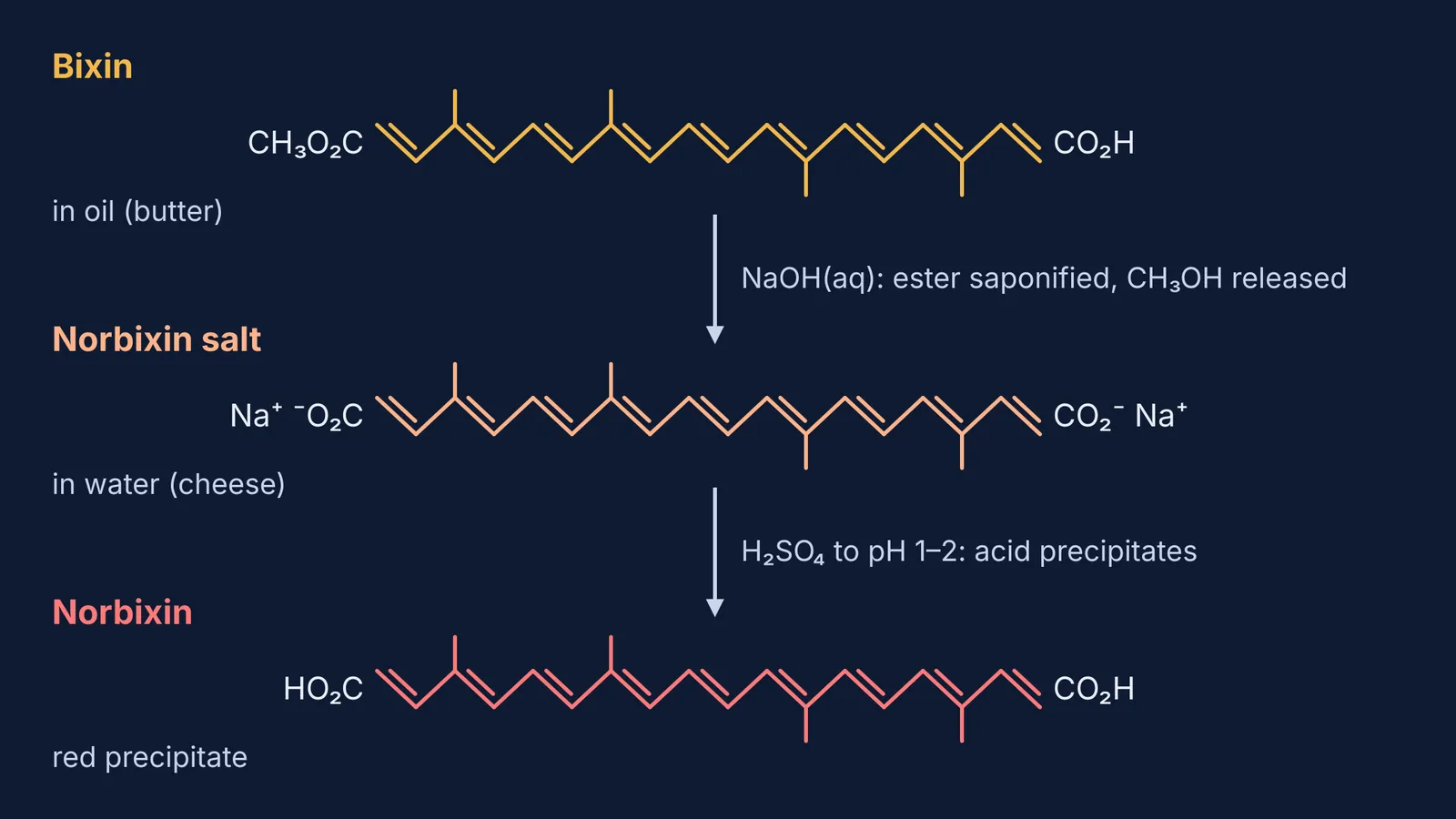
The yellow-orange of many butters and cheeses can come from annatto, a colour from the seed coat of Bixa orellana. The same seeds give two products. Butter is coloured with annatto dissolved in oil; cheese is coloured with annatto dissolved in water. What separates them is one ester group, cut off with alkali. The Indian standard for annatto, IS 2557:1994, describes both forms, includes a test that runs the reaction backwards, and has a Beer–Lambert assay amended in 2011.
What gives annatto its colour?
IS 2557:1994 lists annatto as a carotenoid colour (CI 75120, Natural Orange 4, E-160b). Its main colours are:
Bixin, C₂₅H₃₀O₄ (394.51 g/mol), the major colour in the oil form.
Norbixin, C₂₄H₂₈O₄ (380.48 g/mol), "the hydrolysis product of bixin", present in the water form as its sodium or potassium salt.
Both are built on the same 20-carbon chain with four methyl branches:
HOOC–CH=CH–C(CH₃)=CH–CH=CH–C(CH₃)=CH–CH=CH–CH=C(CH₃)–CH=CH–CH=C(CH₃)–CH=CH–COOH
That is norbixin, a dicarboxylic acid. Bixin is the same molecule with one end as a methyl ester, –COOCH₃.
Check the structure with the degree of unsaturation: for C₂₅H₃₀O₄, DU = (2 × 25 + 2 − 30) ÷ 2 = 11. Norbixin gives (2 × 24 + 2 − 28) ÷ 2 = 11 too. There is no ring, and two of the eleven are C=O, so the chain carries 9 C=C, all conjugated with each other and with both C=O groups.
How does alkali turn oil-soluble bixin into water-soluble norbixin?
The standard says water-soluble annatto "is prepared by extraction of the outer coating of the seeds with aqueous alkali (sodium or potassium hydroxide)". The alkali does two jobs at once. It neutralises the free COOH, and it saponifies the methyl ester:
C₂₅H₃₀O₄ + 2NaOH → C₂₄H₂₆O₄Na₂ + CH₃OH + H₂O
Check it: both sides have 25 C, 32 H, 6 O and 2 Na. The product is a disodium dicarboxylate.
Why does this change the solvent? Bixin is a long hydrocarbon chain with one COOH and one ester, so it is mostly non-polar and dissolves in oil. The disodium salt has an ionic –COO⁻ at each end, so it dissolves in water, just as a soap does. This is the same alkaline hydrolysis you learn in esterification vs saponification. Going from bixin to norbixin (as the acid) the formula loses CH₂, 14.03 g/mol: 394.51 − 14.03 = 380.48.
How does the BIS identity test reverse it?
For the water form, the standard tells the analyst to take 2 mL or 2 g, add 2 N sulphuric acid until the solution is at pH 1–2, and dissolve "the red precipitate of norbixin" in benzene:
C₂₄H₂₆O₄Na₂ + H₂SO₄ → C₂₄H₂₈O₄ + Na₂SO₄
Once both COO⁻ groups are protonated, the molecule is neutral, and a neutral C₂₄ chain does not stay in water. It precipitates, and moves into the organic solvent. It is the same reason a fatty acid separates when soap solution is acidified. The norbixin is then run on an alumina column, where the Carr–Price reagent turns its orange-red band blue-green.
Both this test and the assay below use benzene and chloroform. They are laboratory methods for trained analysts, not school experiments.
Why does annatto absorb in the blue?
The standard gives absorbance maxima of 439, 470 and 501 nm for the oil form in chloroform, and 453 and 482 nm for the water form in water. These are wavelengths in the blue, so the solution looks orange to yellow.
The cause is conjugation. The longer the run of alternating single and double bonds, the smaller the gap between the π and π* orbitals, and the longer the wavelength absorbed. Saffron's colour, crocetin, has 7 C=C and 2 C=O in its chain and is read near 440 nm, as covered in how saffron's colour grade works. Bixin's chain has 9 C=C, and its main band sits further out, at 470 nm. The solvents differ, so compare roughly.
The standard also says bixin and norbixin "may be present in both cis and trans forms", and that thermal degradation products of bixin may be present. That is geometrical isomerism along the chain. Each of bixin's nine C=C bonds has two different groups on each carbon, so in principle there are 2⁹ = 512 geometrical isomers. Reviews usually describe natural bixin as the 9′-cis isomer, which turns into the all-trans form on heating; we have not checked this against a primary source, and the standard itself says only "cis and trans forms".
How do you turn an absorbance into percent bixin?
Annex B of the standard: dissolve 0.1 to 1 g of the oil form in chloroform to 100 mL, dilute 1 mL of that to 100 mL, and read A at 470 nm. Amendment No. 2 (April 2011) gives:
Percent bixin = (A ÷ 2.826) × 1,000,000 ÷ (sample mass in mg × 100)
The 1994 printing had 100,000 in place of 1,000,000. You can check which is right from first principles.
Concentration in the cell. w mg in 100 mL, then 1 mL into 100 mL, leaves w ÷ 100 mg in 100 mL, that is w × 10⁻⁵ g per 100 mL.
What pure bixin would read. E¹%₁cm is the absorbance of 1 g per 100 mL in a 1 cm cell, 2826 for bixin here. So pure bixin would give A = 2826 × w × 10⁻⁵.
Percent. % = 100 × A ÷ (2826 × w × 10⁻⁵) = A × 10⁷ ÷ (2826 × w). The amended formula simplifies to exactly this, with 2.826 standing for 2826 ÷ 1000. The 1994 version gives a result ten times smaller.
Worked example. 400 mg of annatto in oil is treated as above and reads A = 0.565.
Cell concentration: 400 × 10⁻⁵ = 0.00400 g per 100 mL.
Pure bixin would read 2826 × 0.00400 = 11.3.
Percent bixin = 0.565 ÷ 11.3 × 100 = 5.0%. The amended formula gives 0.565 ÷ 2.826 × 1,000,000 ÷ 40,000 = 5.0%. The 1994 formula would give 0.50%.
Molar absorptivity: ε = E¹%₁cm × M ÷ 10 = 2826 × 394.51 ÷ 10 ≈ 111,500 L mol⁻¹ cm⁻¹. For norbixin, 3473 × 380.48 ÷ 10 ≈ 132,100.
The standard's minimum is 0.24%. A 1 g sample at that level reads only A ≈ 0.068, and a 0.1 g sample about 0.007, too low to measure well. That is why a weak sample needs the full 1 g.
To watch absorbance rise in a straight line with concentration, try the colour and concentration simulation guide or the Simulation Lab, which has interactive simulations for ideas easier to see than read.
Where does this show up in JEE and NEET?
Class 12 Carboxylic Acids. Alkaline hydrolysis of an ester; why a carboxylate dissolves in water and the free acid precipitates.
Class 11 Some Basic Concepts and Beer–Lambert. Dilution chains and A = εcl as a concentration skill.
Class 11 Organic Chemistry. Degree of unsaturation and geometrical isomerism in a polyene.
For these topics one at a time, the Concept Library on Fermi Test Prep lays out each idea for JEE preparation.
Quick checklist
Bixin C₂₅H₃₀O₄: one COOH, one COOCH₃, oil-soluble.
NaOH neutralises the COOH and saponifies the ester: norbixin salt, water-soluble.
Acid to pH 1–2 precipitates norbixin; it moves into an organic solvent.
DU = 11: 9 C=C + 2 C=O, no ring.
Percent bixin = A × 10⁷ ÷ (2826 × mass in mg), as in the 2011 amendment.
ε = E¹%₁cm × M ÷ 10.