On this page
India makes parts for ITER, the international fusion experiment being built in France. The cryostat, the 16,000-cubic-metre vacuum chamber that encloses the whole machine, was manufactured by Larsen & Toubro in India under a contract from ITER India. All that engineering serves one physics target. A fusion plasma must be hot, dense enough, and must hold its heat long enough. The rule that ties these together is the Lawson criterion, and you can derive it with two ideas from your syllabus: thermal energy from kinetic theory, and power = energy/time.
What does a fusion plasma have to do?
Fusion needs very high temperatures so that nuclei come close enough to fuse in spite of their electric repulsion. Why the temperature has to be around 150 million °C, and how tunnelling helps, is explained in why nuclear fusion needs very high temperatures. Here we take the temperature as given and ask a different question: once the plasma is hot, how do you keep it hot?
A hot plasma always leaks heat. Particles and radiation carry energy out to the walls. Call the average time the plasma keeps its heat the energy confinement time, τ. To stay hot, the plasma must replace that leak. The most useful way is for the fusion reactions to heat the plasma themselves.
How much heat is stored in a hot plasma?
Take a deuterium–tritium (D–T) plasma at temperature T with n ions per cubic metre, half deuterium and half tritium. It also has n electrons per cubic metre, at the same temperature. From kinetic theory, each particle carries an average thermal energy of (3/2)kT. With 2n particles per cubic metre:
Stored energy per cubic metre: W = 3nkT
If the plasma loses this in a time τ, the power lost per cubic metre is W/τ = 3nkT/τ.
How much heat do the fusion reactions supply?
Each D–T reaction releases 17.6 MeV, as worked out in nuclear fission and fusion energy. That energy is shared: 14.1 MeV goes to the neutron and 3.5 MeV to the alpha particle (a helium nucleus). The neutron has no charge, so it flies straight out of the plasma. The alpha is charged, so the magnetic field keeps it inside, where it heats the plasma.
The reaction rate per cubic metre is n_D n_T⟨σv⟩, where ⟨σv⟩ is the reactivity: the fusion cross-section times the relative speed, averaged over the thermal speeds. With n_D = n_T = n/2:
Alpha heating per cubic metre: (n²/4)⟨σv⟩E_α, with E_α = 3.5 MeV
What is the Lawson criterion?
The plasma heats itself without outside help, called ignition, when alpha heating at least balances the loss:
(n²/4)⟨σv⟩E_α ≥ 3nkT/τ
Divide by n and rearrange:
nτ ≥ 12kT / (⟨σv⟩E_α)
This is the Lawson criterion in its ignition form. It does not ask for density or confinement time separately. It asks for their product. A thin plasma held for a long time and a dense plasma held briefly can both qualify. Multiplying both sides by T gives the triple product nTτ, which is often quoted instead.
This simple version leaves out radiation losses (bremsstrahlung) and assumes the whole plasma is at one temperature. J. D. Lawson set out these conditions in a 1955 report that was published in 1957 as Some criteria for a power producing thermonuclear reactor. A full modern treatment, with radiation included, is Wurzel and Hsu's review of progress against the Lawson criterion in Physics of Plasmas (2022).
Worked example: the criterion at 10, 15 and 20 keV
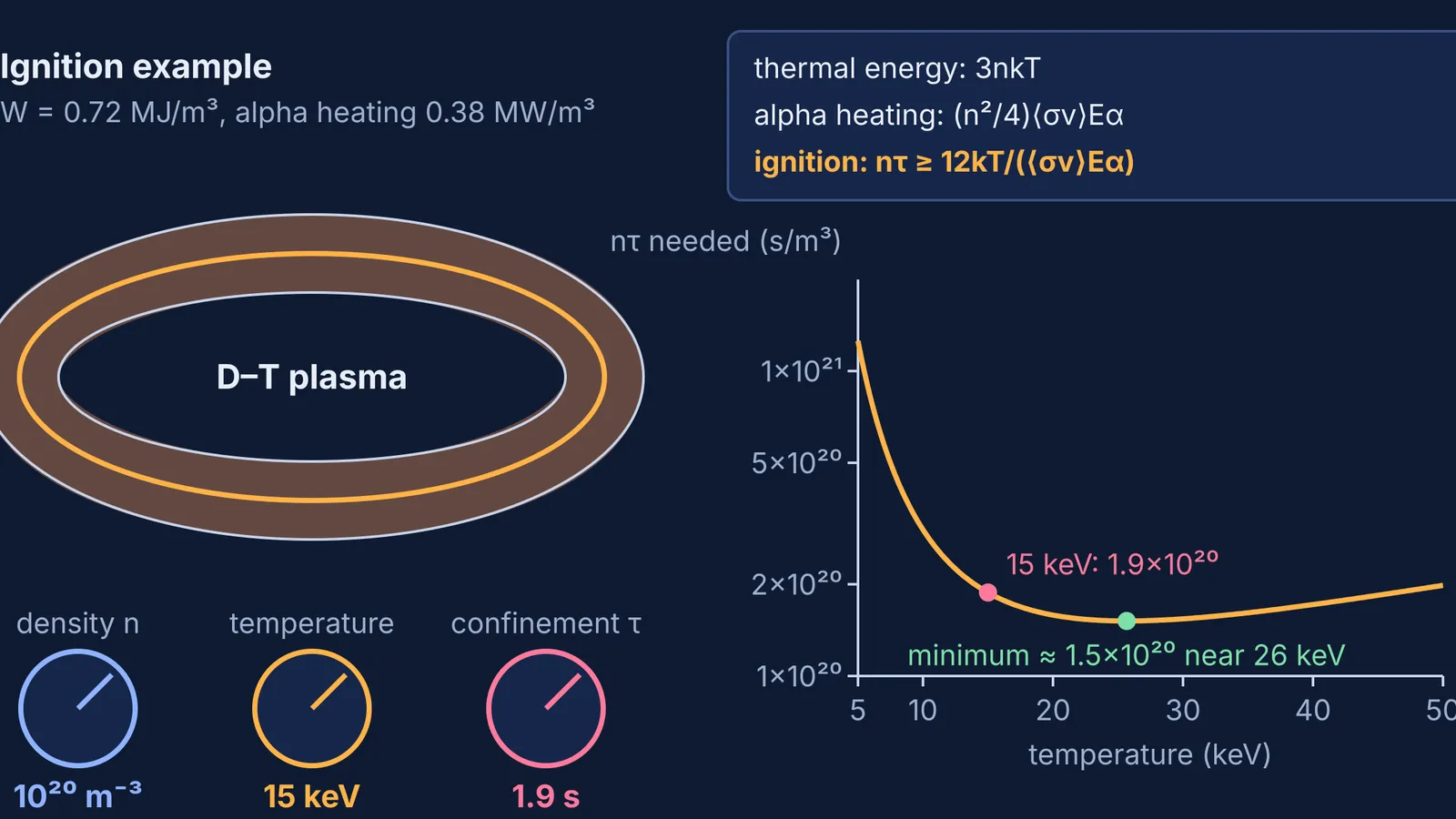
Plasma physicists give temperature in energy units: 1 keV corresponds to 1.16 × 10⁷ K. Reactivities from the standard Bosch and Hale fits (Nuclear Fusion, 1992), computed with python3: ⟨σv⟩ = 1.14 × 10⁻²², 2.74 × 10⁻²² and 4.33 × 10⁻²² m³/s at 10, 15 and 20 keV.
Write the condition in keV. E_α = 3,500 keV, so nτ ≥ 12T/(3,500⟨σv⟩), with T in keV.
At 10 keV. nτ ≥ 12 × 10/(3,500 × 1.14 × 10⁻²²) = 3.0 × 10²⁰ s/m³.
At 15 keV. nτ ≥ 12 × 15/(3,500 × 2.74 × 10⁻²²) = 1.9 × 10²⁰ s/m³.
At 20 keV. nτ ≥ 1.6 × 10²⁰ s/m³.
Units. keV/(m³/s × keV) = s/m³.
Now pick a plasma with n = 1.0 × 10²⁰ m⁻³ at 15 keV (about 174 million K). This is an illustrative plasma, not any machine's design.
Stored energy. W = 3nkT = 3 × 10²⁰ × 15 × 1.602 × 10⁻¹⁶ J = 7.2 × 10⁵ J/m³, about 0.72 MJ/m³.
Pressure. p = 2nkT = 4.8 × 10⁵ Pa, only about 4.7 atmospheres. The plasma is hot but very thin.
Alpha heating. (n²/4)⟨σv⟩E_α = 0.25 × 10⁴⁰ × 2.74 × 10⁻²² × 5.61 × 10⁻¹³ J = 0.38 MW/m³. The total fusion power, using 17.6 MeV, is about 1.9 MW/m³.
Confinement time needed. τ = W/(alpha power) = 7.2 × 10⁵/3.84 × 10⁵ = 1.9 s.
So this plasma must hold its heat for nearly two seconds. How the magnetic field holds such a plasma off the walls, and why its pressure is small compared with the field's, is worked in how a tokamak's 5.3 T field holds the plasma.
Why does one temperature range work better than others?
The required nτ is proportional to T/⟨σv⟩. At low temperature ⟨σv⟩ is tiny, so the requirement is huge: about 1.3 × 10²¹ s/m³ at 5 keV. As T rises, ⟨σv⟩ climbs steeply and the requirement falls. But above about 25 keV, ⟨σv⟩ grows more slowly than T, and the requirement rises again.
In this simple model, nτ is lowest, about 1.5 × 10²⁰ s/m³, near 26 keV. The triple product nTτ is lowest, about 2.8 × 10²¹ keV s/m³, near 14 keV. Wurzel and Hsu, including radiation, give 2.9 × 10²¹ keV s/m³ at 14 keV for D–T ignition, very close. Wurzel and Hsu note that magnetic-confinement machines aim for roughly 10–20 keV, because the plasma pressure needed for high gain is lowest in that range.
To review the kinetic-theory and nuclear-physics ideas behind this, the Fermi Concept Library covers every concept in physics, from mean kinetic energy to binding energy.
Quick checklist
Thermal energy of a D–T plasma: 3nkT per cubic metre (ions and electrons).
Only the 3.5 MeV alpha stays to heat the plasma; the 14.1 MeV neutron escapes.
Alpha heating: (n²/4)⟨σv⟩E_α per cubic metre.
Ignition: nτ ≥ 12kT/(⟨σv⟩E_α), about 1.9 × 10²⁰ s/m³ at 15 keV.
Triple product for ignition: about 3 × 10²¹ keV s/m³ near 14 keV.
n = 10²⁰ m⁻³ at 15 keV needs τ ≈ 1.9 s.
Ignition is not the same as breakeven.