On this page
Most JEE Main Binomial Theorem questions are the general term in disguise: T(r+1) = nCr · a^(n−r) · b^r. The eight original questions below run easy to hard; six are MCQs and two need a numerical answer.
The JEE (Main) 2027 syllabus from NTA lists Unit 5 as "Binomial theorem for a positive integral index, general term and middle term and simple applications." In the JEE (Main) 2027 information bulletin, both question types score +4 for a correct answer and −1 for a wrong one, so picking the trap instead of the right answer costs you five marks.
Easy: how do you find a given term in a binomial expansion?
Q1. The coefficient of x^4 in (1 + 2x)^6 is: (A) 15 (B) 60 (C) 240 (D) 960
Answer: (C). T(r+1) = 6Cr · (2x)^r, so r = 4 gives 15 × 2^4 = 240. Trap: (A) is 6C4 alone; the coefficient also carries 2^4. Check: 6C4 = 6C2 = 15, and 15 × 16 = 240.
Q2. The middle term of (x − 1/(2x))^10 is: (A) −63/8 (B) 63/8 (C) (105/8)x^2 (D) −252
Answer: (A). There are 11 terms, so the middle one is T6, r = 5: 10C5 · x^5 · (−1/(2x))^5 = 252 × (−1/32) = −63/8. Trap: (B) drops the minus sign, but (−1)^5 is negative; (C) is T5. Check: the powers of x cancel, x^5 · x^(−5) = 1, so the middle term must be a constant.
Q3 (numerical). Find the term independent of x in (2x^2 − 1/x)^6.
Answer: 60. T(r+1) = 6Cr · 2^(6−r) · (−1)^r · x^(12−3r). Set 12 − 3r = 0, so r = 4, giving 15 × 2^2 × 1 = 60. Trap: 240 uses 2^4 instead of 2^(6−4). Check: 15 · (2x^2)^2 · (1/x^4) = 15 · 4 = 60.
Medium: how is the binomial theorem used for remainders and products?
Q4. The sum of the binomial coefficients in (2x + 1/x)^n is 64. The term independent of x is: (A) 20 (B) 60 (C) 160 (D) 240
Answer: (C). 2^n = 64, so n = 6. Then T(r+1) = 6Cr · 2^(6−r) · x^(6−2r), so r = 3 and the term is 20 × 8 = 160. Trap: (A) forgets the 2^3. Check: 20 × 8 = 160.
Q5. The remainder when 7^103 is divided by 25 is: (A) 1 (B) 7 (C) 18 (D) 24
Answer: (C). 7^103 = 7 · (50 − 1)^51. Every term but the last contains 50, so 7^103 = 25k − 7 and the remainder is 18. Trap: (B) ignores the sign of (−1)^51. Check: 7^2 = 49, which leaves −1, so 7^4 leaves 1; 103 = 4 × 25 + 3, and 7^3 = 343 = 325 + 18.
Q6. The coefficient of x^4 in (2 − x)(1 + x)^8 is: (A) 14 (B) 84 (C) 126 (D) 196
Answer: (B). 2 × 8C4 − 8C3 = 2 × 70 − 56 = 84. Trap: (D) adds 56 instead of subtracting. Check: (2 − x) = 3 − (1 + x), so the product is 3(1 + x)^8 − (1 + x)^9, giving 3 × 70 − 126 = 84.
Hard: how do you sum weighted binomial coefficients?
Q7 (numerical). Find 10C0 + 3 · 10C1 + 5 · 10C2 + ... + 21 · 10C10.
Answer: 11264. The sum is 2 Σ r · 10Cr + Σ 10Cr, and Σ r · 10Cr = 10 × 2^9 = 5120, so the total is 2 × 5120 + 1024 = 11264. Trap: 21504 uses Σ r · nCr = n · 2^n. Check: pairing r with 10 − r, the multipliers add to 22, so the sum is 11 × 2^10 = 11264.
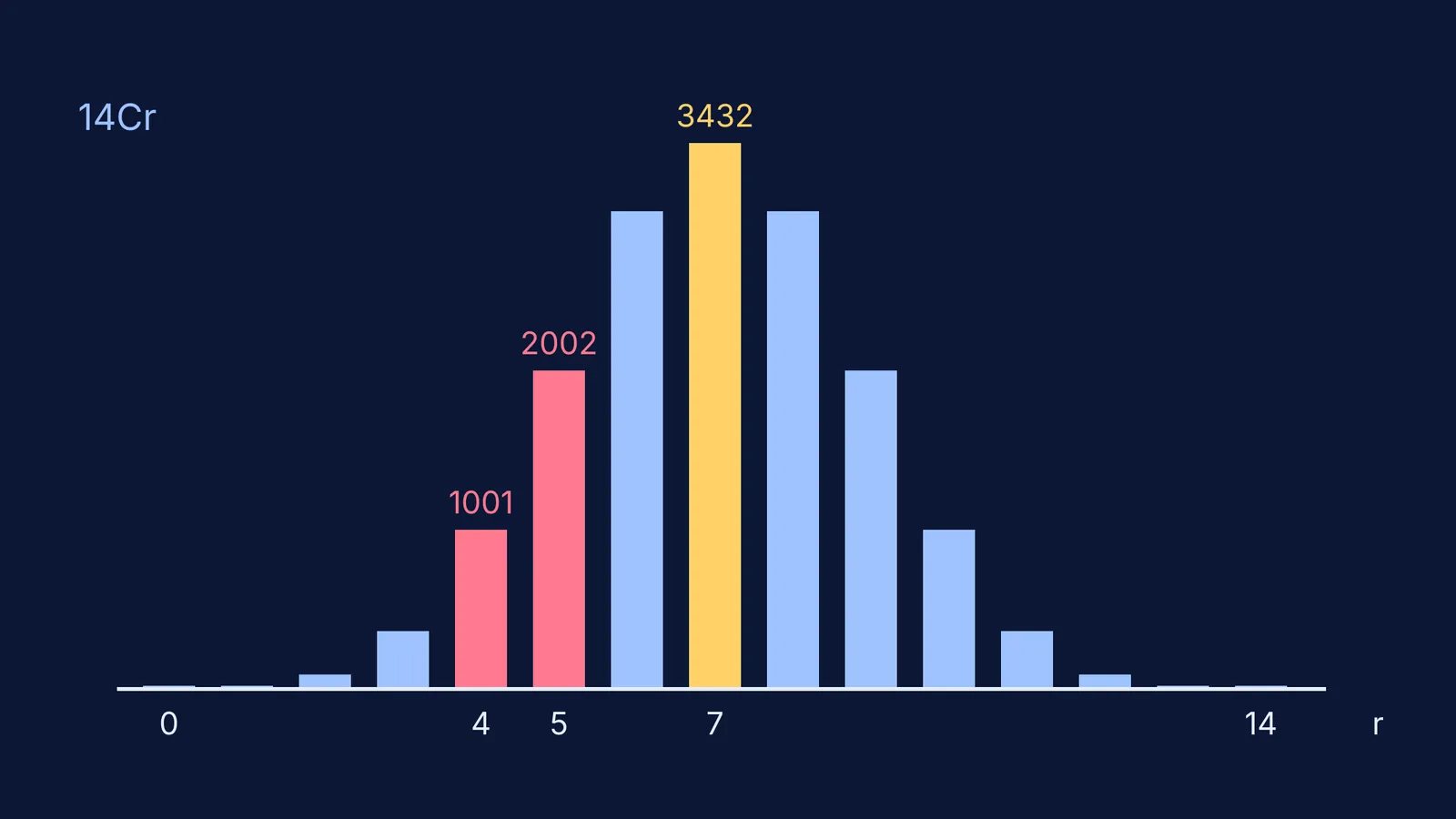
Q8. In (1 + x)^n, the coefficients of x^4 and x^5 are in the ratio 1 : 2. The coefficient of the middle term is: (A) 1716 (B) 3432 (C) 6435 (D) 12870
Answer: (B). nC5 / nC4 = (n − 4)/5 = 2, so n = 14. With 15 terms, the middle term is T8, coefficient 14C7 = 3432. Trap: (C) writes the ratio as (n − 5)/5, gets n = 15 and then 15C7. Check: 14C4 = 1001 and 14C5 = 2002, a ratio of 1 : 2.
How should you use this set in revision?
Do all eight in one sitting, about two minutes each, without notes.
Label each miss with its trap: missing power, lost sign, wrong term number, or wrong identity.
Redo the check line for each miss; in the exam it catches the same error faster than re-solving.
Two days later, redo only the misses, then change one number in each and solve again.
For the theory, read Binomial Theorem for JEE Main: syllabus, examples and a plan; for the counting behind nCr, try 8 JEE Main permutations and combinations questions, solved.
When you can see the answer but not where your method failed, the Fermi Problem Library has a step-by-step solver that explains the reasoning. For the rest of the syllabus, Fermi Test Prep is our hub for JEE Main and Advanced preparation.