On this page
Conic sections questions are short, but one slip (a for 4a, or an ellipse formula on a hyperbola) turns +4 into −1 under the marking scheme in the JEE (Main) 2026 Information Bulletin. Here are eight original JEE Main-style questions, easy to hard, each with a solution, the tempting wrong option and a quick check.
How does JEE Main test conic sections?
In Paper 1, mathematics has 20 multiple-choice questions in Section A and 5 numerical-value questions in Section B, with negative marking in both, according to the NTA Information Bulletin for JEE (Main) 2026. Section B answers are rounded to the nearest integer.
The bulletin points to the official JEE Main website for the detailed syllabus. This set covers the parabola, ellipse and hyperbola in standard form. For a topic plan, read how to prepare conic sections for JEE Main.
Easy questions: parabola, ellipse and hyperbola basics
Question 1. A point P on y² = 8x is 10 units from the focus. Its x-coordinate is (A) 6 (B) 8 (C) 10 (D) 12.
Solution: 4a = 8, so a = 2 and the focus is (2, 0). Focal distance is x + a, so x = 8. Answer (B).
Trap: (A) comes from taking a = 4. a is a quarter of the coefficient, not half.
Check: P(8, 8) satisfies 64 = 8 × 8, and its distance from (2, 0) is √(36 + 64) = 10.
Question 2. The latus rectum of 9x² + 25y² = 225 has length (A) 18/5 (B) 50/3 (C) 6 (D) 36/5.
Solution: dividing by 225 gives x²/25 + y²/9 = 1, so a = 5, b = 3 and the length is 2b²/a = 18/5. Answer (A).
Trap: (B) swaps a and b. Here a sits under x² and is the larger one.
Check: c = 4, and at x = 4, y² = 81/25, so y = ±9/5.
Question 3. A hyperbola has foci (±5, 0) and transverse axis 8. The distance between its directrices is (A) 10 (B) 32/5 (C) 25/2 (D) 8.
Solution: a = 4, c = 5, e = 5/4. The directrices are x = ±a/e = ±16/5, so the distance is 32/5. Answer (B).
Trap: (A) is 2ae, the distance between the foci.
Check: since e > 1, each directrix lies between the centre and a vertex: 3.2 < 4. Directrices also give the polar equation of a conic.
Medium questions: tangents and focal distances
Question 4. The line y = mx + 1 touches y² = 12x. Then m and the point of contact are (A) 3, (1/3, 2) (B) 1/3, (27, 18) (C) 3, (1/3, −2) (D) 1, (3, 6).
Solution: a = 3. The line y = mx + c touches y² = 4ax when c = a/m, so m = 3, and the contact point is (a/m², 2a/m) = (1/3, 2). Answer (A).
Trap: (B) comes from writing c = am.
Check: (3x + 1)² = 12x gives (3x − 1)² = 0, a repeated root, so the line touches once.
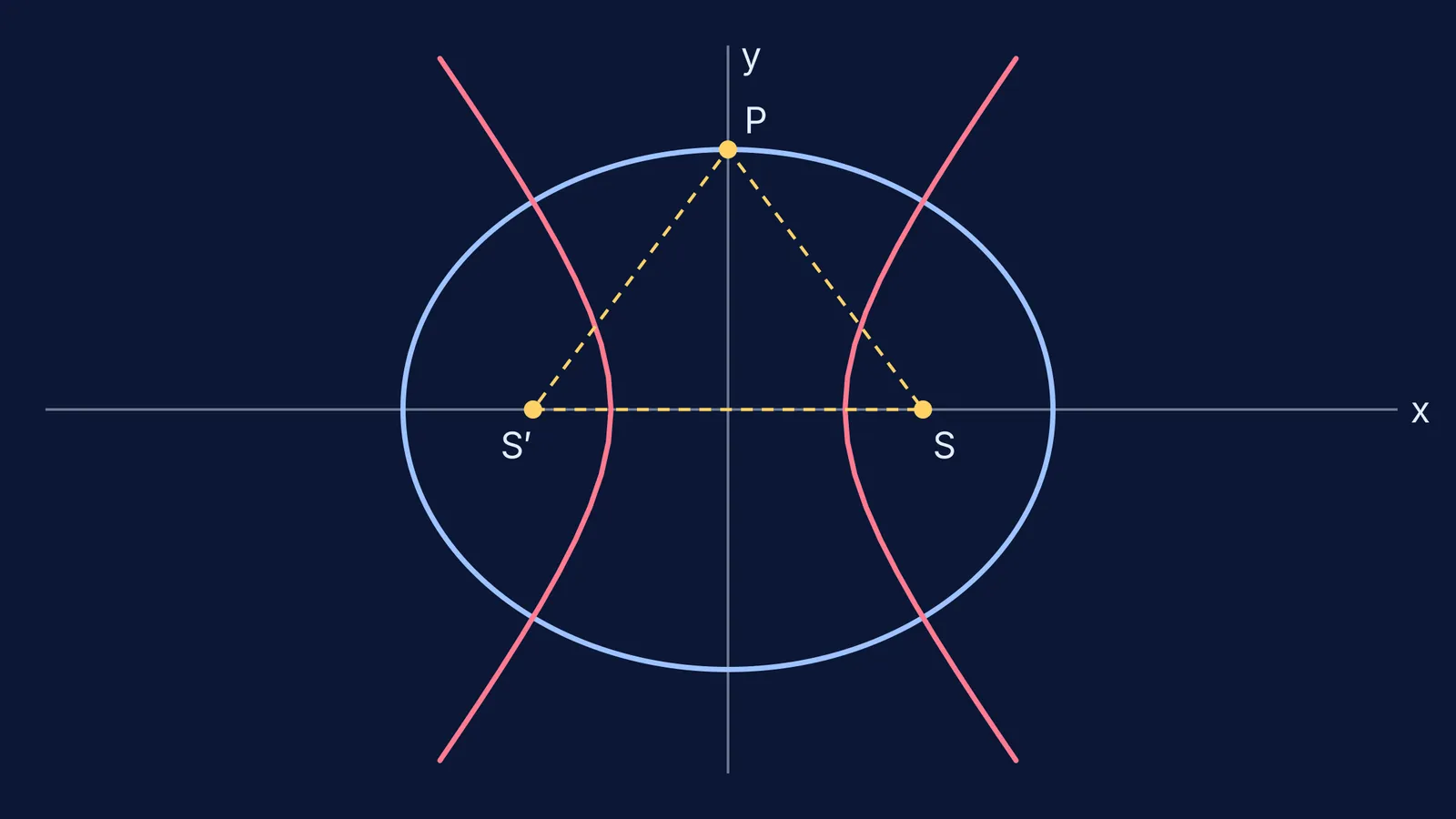
Question 5 (numerical). S and S′ are the foci of x²/25 + y²/16 = 1, and P moves on the ellipse. Find the largest area of triangle PSS′.
Solution: c = √(25 − 16) = 3, so SS′ = 6. The height is P's distance from the x-axis, at most b = 4. Area = ½ × 6 × 4 = 12.
Trap: 15, from using a = 5 as the height.
Check: at P(0, 4), PS + PS′ = 5 + 5 = 10 = 2a, so P is on the ellipse. The same sum rule lets a lithotripter focus a shock wave with an ellipse.
Hard questions: tangent conditions, focal chords, confocal conics
Question 6. y = 2x + c is a tangent to x²/9 − y²/4 = 1 when c is (A) ±4√2 (B) ±2√10 (C) ±2√2 (D) no real value.
Solution: the condition is c² = a²m² − b² = 36 − 4 = 32. Answer (A).
Trap: (B) uses the ellipse condition c² = a²m² + b² = 40.
Check: substituting gives 32x² + 36cx + 9c² + 36 = 0. Its discriminant, 144c² − 4608, is zero exactly when c² = 32.
Question 7 (numerical). PQ is a focal chord of y² = 16x and SP = 6. Find SQ.
Solution: for a focal chord, 1/SP + 1/SQ = 1/a = 1/4, so 1/SQ = 1/12 and SQ = 12.
Trap: taking a = 16 gives 1/SQ = 1/16 − 1/6, a negative length. That sign is your warning.
Check: SP = x + 4 = 6 gives P(2, 4√2). The line PS meets the parabola again at Q(8, −8√2), so SQ = 8 + 4 = 12.
Question 8. A hyperbola has the same foci as x²/25 + y²/16 = 1, and the product of the two eccentricities is 1. Its equation is (A) 25x²/81 − 25y²/144 = 1 (B) 25x²/144 − 25y²/81 = 1 (C) x²/4 − y²/5 = 1 (D) x²/16 − y²/9 = 1.
Solution: the ellipse has c = 3, e = 3/5, so the hyperbola has e = 5/3, a = c/e = 9/5 and b² = c² − a² = 144/25. Answer (A).
Trap: (B) has the same foci but e = 5/4. Swapping a² and b² keeps the foci and changes the shape.
Check: 81/25 + 144/25 = 9 = c², and (3/5)(5/3) = 1. The diagram at the top draws Questions 5 and 8 to scale.
How should you use this set in revision?
Attempt all eight on paper, timed, before reading any solution.
Mark each answer right, wrong, or guessed.
For each miss, write the trap that caught you in one line.
Run the check on every answer until checking is a habit.
A few days later, redo the misses with one number changed.
If the same method error keeps returning, the Fermi Problem Library has a step-by-step solver that explains the reasoning rather than printing an answer. For the rest of your JEE preparation, Fermi Test Prep covers JEE Main and Advanced.