

On this page
A kidney stone sits deep inside the body, behind skin, fat and muscle. A shock wave lithotripter breaks it without a cut. The physics that makes this possible is two ideas you already know from Class 11 and 12: the reflection property of an ellipse, and the reflection of a wave at a boundary between two media. Here both are worked with the real dimensions of an early machine, the Dornier HM3.
This is a physics explainer, not medical advice. Whether shock wave treatment suits a particular stone or patient is decided by doctors.
How does an ellipse focus sound from one point to another?
An ellipse has two foci, F₁ and F₂. Its defining property is that for every point P on the curve, PF₁ + PF₂ = 2a, where a is the semi-major axis. From this follows the reflection property: a ray that leaves F₁ and bounces off the curve always passes through F₂, because the normal at P bisects the angle F₁PF₂.
Rotate the ellipse about its long axis to get an ellipsoid. Cut it in half, fill it with water and put a sound source at F₁: every part of the wave that hits the wall is sent towards F₂.
Compare this with a parabola, covered in the reflection property of a parabola explained. A parabola brings a parallel beam to a point. An ellipse takes rays from one point to another point a finite distance away, which is what a machine needs when the target sits a few centimetres off.
Why must every path have the same length?
The angle rule only tells you that every reflected ray passes through F₂, not when it gets there. If different parts of the wave arrived at different times, you would get a smeared rumble instead of one steep pressure jump.
The ellipse gives you both at once. Since PF₁ + PF₂ = 2a for every P, every reflected path has exactly the same length. All parts of the wave travel at the same speed in water, so they all arrive together. This is the property that makes the ellipse, and not just any curved bowl, the right shape.
This is focusing, a different effect from the sound that creeps round a curved wall in how the Gol Gumbaz whispering gallery works.
How big is a real lithotripter reflector?
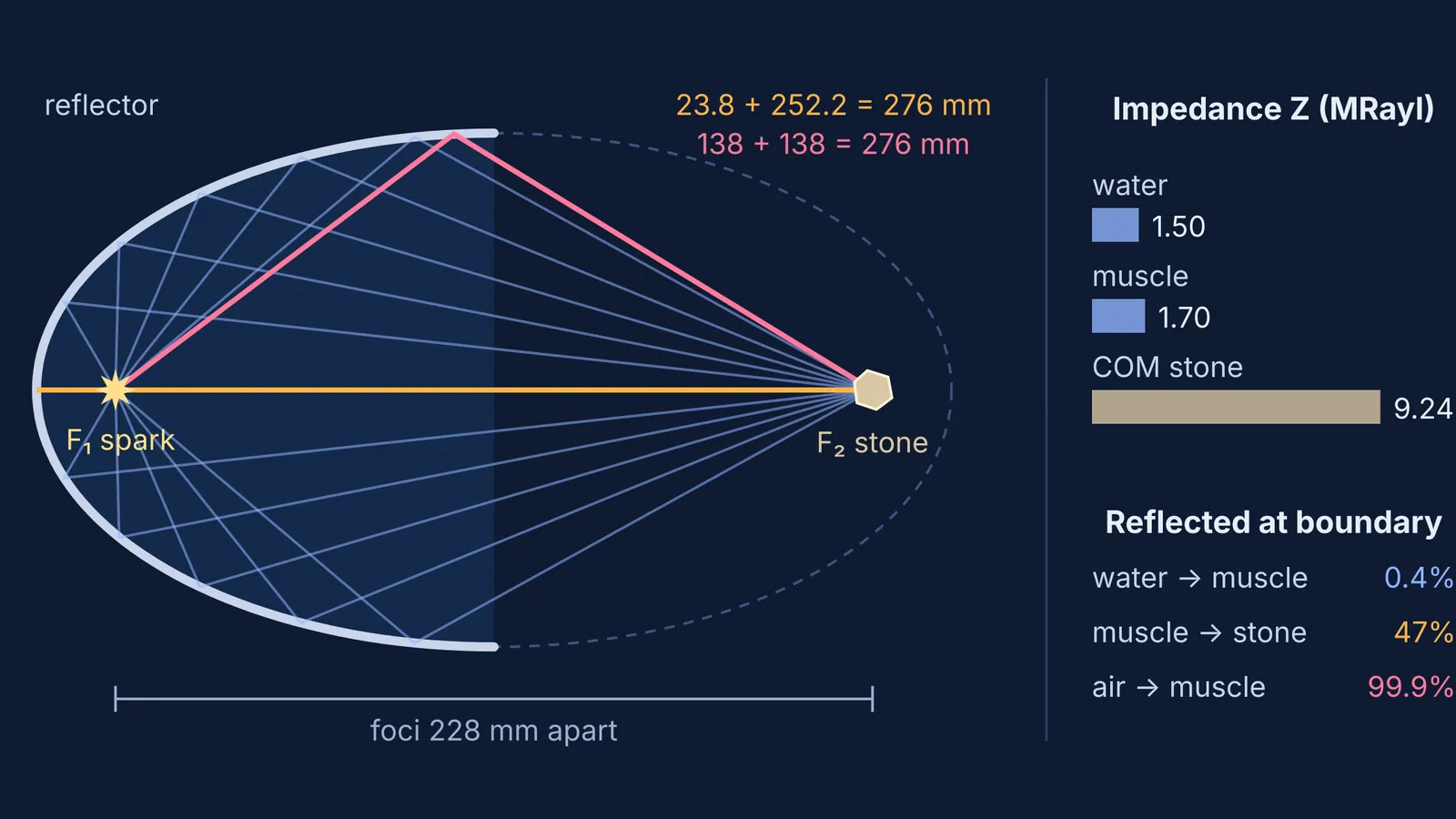
The original Dornier HM3 is an electrohydraulic machine: an underwater spark at F₁ makes the shock wave, and a truncated brass ellipsoid focuses it. Zhou and Zhong (J. Acoust. Soc. Am., 2006) give its reflector as a = 138 mm, b = 77.5 mm and half-focal length c = 114 mm. The patient is positioned so that the stone lies at F₂, outside the reflector, not at the spark.
Many later machines use other sources. As Qin and colleagues (J. Acoust. Soc. Am., 2010) describe, some use an electromagnetic generator with an acoustic lens, and some use a self-focusing piezoelectric source. The ellipsoid described here is the spark design.
Worked example: timing the shock in the HM3 reflector
Use the published HM3 values and take the speed of sound in water as 1,500 m/s, the value in OpenStax College Physics, Table 17.5.
Find the foci. c = √(a² − b²) = √(138² − 77.5²) = √13,038 = 114.2 mm. This matches the published 114 mm. The foci are 2c = 228 mm apart.
Path length. Every reflected path is 2a = 2 × 138 = 276 mm.
Check two paths. The ray that goes straight back to the bottom of the bowl travels 23.8 mm to the wall and 252.2 mm to F₂: total 276.0 mm. The ray that hits the wall level with the centre travels 138 mm and 138 mm: total 276 mm.
Travel time. t = 0.276 m ÷ 1,500 m/s = 1.84 × 10⁻⁴ s = 184 µs, by every route.
Sensitivity. A path just 1 mm longer arrives 0.001 ÷ 1,500 = 0.67 µs late. So the reflector must be accurate and the spark must sit at F₁; Zhou and Zhong note that electrode wear means the spark does not always occur exactly there.
How much of the wave is caught? As an illustration, imagine a bowl cut exactly at its middle. The rim then sits at angle tan⁻¹(b/c) = tan⁻¹(77.5/114.2) = 34.2° from the axis as seen from F₁. Every ray leaving F₁ at more than 34.2° from the direction of F₂ hits the wall. For a point source the fraction of the sphere outside a cone of half-angle θ is (1 + cos θ)/2 = (1 + 0.827)/2 = 0.91, so about 91% of the wave is focused. The real HM3 is also cut away at the sides to make room for X-ray imaging, so its true figure differs.
Why does the patient lie against water and not air?
Whether a wave crosses a boundary depends on the acoustic impedance Z = ρv of each medium, not on density alone. The fraction of intensity reflected is ((Z₂ − Z₁)/(Z₂ + Z₁))². OpenStax lists water at 1.5 × 10⁶ kg m⁻² s⁻¹ (1.5 MRayl), average muscle at 1.70 MRayl and air at only 429 kg m⁻² s⁻¹.
Water to muscle: ((1.70 − 1.5)/(3.20))² = 0.0039, so only 0.4% reflects. Almost all the wave enters the body.
Air to muscle: ((1.70 × 10⁶ − 429)/(1.70 × 10⁶ + 429))² = 0.999, so 99.9% would bounce off the skin.
So the source is coupled to the body through water: a bath in the HM3, a water cushion and gel in many later machines. The same argument explains the gel in ultrasound scans, one of the uses of infrasonic and ultrasonic sound.
What happens when the shock reaches the stone?
Stones are much stiffer than tissue. For calcium oxalate monohydrate (COM) stones, Esch and colleagues (Urol. Res., 2010) quote a density of 2,038 kg/m³ and a longitudinal wave speed of 4,535 m/s, so Z = 9.24 MRayl. Uric acid stones are lower, at 5.37 MRayl.
Muscle to COM stone: ((9.24 − 1.70)/(9.24 + 1.70))² = 0.475, so about 47% of the intensity reflects at the front face.
Muscle to uric acid stone: ((5.37 − 1.70)/(5.37 + 1.70))² = 0.27, about 27%.
The part that enters crosses the stone and meets the back face, where it goes from a high impedance into a low one. There the reflected wave flips sign, so the compression returns as tension. Brittle solids are much weaker in tension than in compression. Real fragmentation also involves shear inside the stone and the collapse of bubbles in the fluid around it, so impedance is only part of the story.
To watch waves reflect and focus, try the Fermi Simulation Lab, with interactive simulations for ideas easier to see than read.
Quick checklist
PF₁ + PF₂ = 2a for every point on an ellipse, so every reflected path from F₁ to F₂ has the same length.
Same length means same arrival time: the shock reaches F₂ as one sharp pulse.
HM3 reflector: a = 138 mm, b = 77.5 mm, c = 114 mm, path 276 mm, about 184 µs in water.
The spark is at F₁, the stone at F₂, outside the bowl.
Reflected fraction = ((Z₂ − Z₁)/(Z₂ + Z₁))², with Z = ρv.
Water couples sound into the body (0.4% lost); air would reflect 99.9%.


