

On this page
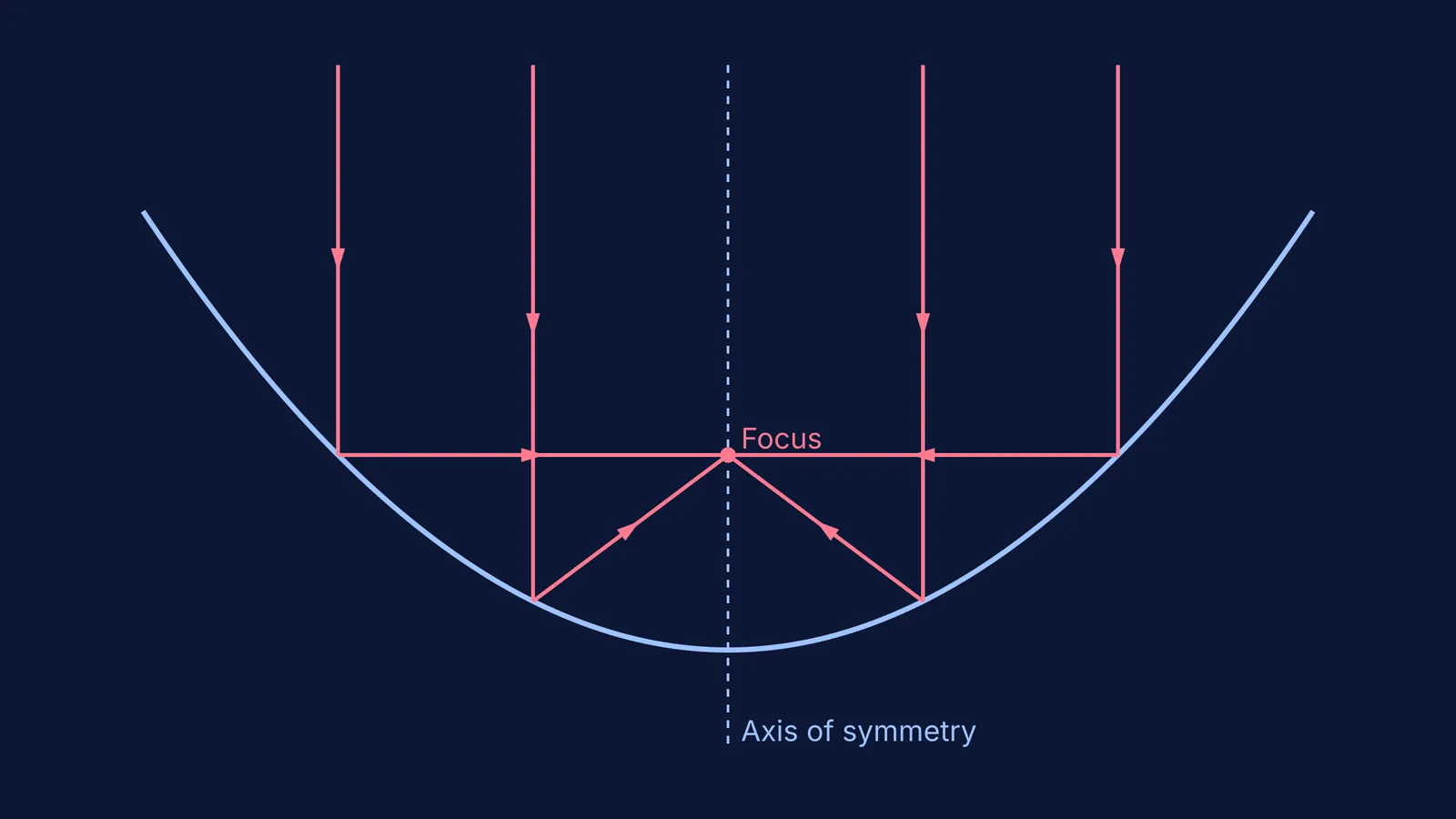
Look closely at a satellite dish or the shiny bowl behind a torch bulb, and you will see they share the same shape. They are not perfect circles or spheres. They are parabolas. Engineers choose this curve because of the reflection property: when parallel rays of light, sound, or radio waves strike a parabolic surface, they all bounce toward a single point.
What is the reflection property of a parabola?
A parabola is defined mathematically as the set of all points in a plane that are the same distance from a fixed point, known as the focus, and a fixed straight line, called the directrix. Because of this strict distance rule, a parabola interacts with waves in a perfectly synchronised way.
When straight, parallel rays—such as sunlight or signals from a distant satellite—travel toward a parabola, they hit the curve and reflect. The law of reflection dictates that the angle of incidence equals the angle of reflection. For a parabola, this geometry guarantees that every single parallel ray will be angled exactly towards the focus. Furthermore, because every path from the source to the focus via the parabola has the exact same total length, the waves arrive "in phase," ensuring the signal remains strong rather than cancelling itself out.
How do dish antennas and torches use the focus?
The reflection property works in two directions: collecting incoming energy and projecting outward energy.
When collecting energy, the parabola takes parallel incoming waves and brings them to a sharp point. According to Wikipedia, the 100-metre Robert C. Byrd Green Bank Telescope in West Virginia uses a giant parabolic dish to collect faint radio signals from deep space. By placing the receiver right at the focal point, the telescope gathers signals spread across a massive area and concentrates them into one intense spot.
When projecting energy, the process runs in reverse. If you place a light bulb exactly at the focus of a parabolic mirror, the light rays shining backward hit the mirror and bounce forward in perfectly parallel lines. This is how a car headlight or a searchlight creates a tight, straight beam instead of scattering light in all directions.
What is the reflection property of an ellipse?
While a parabola has one focus and a flat directrix, an ellipse has two focal points. Its defining rule is that the sum of the distances from any point on the curve to the two foci is always constant.
This gives the ellipse its own version of the reflection property: any ray starting at one focus will bounce off the ellipse and travel straight to the other focus, as explained by Wikipedia.
This phenomenon is famous for creating "whispering galleries" in architecture. If a room is built with an elliptical ceiling, you can stand at one focus and whisper, and someone standing at the other focus will hear you clearly, even if they are metres away. The sound waves spread out, hit the ceiling, and all bounce perfectly to the second focus at the exact same time.
For more on how to work with these shapes in exam problems, read our guide on a five-step method for any conic section.
How do you prove the parabola's reflection property?
For JEE and other exams, you can prove the reflection property using coordinate geometry and basic calculus. The goal is to show that a horizontal incoming ray reflects perfectly toward the focus.
Let the parabola be y² = 4ax. The focus F is at (a, 0). Take any point P(at², 2at) on the curve.
Find the slope of the tangent at P. Differentiating y² = 4ax gives 2y(dy/dx) = 4a, so dy/dx = 2a/y = 2a/(2at) = 1/t.
The incoming ray is parallel to the x-axis, which is a horizontal line with a slope of 0.
Find the angle θ between the horizontal ray and the tangent. Using the slopes, tan θ = 1/t.
Next, find the slope of the line FP. The coordinates of F are (a, 0), so the slope is (2at − 0) / (at² − a) = 2t / (t² − 1).
Calculate the angle φ between the tangent (slope 1/t) and FP (slope 2t / (t² − 1)). Using the angle formula tan φ = |(m₁ − m₂) / (1 + m₁m₂)|, you get:
tan φ = |(1/t − 2t/(t² − 1)) / (1 + (1/t) × (2t/(t² − 1)))|
Simplifying the numerator: (t² − 1 − 2t²) / (t(t² − 1)) = (−t² − 1) / (t(t² − 1)).
Simplifying the denominator: (t² − 1 + 2) / (t² − 1) = (t² + 1) / (t² − 1).
Dividing them gives |−(t² + 1) / (t(t² + 1))| = |−1/t| = 1/t.
Because tan θ = tan φ = 1/t, the angles are equal. The ray passes perfectly through the focus.
If you are stuck proving coordinate geometry properties, the Fermi Problem Library provides worked problems with a step-by-step solver that explains the reasoning rather than printing an answer. You can also explore why the latus rectum of a parabola is 4a or read our proof showing why ellipse focal distances add up to 2a.


