On this page
Step into the gallery at the foot of the Gol Gumbaz dome in Vijayapura (Bijapur) and whisper into the wall. A friend on the far side hears you. Clap once and the clap comes back again and again. Both follow from one rule you meet in Class 9: sound reflects off a hard surface at the same angle at which it arrives.
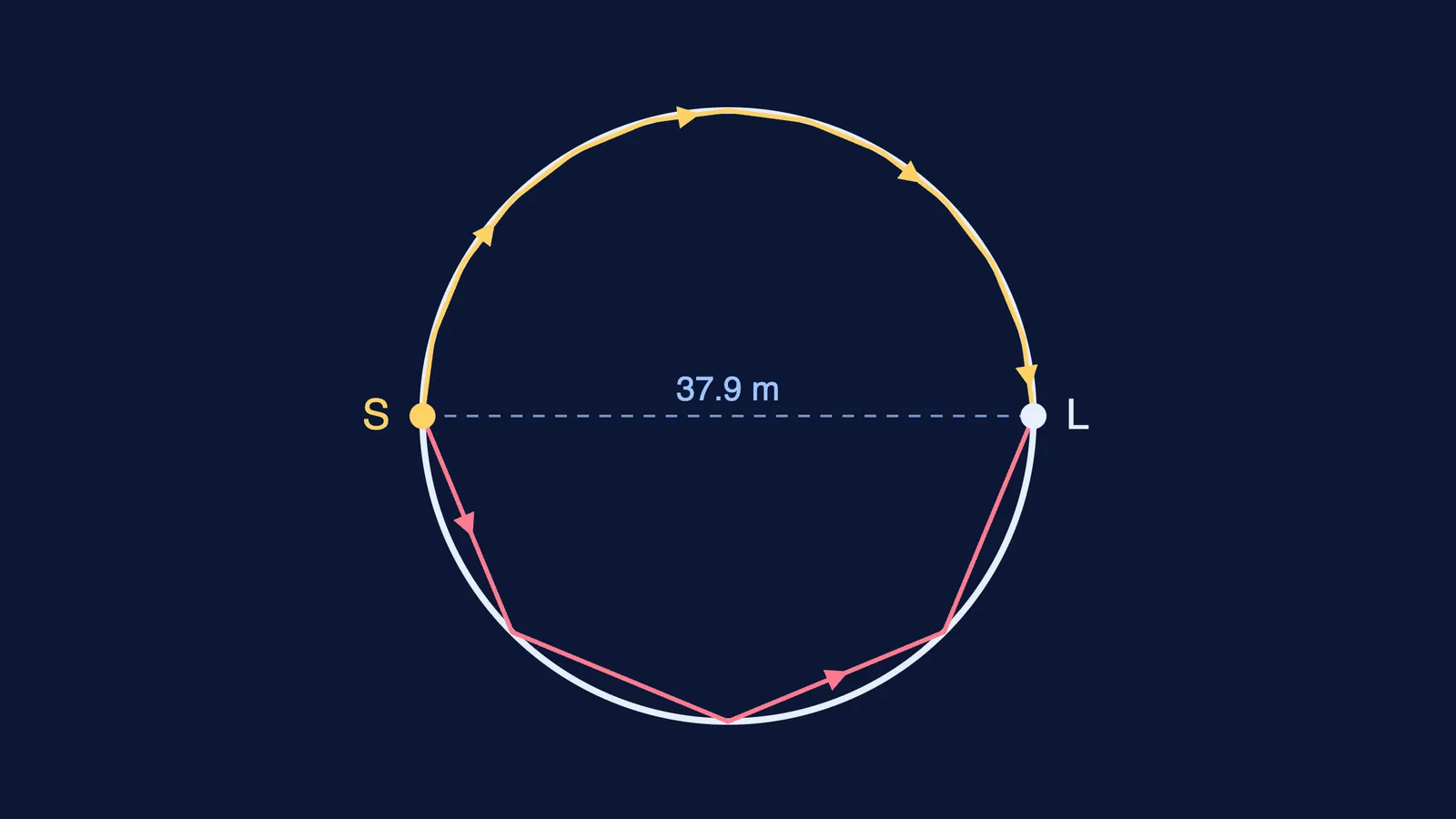
The building is the tomb of Sultan Muhammad Adil Shah, built in 1656, according to a 1946 report by S S Reuben, an assistant professor of architecture in Bombay. Reuben gives the dome an inside diameter of 124 feet 5 inches, about 37.9 m. The gallery is 11 feet wide and hangs 109 feet 6 inches above the floor.
How does the Gol Gumbaz whispering gallery work?
Most of a whisper spreads out in every direction, so it fades quickly. The part that leaves close to the wall, almost parallel to it, behaves differently. It strikes the curved wall at a shallow angle, reflects at that same shallow angle, strikes the wall again a little further round, and so on. The wall keeps turning the sound back, so it runs round the gallery in a narrow band.
Lord Rayleigh explained the effect at St Paul's Cathedral this way. C V Raman and G A Sutherland summarised the explanation in their 1922 paper in the Proceedings of the Royal Society: the sound waves "cling to the concave surface of the wall and travel circumferentially along it", losing far less intensity than waves spreading out from the source.
That is why the trick works best with your mouth close to the wall and your friend's ear against it. Reuben found that dropping a coin, lighting a match and tearing paper were all clearly heard 124 feet away, but a dropped pin was not (Reuben, 1946). He also noted that the effect is strongest when speaker and listener sit at opposite ends of a diameter.
Why does one clap echo many times in Gol Gumbaz?
On 24 October 1945 Reuben tested sounds in the dome. One handclap gave 12 clear echoes, a repeated handclap 14 clear and 3 fading, and pistol shots rang on for 13.5 to 14 seconds by stopwatch (Reuben, 1946). Reuben himself put the echoes down to the great size of the dome.
Raman explained this kind of repetition in his 1922 paper On Whispering Galleries. Working in three whispering galleries in Kolkata, two of them at the Victoria Memorial, he concluded that the multiple sound "is not due to any echo". One sound wave travels round and round the gallery and is heard each time it passes you. He checked this with a stopwatch: the time between returns equalled the gallery's circumference divided by the speed of sound, to within one per cent. He wrote that it would be interesting to repeat the test at the Gol Gumbaz.
How long does one lap of the gallery take?
The speed of sound in air at 20 °C is about 343 m/s (Speed of sound). Take the gallery wall's diameter as the dome's inner diameter, 37.9 m:
Circumference = π × 37.9 m = 119 m.
Time for one lap = 119 m ÷ 343 m/s = 0.35 s.
Twelve laps = about 4.2 s of repeats from a single clap.
A whisper to the opposite side along the wall travels half a lap, 59.5 m, in 0.17 s.
The straight path across, 37.9 m, takes 0.11 s, but that sound spreads out and fades.
For a refresher, see wavelength, frequency and the speed of sound, and for why a plain echo needs a distant wall, the minimum distance for an echo.
How can you test Raman's idea yourself?
On a visit, you can run Raman's test with a phone.
Stand in the gallery, start a voice recording, and clap once.
Open the recording in any free audio editor and look for a row of spikes.
Measure the gap between neighbouring spikes, t, in seconds.
Work out the diameter: d = 343 × t ÷ π. A gap of 0.35 s gives about 38 m.
Ask a friend to clap from a quarter of the way round, and look for two interleaved rows of spikes.
If your gap matches, Raman's circling wave fits; if not, reflections from the dome may dominate. Sound travels a little faster in warm air, so a hot afternoon gives a slightly shorter gap. If angles of reflection are hard to picture, the Fermi Simulation Lab has interactive simulations for ideas that are easier to see than to read. For echo and speed-of-sound numericals, the Fermi Problem Library has worked problems with a step-by-step solver that explains the reasoning.
For another Indian monument that turns physics into sound, read about the musical pillars of Hampi.